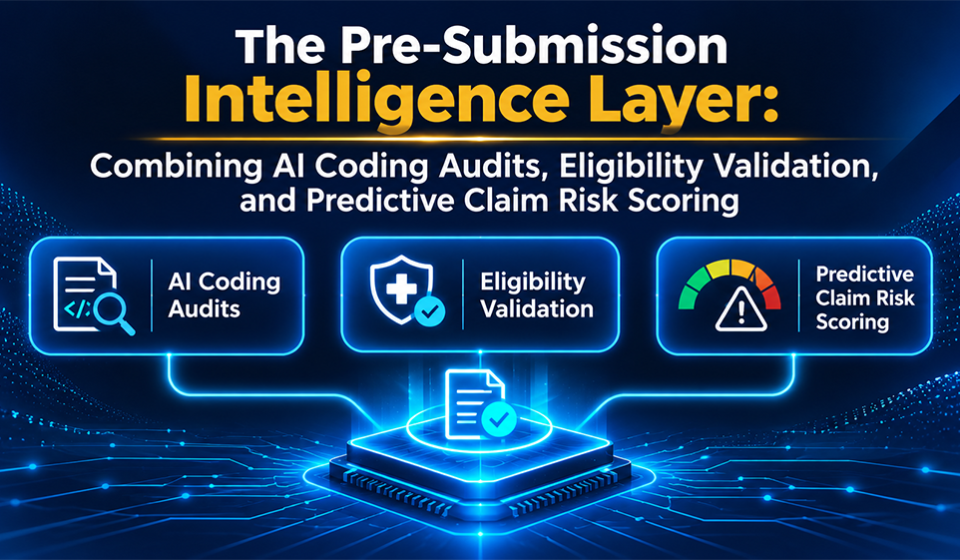
The Pre-Submission Intelligence Layer: Combining AI Coding Audits, Eligibility Validation, and Predictive Claim Risk Scoring

Healthcare organizations invest heavily in medical billing systems, coding teams, eligibility verification tools, and claim scrubbing software. However, even with these technologies in place, preventable claim denials continue to affect reimbursement timelines, operational efficiency, and financial performance. The underlying problem is often not the absence of automation. Instead, it is the lack of intelligence connecting different stages of the revenue cycle before a claim reaches the payer.
According to Experian Health’s October 2026 State of Claims survey, 75% of surveyed providers reported increasing claim denials, while 65% said submitting clean claims had become more difficult. Furthermore, 78% reported that payer policies were changing more frequently. These findings highlight why healthcare organizations need stronger pre-submission validation rather than relying entirely on post-denial recovery. experianplc.com+1
This is where a pre-submission intelligence layer becomes valuable. By combining HIM coding audits, automated insurance eligibility checks, and predictive claim intelligence, healthcare providers can evaluate claim accuracy, coverage conditions, and potential financial risks within a connected workflow.
Instead of identifying individual errors after submission, this approach examines multiple dimensions of a claim simultaneously. Consequently, revenue cycle teams gain better visibility into potential problems, receive actionable recommendations, and can correct preventable issues before claims enter the payer adjudication process.
What Is a Pre-Submission Intelligence Layer in Healthcare RCM?
A pre-submission intelligence layer is an integrated AI-driven validation framework that evaluates clinical documentation, coding accuracy, insurance coverage, authorization requirements, and historical payer behavior before claim submission. Traditional claim scrubbing primarily checks whether claims satisfy predefined billing rules. Although these checks are important, they may not identify deeper inconsistencies between clinical documentation, selected diagnosis codes, insurance coverage, and payer-specific requirements.
For example, a claim might contain a technically valid procedure code and an active insurance policy. However, the documentation may not sufficiently support the billed service, the authorization may not cover the procedure performed, or the payer may require an additional modifier. Individually, each system might report a successful validation. Nevertheless, the combined claim could still carry a significant denial risk.
A pre-submission intelligence layer addresses this gap by connecting three essential capabilities: AI-powered HIM coding audits, automated insurance eligibility validation, and predictive claim risk scoring. More importantly, these capabilities exchange information rather than operating independently. Therefore, a coding discrepancy can influence risk scoring, while an eligibility mismatch can trigger additional validation before the claim moves forward.
Why Traditional Claim Validation Is No Longer Sufficient
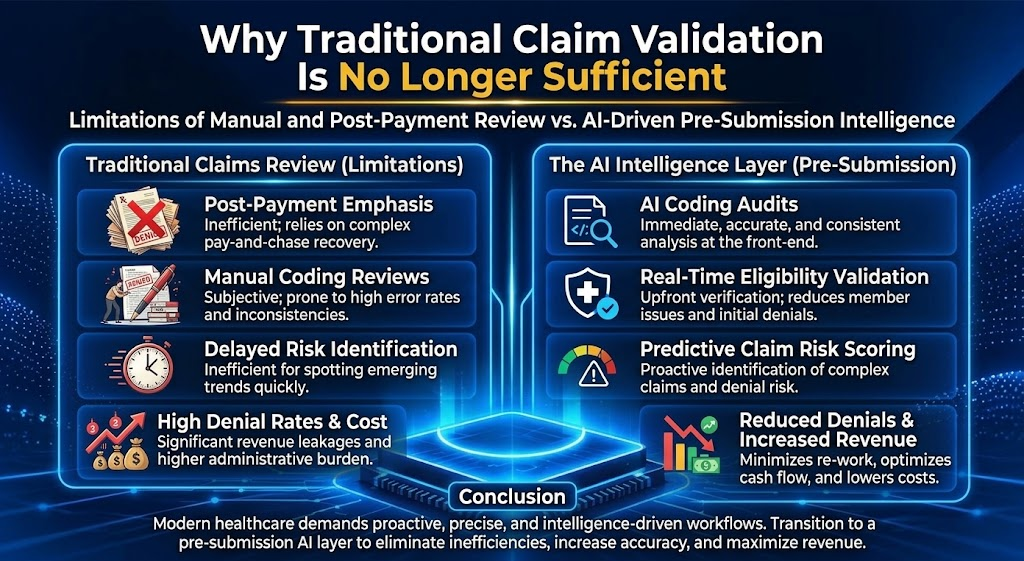
One of the biggest challenges in healthcare revenue cycle management is fragmented information. Clinical documentation, patient registration, payer coverage, authorization records, and billing data frequently exist across different systems. As a result, coding professionals may not have complete visibility into payer requirements, while billing teams may discover coverage inconsistencies only when a claim is rejected.
This creates unnecessary rework, delayed reimbursement, and increased administrative costs. The American Hospital Association estimates that hospitals spent approximately $43 billion in 2025 trying to collect payments owed by insurers for care already delivered. Furthermore, nearly $18 billion was spent overturning claim denials alone. AHA
The financial impact becomes even greater when organizations repeatedly investigate the same underlying errors. For instance, an inaccurate diagnosis may originate from incomplete documentation. Similarly, an incorrect insurance record may affect authorization checks and ultimately influence reimbursement eligibility.
Therefore, simply adding another isolated automation tool does not necessarily solve the problem. Healthcare organizations need a connected intelligence framework that understands how one data issue can affect the entire claim.
Layer One: AI-Powered HIM Coding Audits for Clinical and Coding Accuracy
Health Information Management (HIM) coding accuracy is the foundation of a reliable claim. However, coding errors are not always obvious during conventional manual reviews. A diagnosis code may be valid according to ICD-10-CM, yet it may not accurately represent the documented clinical condition. Likewise, a procedure code may be appropriate in isolation but inconsistent with the operative report, physician documentation, or applicable coding guidelines.
An AI-powered HIM coding audit evaluates the relationship between clinical documentation and the codes selected for billing.
How AI Models Identify Coding Inconsistencies
Modern AI coding audit systems can combine natural language processing (NLP), clinical language models, terminology mapping, and rule-based validation. First, NLP models extract relevant clinical information from physician notes, discharge summaries, operative reports, and other supporting documentation.
Next, terminology mapping connects clinical descriptions with standardized coding concepts. Depending on the service and applicable coding requirements, the system can evaluate ICD-10-CM, CPT, HCPCS, and relevant modifier information. Subsequently, machine learning models compare the extracted clinical information with the proposed claim codes.
For example, if the documentation describes a specific procedure but the submitted claim contains a code representing a different service, the system can identify the inconsistency and flag it for review. Similarly, it can detect potentially missing modifiers, conflicting diagnosis relationships, insufficient supporting documentation, and code combinations requiring further examination.
However, AI should not independently determine clinical intent or replace qualified coding professionals. Instead, it should prioritize exceptions, explain potential discrepancies, and provide evidence for human review.
Connecting HIM Coding Audits With Revenue Integrity
Coding accuracy also influences revenue integrity in healthcare. When documentation does not adequately support the services billed, organizations may encounter denials, compliance concerns, undercoding, or overcoding risks. An intelligent HIM audit can therefore evaluate both claim accuracy and documentation completeness before billing.
Furthermore, audit findings can become valuable inputs for predictive claim intelligence. If a particular provider, department, or procedure repeatedly generates documentation-related discrepancies, the system can identify recurring patterns and recommend targeted improvements. Consequently, HIM coding audits become more than a final quality-control checkpoint. They become an important source of intelligence for preventing downstream reimbursement problems.
Layer Two: Automated Insurance Eligibility Check and Coverage Validation
Accurate coding alone cannot guarantee reimbursement. Even a clinically supported and correctly coded claim can encounter problems when patient coverage information is outdated, incomplete, or inconsistent. An automated insurance eligibility check addresses this problem by validating coverage information before services are billed and claims are submitted.
Traditional eligibility verification often depends on staff accessing payer portals, making phone calls, or checking individual records. Unfortunately, these processes can become time-consuming, especially when organizations handle high patient volumes across multiple insurance plans. AI-enabled eligibility validation introduces a more connected approach.
Moving Beyond Basic Active Insurance Verification
A basic eligibility response may indicate whether a patient’s insurance policy is active. However, active coverage does not automatically mean that every service is covered or payable. Therefore, a more advanced eligibility validation process should evaluate the available information across several dimensions.
These include coverage effective dates, termination dates, member identification, group information, coordination of benefits, network status, service-specific coverage, and relevant authorization requirements. For example, a patient may have active insurance on the date of service, but the planned procedure may require prior authorization.
Similarly, a patient may have multiple insurance policies, creating coordination-of-benefits questions that must be resolved before the claim is submitted. An intelligent system can compare registration information with payer responses, identify mismatches, and direct unresolved cases to the appropriate team.
Using AI to Identify Eligibility-Related Claim Risks
Machine learning can strengthen eligibility validation by recognizing recurring discrepancies across historical registration records and payer responses. For instance, models can identify patterns involving incorrect member IDs, recurring coverage mismatches, inactive policies, and payer-specific verification exceptions.
Additionally, anomaly detection can identify unusual changes in eligibility information or conflicting coverage records. When an exception occurs, the system can explain which information requires attention rather than simply returning a failed verification status. Importantly, eligibility checks should use current payer responses and applicable transaction standards. Historical patterns can help identify risk, but they cannot replace real-time coverage confirmation.
Therefore, automated insurance eligibility checks become more effective when their results are shared with coding audits and downstream claim risk models.
Layer Three: Predictive Claim Intelligence and Risk Scoring
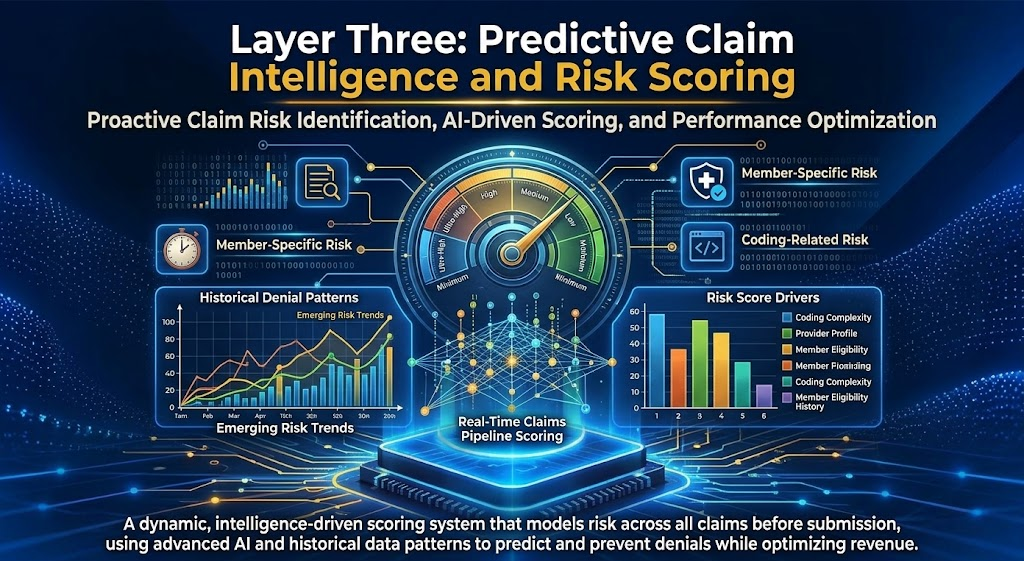
Once coding and eligibility information have been evaluated, the next challenge is understanding the overall likelihood of a claim encountering a problem. This is where predictive claim intelligence becomes particularly valuable. Traditional claim scrubbing generally identifies predefined errors. In contrast, predictive claim intelligence evaluates multiple data points and historical outcomes to estimate the likelihood of claim rejection, denial, or additional review.
The objective is not simply to identify whether a claim contains an error. Instead, it is to understand how different risk factors interact and which claims require attention first.
How AI-Based Predictive Claim Risk Scoring Works
A predictive claim intelligence model can combine supervised machine learning, anomaly detection, NLP, and rule-based decision engines. First, the model receives structured and unstructured information from multiple sources, including historical claims, coding audit results, eligibility responses, authorization records, clinical documentation, and payer-specific claim outcomes.
Next, feature engineering transforms this information into measurable variables. These variables may include coding discrepancy frequency, eligibility mismatch indicators, missing documentation signals, authorization status, payer-specific denial history, procedure complexity, and previous claim outcomes.
Subsequently, supervised machine learning algorithms such as gradient-boosted decision trees or other suitable classification models evaluate historical relationships between these features and claim outcomes. For example, an organization may train a model using previously adjudicated claims labelled as paid, denied, rejected, or requiring additional review.
The model learns patterns associated with different outcomes and generates a probability-based risk score for new claims. Meanwhile, anomaly detection can identify unusual combinations of claim attributes that do not resemble established patterns.
Turning Predictive Scores Into Actionable Decisions
A risk score becomes useful only when it helps revenue cycle teams make better decisions. For example, consider a claim with a valid procedure code but incomplete supporting documentation, an eligibility discrepancy, and a history of similar payer-specific denials. Although each issue might appear manageable individually, their combined effect could increase the likelihood of a claim problem.
The predictive engine can assign a higher risk score and recommend a detailed review before submission. In contrast, a claim with validated coverage, consistent clinical documentation, and no significant coding discrepancies may receive a lower risk classification. The organization can then establish configurable review thresholds based on its own historical performance and operational requirements.
Importantly, these scores represent model-estimated risk, not guaranteed denial outcomes. Human oversight, model calibration, and continuous performance monitoring remain essential.
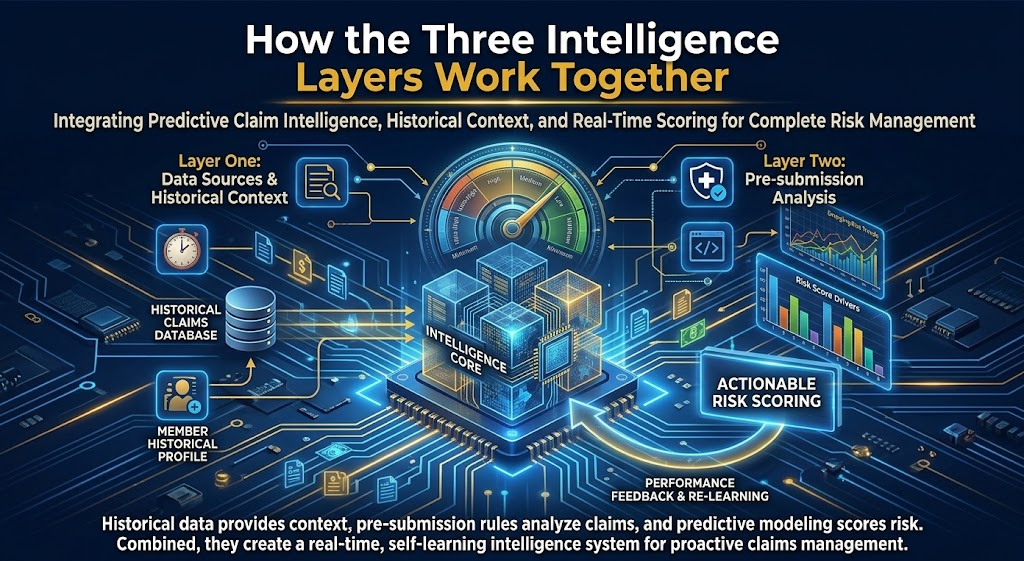
How the Three Intelligence Layers Work Together
The real advantage of a pre-submission intelligence layer emerges when all three capabilities exchange information through one coordinated workflow. Consider a patient receiving a procedure that requires specific documentation and insurance authorization. First, the HIM coding audit evaluates the clinical record and identifies whether the diagnosis and procedure codes are supported by the available documentation.
Next, the automated insurance eligibility check validates the patient’s coverage and highlights any authorization or coverage discrepancies. Afterward, predictive claim intelligence combines these findings with historical claim outcomes and payer-specific patterns to estimate the overall risk. If the model identifies a high-risk claim, it can recommend corrective action and route the case to a coding specialist or billing professional.
Once the issue is resolved, the claim can undergo another validation cycle before submission. This creates a continuous feedback loop in which coding accuracy, coverage validation, and risk prediction strengthen one another. Moreover, claim outcomes after submission can be used to evaluate model performance and improve future predictions.
The AI Architecture Behind an Intelligent Pre-Submission Workflow
An effective architecture requires more than connecting three software modules. It needs reliable data integration, consistent validation logic, explainable predictions, and appropriate governance. The workflow can begin with data ingestion from EHR platforms, practice management systems, clearinghouses, payer eligibility transactions, and historical claims repositories.
Next, an NLP-based processing layer extracts relevant information from clinical documentation. Structured validation engines then evaluate coding and eligibility information against applicable standards and payer rules. A feature engineering layer combines the results into a unified claim representation. Subsequently, predictive models calculate risk probabilities and identify contributing factors.
Finally, a decision engine determines whether a claim should proceed, undergo additional validation, or be escalated for human review. Importantly, the architecture should support secure data exchange, role-based access, audit trails, and applicable HIPAA requirements.
It should also monitor model drift, false positives, false negatives, and performance differences across payers, specialties, and claim types.
For healthcare organizations, the goal is not to create an AI system that automatically approves every claim. Rather, it is to create an intelligent validation environment that helps staff make more accurate decisions with less repetitive investigation.
What Healthcare Organizations Should Evaluate Before Implementation
Before adopting predictive claim intelligence, healthcare leaders should examine the quality and accessibility of their existing data. Disconnected EHR, billing, coding, and payer systems can limit the effectiveness of predictive models. Therefore, integration capabilities and standardized data mapping should be evaluated early.
Furthermore, organizations should assess whether the AI solution can explain why a claim has been flagged. A risk score without understandable contributing factors may create additional work rather than reducing it. Model performance should also be measured against actual claim outcomes. Organizations can monitor denial rates, first-pass acceptance, coding audit accuracy, eligibility exception rates, manual review volumes, and time spent correcting claims.
Additionally, implementation should begin with a controlled pilot involving selected specialties, payers, or claim categories. This approach helps teams establish a baseline and measure improvements before expanding across the organization. Finally, clinical coding professionals and revenue cycle specialists should remain involved throughout implementation. Their feedback helps identify operational exceptions that historical datasets may not adequately represent.
The Future of Healthcare RCM: From Reactive Denial Management to Predictive Claim Intelligence
Healthcare reimbursement increasingly depends on accurate information, changing payer requirements, and timely access to relevant data. CMS’s Interoperability and Prior Authorization Final Rule is also advancing this shift. Certain operational provisions began in 2026, while major API implementation requirements generally begin in 2027. These developments reinforce the importance of interoperable healthcare data and more connected payer-provider workflows. CMS+1
Consequently, healthcare organizations have an opportunity to move beyond disconnected claim scrubbing and reactive denial management. By combining HIM coding audits, automated insurance eligibility checks, and predictive claim intelligence, providers can establish a more comprehensive pre-submission validation strategy.
For revenue cycle leaders, this means identifying potential problems earlier, prioritizing high-risk claims, reducing avoidable manual rework, and improving visibility into reimbursement risks. For technology leaders, it means building an integrated intelligence architecture that connects clinical, financial, and payer information.
Aiclaim is focused on advancing this approach through AI-powered claim intelligence, denial prediction, and pre-submission risk identification. Rather than waiting for an insurer to identify a problem, healthcare organizations can use intelligent validation to understand potential claim issues before they reach the payer.
The next step in revenue cycle transformation is not simply processing claims faster. It is understanding claim risks earlier and making better decisions before submission.
Frequently Asked Questions About Pre-Submission Claim Intelligence
What is pre-submission claim intelligence?
Pre-submission claim intelligence is an AI-driven approach that evaluates coding accuracy, insurance coverage, documentation, authorization requirements, and historical payer patterns to identify potential claim risks before submission.
How does AI-powered HIM coding improve claim accuracy?
AI-powered HIM coding uses NLP, clinical terminology mapping, and machine learning to compare clinical documentation with proposed billing codes. It helps identify missing information, potential coding inconsistencies, and documentation gaps for qualified professionals to review.
How does an automated insurance eligibility check prevent claim denials?
An automated insurance eligibility check validates coverage information using payer responses and available policy data. It helps identify inactive coverage, incorrect member details, coordination-of-benefits issues, and potential authorization requirements before billing.
What is predictive claim risk scoring in healthcare?
Predictive claim risk scoring uses historical claim outcomes, coding information, eligibility results, payer patterns, and other relevant features to estimate the likelihood of a claim encountering a rejection or denial.
Can AI prevent all healthcare claim denials?
No. AI cannot guarantee that every claim will be accepted or paid. However, it can identify many preventable issues earlier, prioritize manual reviews, and support more accurate claim submissions when combined with reliable data and human oversight.
How do coding audits, eligibility validation, and predictive claim intelligence work together?
Coding audits evaluate clinical and billing accuracy, eligibility validation checks insurance coverage, and predictive claim intelligence combines these findings with historical patterns to estimate overall claim risk. Together, they create a connected pre-submission validation workflow.
Strengthen Your Pre-Submission Claim Intelligence Strategy With Aiclaim
Are coding discrepancies, eligibility mismatches, and unpredictable payer denials affecting your revenue cycle performance?
Aiclaim helps healthcare organizations explore AI-powered claim intelligence and predictive denial identification to uncover potential claim risks before submission. Discover how intelligent claim validation can help your organization improve claim accuracy, reduce avoidable rework, and strengthen revenue cycle performance.
Explore Aiclaim: https://www.aiclaim.com/
Email: info@aiclaim.com
Book a Demo: Connect with our team to explore AI-powered claim intelligence and denial prevention solutions.