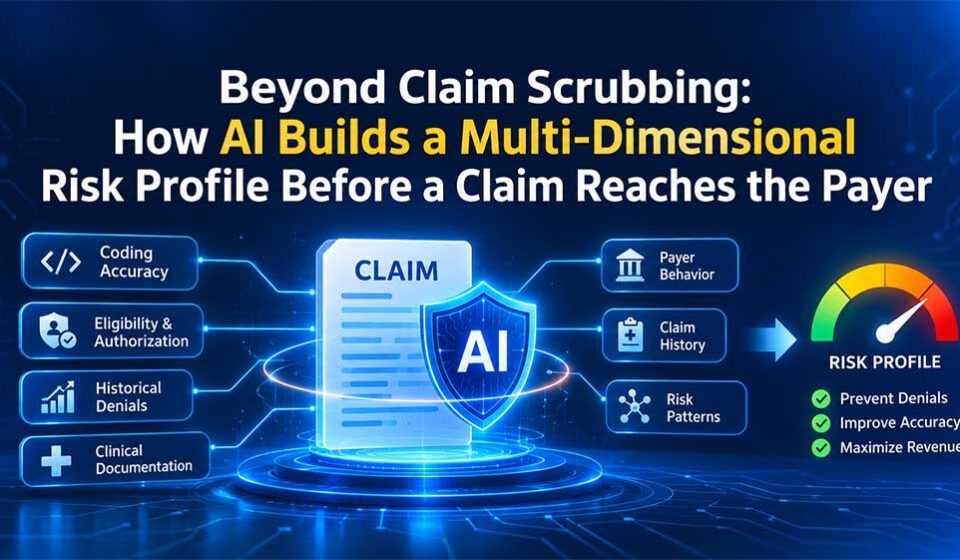
Beyond Claim Scrubbing: How AI Builds a Multi-Dimensional Risk Profile Before a Claim Reaches the Payer

A healthcare claim can pass every conventional validation check and still encounter a denial. A diagnosis code may be valid, the patient’s insurance may be active, and the required authorization may appear on file. However, the claim can still contain underlying inconsistencies that affect reimbursement.
The problem is that traditional claim scrubbing primarily evaluates whether a claim meets predefined technical and administrative requirements. It does not necessarily understand how coding decisions, clinical documentation, payer-specific policies, authorization conditions, and historical reimbursement patterns interact. This is where AI claim risk scoring introduces a more advanced approach to revenue cycle management (RCM).
Instead of examining individual claim fields independently, predictive claim intelligence evaluates multiple dimensions of risk simultaneously. It analyzes clinical, financial, administrative, and payer data to predict claim denials, delays, underpayments, and information requests.
Experian Health’s 2026 survey found rising denials among 75% of providers, denial rates above 10% for 40%, and policy changes affecting 78%. These findings demonstrate why conventional validation alone is increasingly insufficient for complex healthcare reimbursement environments.
Source: Experian Health, 2026 State of Claims Survey.
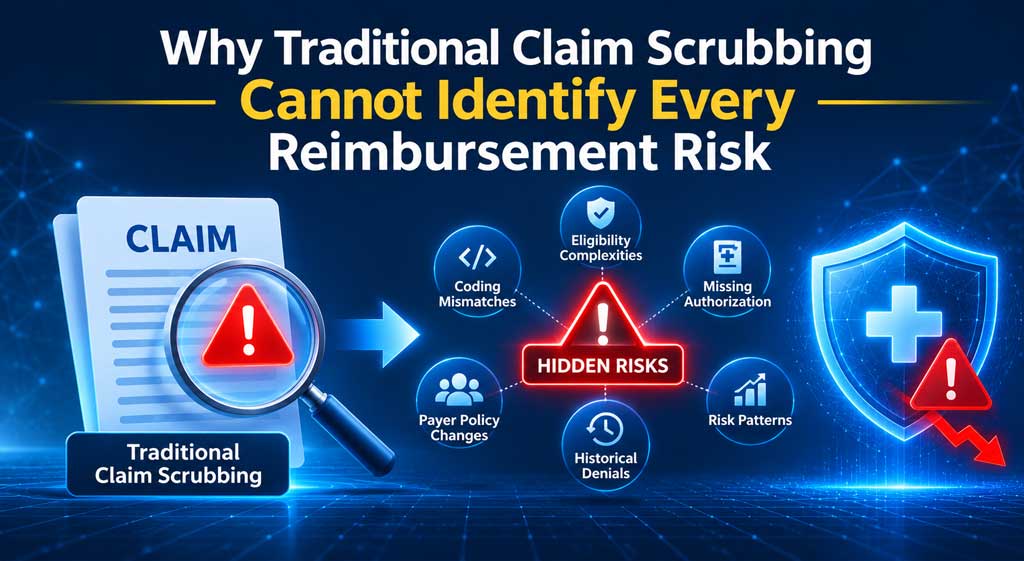
Why Traditional Claim Scrubbing Cannot Identify Every Reimbursement Risk
Traditional claim scrubbing remains important for identifying missing fields, invalid codes, incorrect formatting, duplicate submissions, and other predefined errors. Nevertheless, passing these checks does not automatically mean a claim is financially or clinically defensible.
Consider a patient receiving a specialty procedure. The insurance policy is active, the procedure code is valid, and the claim contains the required diagnosis. However, authorization may mismatch services, documentation may lack medical necessity support, or payer policies may restrict reimbursement.
A conventional rule-based system may validate each field without recognizing the relationship between these conditions. Consequently, the claim moves forward even though several warning signals exist. Healthcare organizations often make fragmented decisions because their systems operate independently without connecting critical claim information. Eligibility systems verify coverage, coding systems examine code accuracy, authorization teams manage approvals, and billing platforms validate claim structure. However, these processes frequently operate without a unified understanding of reimbursement risk.
AI claim risk scoring addresses this limitation by connecting these separate intelligence layers into one predictive evaluation process.
What Is AI Claim Risk Scoring in Healthcare RCM?
AI claim risk scoring is a predictive analytical approach that evaluates multiple claim-related variables to estimate the probability of an adverse reimbursement outcome before submission. Traditional claim scrubbing primarily checks whether claims meet predefined conditions. However, AI-driven risk assessment goes further by analyzing patterns, identifying relationships, learning from historical outcomes, and evaluating contextual information.
For example, an AI model can identify combinations of procedure codes, diagnosis relationships, authorization conditions, documentation gaps, and payer-specific requirements that have historically increased the likelihood of claim denials. Importantly, the system does not simply identify an error. It estimates the potential financial and operational consequences of the combined risk factors.
This distinction changes how revenue cycle teams prioritize their work. Rather than treating every claim equally, they can focus on claims that require additional investigation, documentation, coding review, or authorization verification.
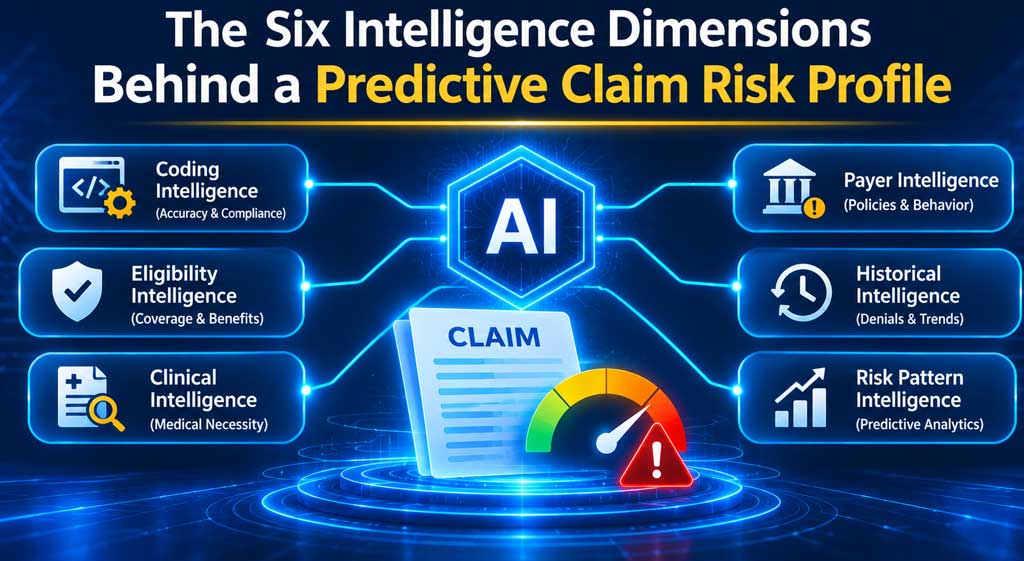
The Six Intelligence Dimensions Behind a Predictive Claim Risk Profile
A reliable predictive model requires more than a single validation engine. Instead, it needs multiple intelligence dimensions that contribute different information to the final risk assessment.
1. AI-Powered Coding Accuracy and Clinical Consistency Analysis
Coding accuracy is one of the most important components of claim integrity. However, checking whether an ICD-10-CM or CPT code is valid does not establish whether the code is appropriate for the documented clinical circumstances. For example, a procedure code may be technically valid but may not align with the diagnosis, documented service, modifier requirements, or applicable coding guidelines.
An AI-powered coding intelligence layer can analyze clinical documentation, diagnosis relationships, procedure combinations, modifier usage, and historical coding corrections. Natural language processing (NLP) can extract relevant clinical concepts from documentation, while machine learning models can identify inconsistencies between documented services and submitted codes.
Furthermore, contextual analysis can identify situations in which a code combination requires additional review rather than automatically assuming that a technically valid code is correct. The result is a more comprehensive coding risk assessment that considers both code validity and clinical support.
2. Real-Time Eligibility and Insurance Coverage Intelligence
An active insurance policy does not necessarily mean that the insurer will cover the specific service. Coverage can depend on benefit limitations, service dates, network participation, coordination of benefits, patient responsibility, and specific payer conditions. Consequently, checking eligibility only during registration can create reimbursement risks when coverage information changes before the service or claim submission.
AI-driven eligibility intelligence can combine verification responses with patient registration data, insurance history, service information, and coverage-related conditions. For example, the system can identify discrepancies between the insurance information collected during registration and the coverage details returned during a subsequent eligibility transaction.
Moreover, it can flag potential coverage gaps, outdated member information, and coordination-of-benefits inconsistencies. Healthcare organizations can connect eligibility information with the services they bill to determine whether each claim is ready for submission.
3. Authorization Intelligence and Service-Level Matching
Payers do not always deny claims because providers fail to obtain authorization. In many situations, authorization exists, but its conditions do not match the submitted claim. The approved service, provider, facility, date range, number of visits, or procedure configuration may differ from the actual service delivered.
An advanced AI authorization engine can compare authorization records against the corresponding clinical encounter and claim information. For instance, it can identify an expired authorization, a procedure-code mismatch, an approved service that differs from the billed service, or an authorization that does not cover the complete treatment period.
Additionally, predictive models can learn from previous authorization-related denials to identify recurring payer-specific requirements. This helps healthcare organizations go beyond confirming authorization availability and verify whether the approval covers the services they include in the claim.
4. Payer Behavior Intelligence and Policy Pattern Recognition
One of the most overlooked dimensions of claim risk is payer behavior. Different insurance companies may interpret documentation requirements, apply reimbursement policies, process specific code combinations, and request additional information differently.
Furthermore, payer policies change over time, creating challenges for healthcare organizations that depend on static validation rules. An AI payer intelligence layer can analyze historical remittance advice, denial reason codes, claim outcomes, reimbursement adjustments, and available payer policy information.
For example, if a particular payer repeatedly requests additional documentation for a specific procedure and diagnosis combination, the model can recognize that pattern and assign additional risk to similar claims. However, historical behavior should not automatically be interpreted as a current payer rule. The model must distinguish between documented policy requirements, observed historical patterns, and statistical correlations.
By doing so, healthcare organizations can identify payer-specific risks without relying entirely on generalized claim validation rules.
5. Historical Denial Intelligence and Recurring Error Detection
Historical denial data contains valuable information about where the revenue cycle repeatedly fails. However, many organizations use this information primarily for retrospective reporting rather than preventive decision-making. AI changes this approach by learning from previous claim submissions, denial codes, appeal outcomes, corrected claims, and final reimbursement results.
For example, a model may identify that claims involving a particular specialty, procedure combination, missing modifier, and payer frequently experience reimbursement problems. It can then recognize similar patterns in newly generated claims. More importantly, the model identifies errors that require simple data corrections and distinguishes them from complex medical necessity, documentation, or payer interpretation issues.
As a result, historical denial intelligence becomes an active component of pre-submission risk prediction rather than merely a reporting function.
6. Clinical Documentation and Medical Necessity Intelligence
A claim may contain accurate patient information and valid procedure codes while still lacking sufficient clinical evidence to support reimbursement. This creates a particularly challenging problem because many documentation-related issues cannot be identified through conventional field-level validation.
AI-powered documentation intelligence can evaluate relevant clinical notes, procedure indications, diagnosis relationships, supporting evidence, and applicable medical necessity requirements. Using NLP and clinical language models, the system can identify missing documentation elements, inconsistent clinical statements, and potential gaps between the documented encounter and the submitted services.
For example, if the billed procedure requires specific clinical justification but the supporting documentation does not clearly establish that justification, the system can flag the claim for HIM or clinical review. Importantly, AI should identify documentation gaps rather than generate unsupported clinical statements or independently alter provider documentation.
This preserves clinical integrity while helping revenue cycle teams resolve potential reimbursement risks before submission.
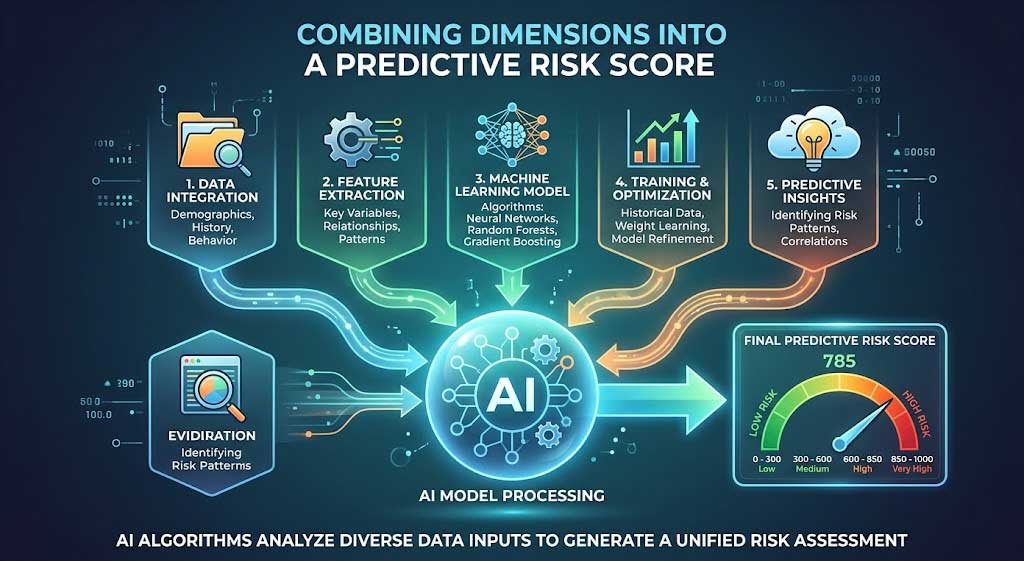
How an AI Model Combines These Dimensions Into One Predictive Risk Score
The real value of AI claim risk scoring lies in combining all six intelligence dimensions into a unified predictive model rather than evaluating each dimension independently. A hybrid AI architecture can integrate gradient-boosted decision trees, NLP-based document analysis, anomaly detection, and explainable AI to evaluate different risk factors and generate a comprehensive claim risk assessment.
How the AI Model Processes Claim Data
First, the data integration layer gathers information from EHR platforms, practice management systems, clearinghouses, eligibility transactions, authorization records, coding systems, and historical remittance data. Next, the feature engineering layer converts this information into measurable variables, including code-to-documentation consistency, authorization-to-service matching, coverage confidence, payer-specific denial patterns, and historical correction trends.
The predictive engine then analyzes these variables through trained machine learning models to calculate the overall claim risk. Instead of relying on a single validation rule, the system evaluates how multiple risk factors interact and influence potential reimbursement outcomes.
How AI Calculates the Overall Claim Risk Score
An illustrative risk-scoring architecture can distribute weights across the six intelligence dimensions as follows:
| Intelligence dimension | Illustrative weight |
|---|---|
| Coding and clinical consistency | 20% |
| Eligibility and coverage | 15% |
| Authorization matching | 20% |
| Payer behavior | 15% |
| Historical denial patterns | 15% |
| Clinical documentation | 15% |
These weights are an architectural example, not validated industry-wide percentages. In a production environment, weights should be learned or calibrated using representative, organization-specific claim outcomes.
A simplified weighted risk model can be expressed as:
Claim Risk Score = Σ (Dimension Risk × Dimension Weight)
For example, consider a hypothetical claim with an overall risk score of 72 out of 100. The system could classify it as high risk because authorization matching, clinical documentation, and payer-specific patterns indicate multiple reimbursement concerns. However, the most valuable output is not the number itself. It is the explanation behind the score.
An explainable AI layer should identify the specific contributing factors, their supporting evidence, confidence levels, and recommended corrective actions.
Furthermore, a calibrated probability model can estimate the likelihood of denial using historical labeled outcomes. This probability must be evaluated separately from the weighted operational risk score because a risk index and a statistically calibrated denial probability are not interchangeable.
From Risk Detection to Intelligent Pre-Submission Action
Predictive intelligence becomes commercially valuable when it changes what happens next. A healthcare organization does not need another dashboard that simply displays high-risk claims. It needs a system that helps teams resolve the underlying problems.
For example, a high-risk claim involving a missing modifier can be routed to coding review. An authorization mismatch can be sent to the authorization team. An eligibility discrepancy can trigger another verification transaction, while a documentation concern can be escalated to the appropriate HIM or clinical reviewer.
Meanwhile, claims with lower risk and sufficient supporting evidence can continue through the existing submission workflow, subject to the organization’s validation policies. This creates a risk-based operational model in which staff attention is directed toward the claims that require it most.
Additionally, every correction and subsequent payer outcome can become feedback for future model evaluation and retraining. Consequently, the system evolves from identifying isolated errors to continuously improving the organization’s understanding of reimbursement risk.
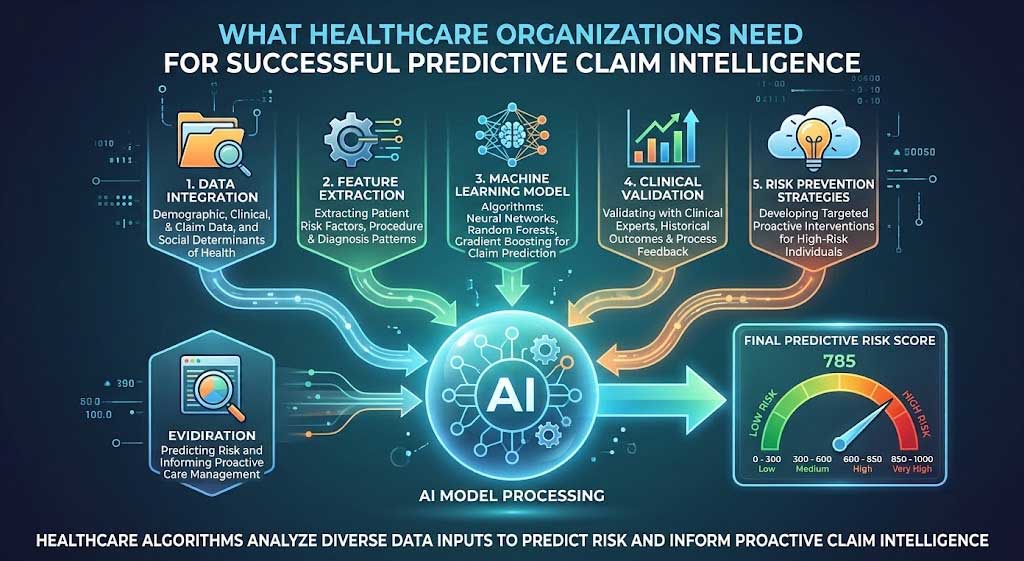
What Healthcare Organizations Need to Implement Predictive Claim Intelligence Successfully
Implementing AI claim risk scoring requires more than integrating a machine learning model into an existing billing platform. The quality of the underlying data determines the reliability of the predictions. Healthcare organizations should begin by connecting relevant data sources and establishing consistent claim identifiers across clinical, administrative, coding, authorization, and financial systems.
Next, historical claims should be labeled using meaningful outcomes, including initial acceptance, denial, partial payment, underpayment, successful appeal, and final adjudication. Importantly, accepted claims should not automatically be treated as fully reimbursed claims. Similarly, denied claims that were subsequently overturned should be distinguished from permanent denials.
The model should also account for changing payer policies, evolving code sets, differences between specialties, and variations in claim types. Furthermore, organizations should evaluate model performance using precision, recall, calibration, false-positive rates, and financial impact rather than relying on a single accuracy percentage.
Human oversight remains essential, particularly for clinical documentation, medical necessity, coding interpretation, and complex payer requirements. A controlled pilot using historical data and a prospective validation period can help organizations establish whether the system delivers measurable improvements before expanding deployment.
The Future of Healthcare RCM Is Predictive, Contextual, and Explainable
The direction of healthcare reimbursement technology is moving beyond isolated automation toward connected intelligence. CMS’s Interoperability and Prior Authorization Final Rule (CMS-0057-F) establishes important requirements for impacted payers, including operational provisions beginning in 2026 and API implementation requirements generally beginning in 2027. These developments create opportunities for more structured information exchange across healthcare organizations.
However, better data availability alone will not eliminate reimbursement problems. Healthcare providers still need intelligent systems that interpret information, identify inconsistencies, and prioritize potential risks. That is where multi-dimensional AI claim risk scoring becomes important.
Instead of waiting for a payer to identify an error, healthcare organizations can evaluate the claim using coding intelligence, coverage information, authorization conditions, payer patterns, historical outcomes, and clinical documentation before submission.
Ultimately, the objective is not simply to produce cleaner claims. It is to build a more intelligent revenue cycle in which preventable reimbursement problems are identified earlier, corrective actions are more targeted, and financial performance becomes more predictable.
How Aiclaim Helps Healthcare Organizations Move Beyond Traditional Claim Scrubbing
At Aiclaim, we believe effective claim intelligence should begin before a claim reaches the payer. Our AI-driven approach focuses on identifying potential reimbursement risks through predictive analysis, coding intelligence, claim validation, and pre-submission risk assessment.
With solutions such as ClearClaim, healthcare organizations can explore predictive denial intelligence designed to identify potential claim issues before submission. Rather than depending exclusively on retrospective denial reports, providers can move toward a more proactive approach to claim management.
Ready to understand the risks hidden inside your claims before submission?
Explore Aiclaim’s AI-powered healthcare insurance and revenue cycle management solutions at https://www.aiclaim.com/.
Request a Demo: https://www.aiclaim.com/
Contact: info@aiclaim.com
Frequently Asked Questions About AI Claim Risk Scoring
What is AI claim risk scoring?
AI claim risk scoring is a predictive approach that uses machine learning to evaluate coding, eligibility, authorization, payer behavior, historical denials, and clinical documentation. It estimates potential reimbursement risks before a healthcare claim is submitted.
How is AI claim risk scoring different from traditional claim scrubbing?
Traditional claim scrubbing primarily checks claims against predefined validation rules. AI claim risk scoring examines relationships between multiple data dimensions, identifies historical patterns, and estimates potential denial risks that may not be detected through conventional rule-based checks.
What data does an AI model need to predict claim denials?
An effective model can use historical claim outcomes, ICD-10-CM and CPT information, eligibility responses, authorization records, clinical documentation, payer policies, remittance advice, and previous denial and appeal records. Data quality, completeness, and appropriate labeling are essential for reliable predictions.
Can AI predict a claim denial before submission?
Yes. Machine learning models can estimate the likelihood of denial by identifying patterns associated with previous reimbursement outcomes. However, predictions are probabilistic rather than guarantees, and their reliability depends on model quality, data coverage, and changing payer requirements.
Can AI claim risk scoring reduce healthcare revenue leakage?
AI claim risk scoring can help reduce preventable revenue leakage by identifying potential errors, documentation gaps, coverage discrepancies, and authorization mismatches before submission. Its financial impact should be measured through actual denial rates, reimbursement outcomes, rework costs, and recovery performance.
Why is payer-specific intelligence important in predictive claim analysis?
Different payers may apply different reimbursement policies, documentation requirements, and authorization conditions. Payer-specific intelligence helps predictive systems recognize these variations and evaluate claims using relevant historical outcomes and current policy information rather than relying entirely on generic validation rules.
What is the role of explainable AI in claim risk scoring?
Explainable AI identifies the factors contributing to a claim’s risk score. It helps coding professionals, billing teams, and RCM leaders understand why a claim was flagged, what evidence supports the prediction, and which corrective action may be appropriate before submission.