
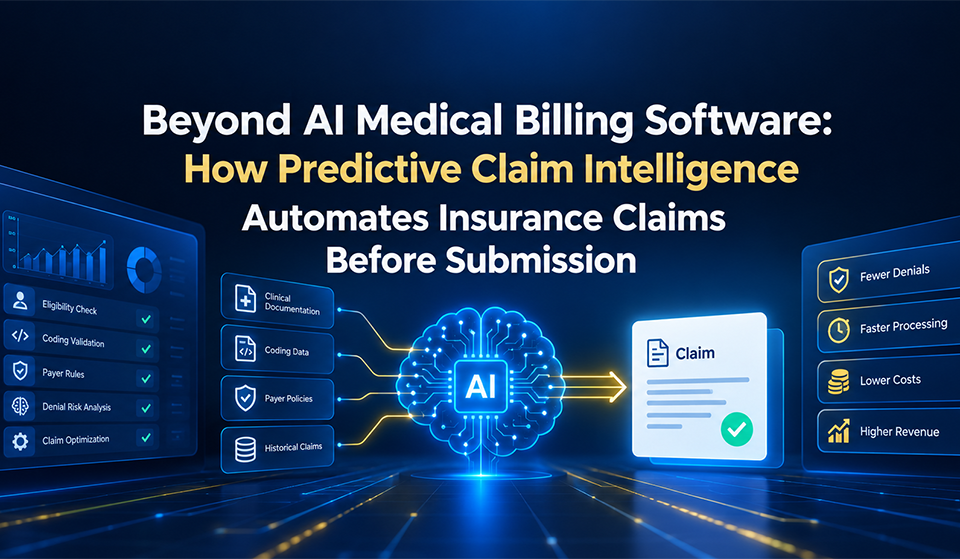
Beyond AI Medical Billing Software: How Predictive Claim Intelligence Automates Insurance Claims Before Submission

AI medical billing software is evolving beyond routine claim processing toward predictive claim intelligence that identifies denial risks before submission. AI models analyze claim history, payer behavior, coding, eligibility, and clinical documentation to identify errors and recommend corrections before submission. Consequently, healthcare providers and revenue cycle management (RCM) teams can reduce avoidable rework, improve claim accuracy, and strengthen reimbursement workflows. Discover how predictive AI transforms traditional medical billing into a proactive, data-driven approach to insurance claims automation.
Why Traditional AI Medical Billing Software Needs Predictive Claim Intelligence
A medical claim can look complete in a billing system and still fail at the payer’s end. A claim may contain valid codes, active insurance coverage, and correct formatting yet still face denial due to hidden errors. However, an authorization mismatch, an unsupported diagnosis, or a payer-specific billing requirement can still delay reimbursement.
This gap exposes a critical limitation in conventional AI medical billing software. Automation can accelerate claim creation, eligibility checks, and claim scrubbing; however, these tasks alone do not guarantee that payers will approve a claim.
The financial impact is becoming increasingly difficult to ignore. According to Experian Health’s 2025 State of Claims survey, 41% of surveyed providers reported denial rates of at least 10%. Furthermore, 50% identified missing or inaccurate claim data as a leading denial trigger, while authorization issues accounted for 35% and inaccurate or incomplete patient registration accounted for 32%. These findings came from a survey of 250 healthcare professionals responsible for financial, billing, or claims management decisions.
Consequently, healthcare organizations need more than faster billing workflows. They need a system that evaluates the likelihood of claim failure before submission and explains which issues require attention.
Predictive claim intelligence addresses this need by combining machine learning, deterministic validation, payer-policy analysis, and clinical documentation intelligence. Instead of simply processing a claim, it evaluates the claim’s readiness for reimbursement and recommends corrective action before preventable errors reach the insurer.
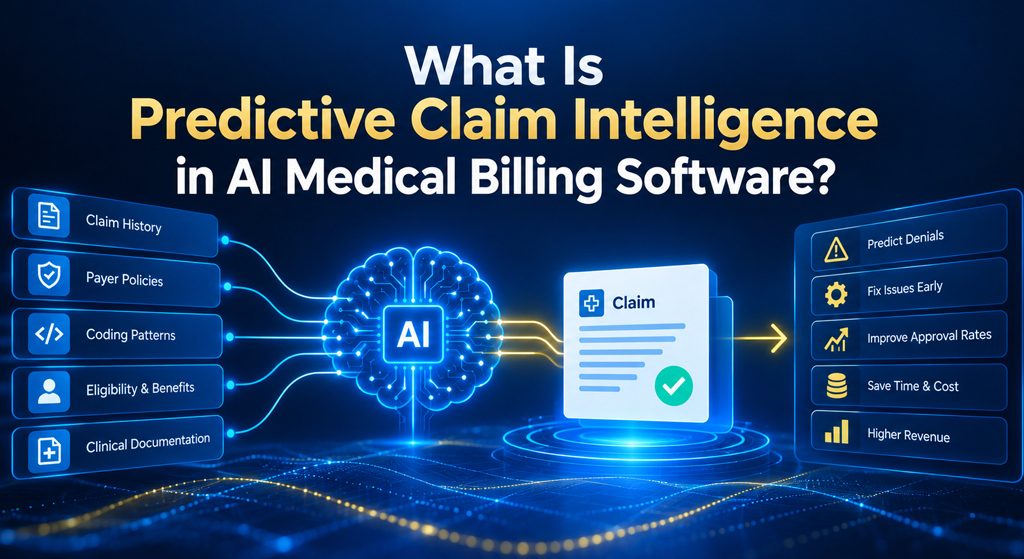
What Is Predictive Claim Intelligence in AI Medical Billing Software?
Predictive claim intelligence is an AI-driven approach that evaluates claim data, historical outcomes, payer requirements, and clinical evidence to estimate denial risk before a claim is submitted. Traditional claim scrubbing generally checks whether a claim meets configured billing rules. Predictive intelligence adds another layer by identifying combinations of factors that have historically contributed to unsuccessful claims.
For instance, a claim might pass basic coding edits but contain a procedure-diagnosis combination associated with frequent denials for a particular payer. A predictive model can flag that combination for review, provided the organization has suitable historical data and validated rules. Importantly, a prediction is not a guarantee of denial. Instead, it gives revenue cycle management (RCM) teams an evidence-based opportunity to investigate and correct potential problems.
For healthcare providers, this approach can reduce avoidable rework, improve first-pass claim quality, and help staff prioritize high-risk claims. For medical billing companies, it can support more consistent quality checks across multiple practices, specialties, and payer contracts.
How AI Models Predict Claim Denials Before Submission
Effective AI medical billing software should not depend on a single algorithm. Instead, it should use a layered architecture in which each model or validation component addresses a different source of claim risk.
Historical Claim Analysis and Machine Learning
The process begins with historical claims containing relevant information such as payer, specialty, procedure and diagnosis codes, authorization status, submission edits, remittance outcomes, and denial reasons. A supervised machine learning model can learn patterns associated with previously paid and denied claims. Depending on the available data, suitable approaches may include gradient-boosted decision trees, logistic regression, or other validated classification models.
For example, a model may identify that a particular combination of missing documentation, payer requirements, and procedure codes is associated with elevated denial risk. It then calculates a risk score for a new claim with similar characteristics. However, model quality depends on representative data, accurate denial labels, and regular validation. Therefore, developers should evaluate precision, recall, calibration, and performance across specialties and payer groups rather than relying on accuracy alone.
Payer Behavior and Policy Intelligence
Different insurers may apply different coverage policies, authorization requirements, documentation standards, and claim edits. Consequently, a rule that works for one payer may not adequately protect a claim submitted to another. Predictive claim intelligence can combine payer-specific policy rules with historical outcomes to identify potential mismatches. For example, the system may flag a service that appears to require authorization under an applicable payer policy or identify missing documentation required for a covered service.
Nevertheless, historical payer behavior should not replace current policy verification. Payer rules change, and historical correlations may not reflect present requirements. Therefore, reliable AI medical billing software must use current, traceable policy sources and version-controlled validation rules.
Eligibility and Authorization Intelligence
Active insurance coverage does not automatically mean that every service is covered. Coverage may depend on the plan, service date, provider network, benefit limitations, authorization status, and other conditions. An intelligent eligibility workflow verifies available coverage information and compares it with the proposed service. Subsequently, the system checks whether required authorization information is present and whether the authorization aligns with the relevant patient, service, provider, and date.
When information is missing or inconsistent, the software can flag the claim before submission. As a result, registration and authorization teams can resolve problems earlier instead of investigating them after a denial occurs.
Clinical Documentation and Coding Analysis
Another major source of claim risk is the gap between clinical documentation and the codes reported on the claim. Natural language processing (NLP) and clinical language models can extract relevant concepts from clinical notes, identify supporting documentation, and highlight potential inconsistencies between recorded services, diagnoses, and coded information.
For example, the system might flag a diagnosis that lacks sufficient supporting documentation or identify a potential mismatch between the documented procedure and the submitted code. A separate rules engine can then check code validity, applicable coding guidelines, and payer-specific requirements.
Importantly, AI should support qualified coding professionals rather than independently invent diagnoses or alter clinical facts. Final coding decisions must remain consistent with the medical record and applicable professional standards.
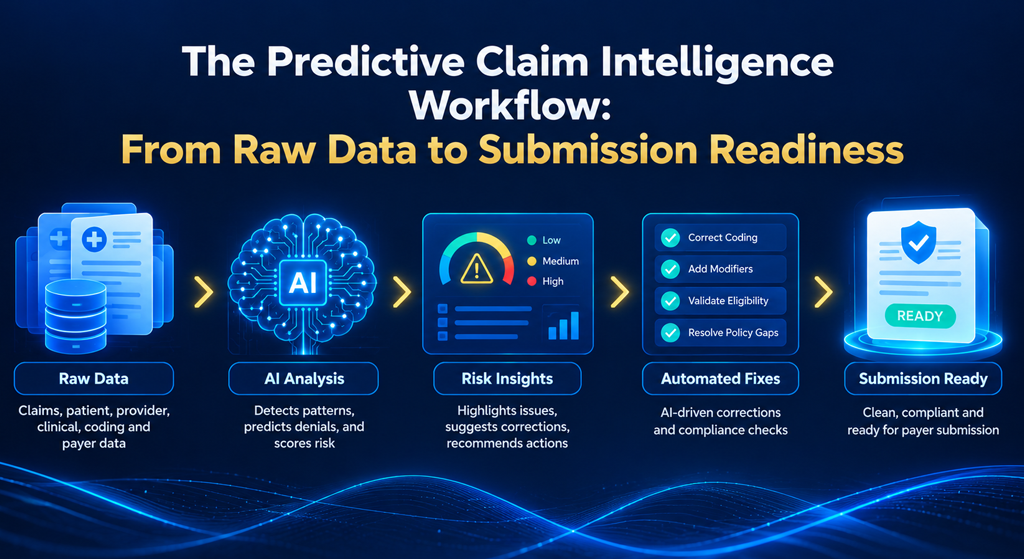
The Predictive Claim Intelligence Workflow: From Raw Data to Submission Readiness
A practical pre-submission architecture connects multiple data sources and validation stages instead of treating each billing task as an isolated process. First, the system receives claim data from the practice management system, electronic health record (EHR), eligibility workflow, authorization records, and relevant billing interfaces. Data normalization then aligns patient identifiers, dates of service, provider details, codes, and payer information.
Next, deterministic checks identify known errors, such as missing required fields, invalid code combinations, and applicable billing-rule violations. Machine learning models evaluate additional patterns associated with historical denials, while clinical NLP helps identify documentation gaps.
The system then combines these findings into an explainable risk assessment. Rather than displaying only a high-risk label, it should identify the specific evidence behind the alert, such as a missing authorization reference or a potentially unsupported diagnosis-procedure relationship.
Finally, the claim enters a decision workflow. Low-risk claims can proceed through the organization’s normal submission controls, while medium-risk claims receive targeted review and high-risk claims are held for correction when a material issue requires resolution. This design combines predictive intelligence with established claim validation. It also allows billing teams to retain human oversight over ambiguous clinical, coding, and payer-policy decisions.
Why Predictive Claim Intelligence Solves Persistent RCM Problems
Reducing Preventable Denials and Rework
Every avoidable denial creates additional work. Staff may need to review the original claim, identify the root cause, obtain missing information, correct coding or authorization details, and resubmit the claim. Predictive claim intelligence moves selected checks upstream. Therefore, teams can address issues while the original encounter and supporting information are still accessible.
The benefit should be measured through changes in preventable denial rates, first-pass acceptance, rework hours, and days in accounts receivable. Actual results will depend on baseline performance, data quality, implementation, and the types of claims processed.
Improving Staff Productivity Without Removing Human Judgment
RCM teams frequently work under staffing pressure while managing growing claim volumes. Manual review of every claim can become expensive, particularly when most claims contain no significant problems. Risk-based prioritization allows staff to focus on claims with meaningful warning signals. Meanwhile, routine validation can be automated and straightforward corrections can be routed to the appropriate team.
Consequently, organizations can allocate experienced billers, coding specialists, and authorization staff more effectively without treating every AI prediction as an unquestionable decision.
Turning Denial Data Into Continuous Improvement
A denial report explains what happened to previously submitted claims. Predictive intelligence can use similar information to identify recurring risks before future claims are submitted. For example, repeated authorization-related denials may indicate a weakness in the scheduling workflow. Recurring diagnosis mismatches may point to documentation or coding education needs. Meanwhile, payer-specific rejection patterns may reveal that an existing edit configuration requires updating.
By connecting these findings to operational workflows, healthcare organizations can address root causes instead of repeatedly correcting individual claims.
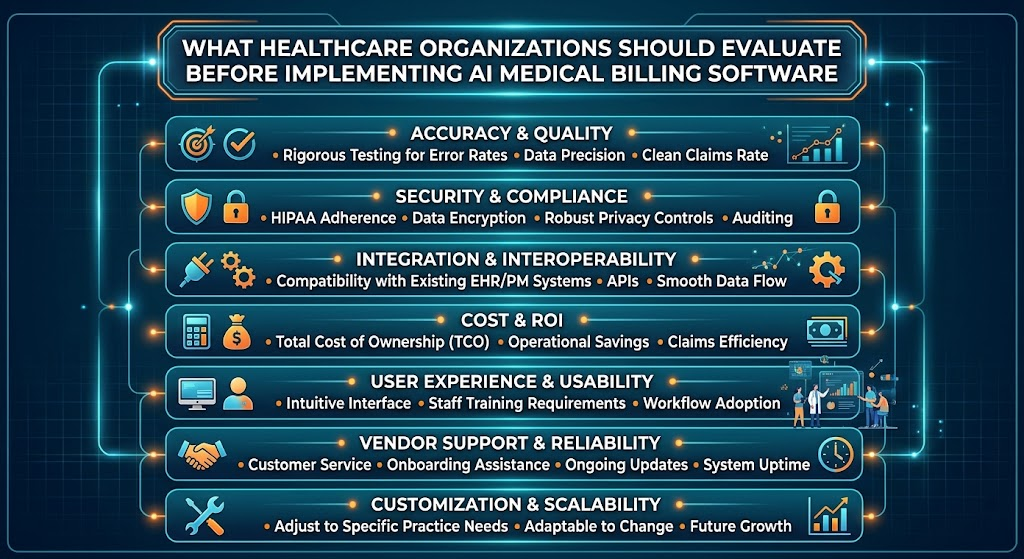
What Healthcare Organizations Should Evaluate Before Implementing AI Medical Billing Software
Predictive capabilities are only as dependable as the data, rules, and controls behind them. Therefore, healthcare leaders should evaluate more than the number of automated tasks a platform can perform. The system should support appropriate integration with EHR, practice management, billing, and claim transaction workflows. It should also provide transparent risk explanations, role-based access, audit trails, secure handling of protected health information, and clear processes for reviewing uncertain predictions.
Model governance is equally important. Organizations should monitor false positives, missed denials, calibration, data drift, and performance differences across specialties and payer categories. In addition, they should verify that the platform’s policy sources and coding logic remain current. Most importantly, vendors should demonstrate performance against a representative historical dataset or controlled pilot. A credible evaluation compares the AI-assisted workflow with the existing process and measures outcomes over an appropriate period.
No software can guarantee that every claim will be paid. However, a properly governed predictive workflow can help organizations identify preventable errors earlier and make claim preparation more consistent.
How Aiclaim Approaches Pre-Submission Claim Intelligence
Aiclaim’s ClearClaim is designed around the principle that claim risk should be identified before submission, rather than addressed only after a payer denial.
Its stated approach focuses on AI-powered denial prediction, helping healthcare teams examine potential claim issues before they enter the payer workflow. Relevant use cases include identifying missing modifiers, potential diagnosis mismatches, and other claim-level risk signals that may warrant correction.
For organizations evaluating predictive claim technology, the important question is whether the software can translate risk signals into clear, actionable guidance. A useful workflow should explain why a claim is flagged, what information requires review, and how staff can resolve the issue before submission.
ClearClaim is currently described by Aiclaim as being in alpha. Its published positioning includes a target of up to 80% denial-prediction accuracy. This figure should be interpreted as a stated product target, not a guarantee of denial prevention or reimbursement outcomes. Prospective users should confirm the evaluation methodology, dataset, measured performance, and applicable limitations directly with Aiclaim.
Healthcare organizations interested in evaluating the workflow can explore the product at Aiclaim.com.
Frequently Asked Questions About AI Medical Billing Software
How does AI medical billing software predict claim denials?
AI medical billing software can analyze historical claim outcomes, payer-specific requirements, coding patterns, eligibility information, authorization records, and clinical documentation. It combines machine learning predictions with deterministic validation to identify potential denial risks before submission.
What is the difference between claim scrubbing and predictive claim intelligence?
Claim scrubbing primarily checks claims against configured billing and formatting rules. Predictive claim intelligence adds risk scoring and pattern analysis to identify potential problems that may not be captured by conventional edits. Both approaches are most useful when they work together.
Can AI prevent all medical claim denials?
No. Some denials depend on changing payer policies, incomplete external information, medical necessity decisions, contractual interpretations, or factors outside the provider’s control. AI can help identify preventable risks, but it cannot guarantee payment or eliminate every denial.
What data does predictive claim intelligence require?
Depending on the use case, it may require historical claim outcomes, denial codes, payer information, procedure and diagnosis codes, eligibility responses, authorization records, clinical documentation, and current policy rules. Data completeness, accuracy, and representativeness are essential for reliable predictions.
How can healthcare providers measure the ROI of predictive claim software?
Providers can compare baseline and post-implementation denial rates, first-pass acceptance, staff review time, correction costs, rework volume, and days in accounts receivable. They should also calculate implementation and operating costs and avoid attributing every improvement to AI without accounting for other workflow changes.
Move From Reactive Billing to Predictive Claim Intelligence
Healthcare organizations do not need another layer of automation that simply moves claims through the billing process faster. They need greater visibility into the problems that can prevent reimbursement before submission. By combining machine learning, current payer rules, eligibility verification, clinical documentation analysis, and explainable validation, AI medical billing software can help RCM teams move from reactive denial management toward proactive claim preparation.
The strongest implementation is not one that replaces every human decision. Instead, it identifies risk earlier, directs staff toward the right corrective action, and measures whether those interventions improve financial and operational outcomes.
Ready to evaluate claim risks before submission? Explore Aiclaim’s ClearClaim and discuss how predictive denial intelligence could fit your existing RCM workflow. Visit www.aiclaim.com or contact info@aiclaim.com to request more information.
The Pre-Submission Claim Risk Assessment Checklist: 15 Checks to Help Identify Preventable Denials Before Claims Reach Payers. Offer it as a downloadable resource alongside the ClearClaim demo CTA.
Editorial note: Industry statistics in this article are drawn from Experian Health’s 2025 State of Claims survey. Product capabilities and performance statements should be verified against current Aiclaim documentation before publication.