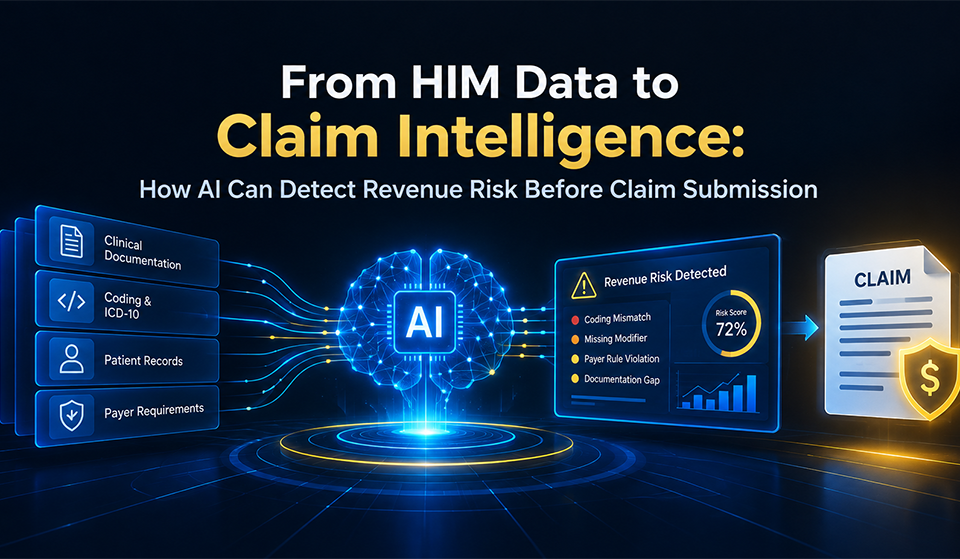
From HIM Data to Claim Intelligence: How AI Can Detect Revenue Risk Before Claim Submission

A claim may still face rejection or denial even when a healthcare organization documents the patient encounter, completes the coding process, and verifies insurance coverage. The underlying problem is often not a single missing field. Instead, it is a mismatch between clinical documentation, coded services, patient records, authorization details, and payer-specific requirements.
Traditional claim scrubbing identifies many errors after information has already passed through multiple workflows. However, healthcare organizations can take a more proactive approach by connecting health information management (HIM) data with AI-powered claim intelligence.
By analyzing documentation, coding patterns, historical claim outcomes, and payer rules before submission, AI can help revenue cycle teams identify financial risk while there is still time to correct it. Consequently, organizations can move beyond basic claims processing automation toward predictive, evidence-based claim optimization.
Why HIM Data Is Becoming a Critical Source of Claim Intelligence
Health information management plays an important role in maintaining accurate clinical records, supporting compliant coding, and ensuring that documentation reflects the services provided. Nevertheless, HIM data often remains separated from the systems responsible for billing and claim submission.
For example, a clinical note may describe a service in detail, while the assigned diagnosis code does not fully reflect the documented condition. Similarly, a procedure may require supporting documentation that is missing from the final claim package. Although each department may complete its individual task, the combined workflow can still contain a revenue risk.
This is where AI-powered HIM solutions can create additional value. Instead of examining documents, codes, and claim fields independently, an intelligent system can evaluate their relationships and identify inconsistencies before the claim reaches the payer. The objective is not simply to digitize health records. Rather, it is to transform clinical and administrative information into actionable claim intelligence that helps teams make better decisions before submission.
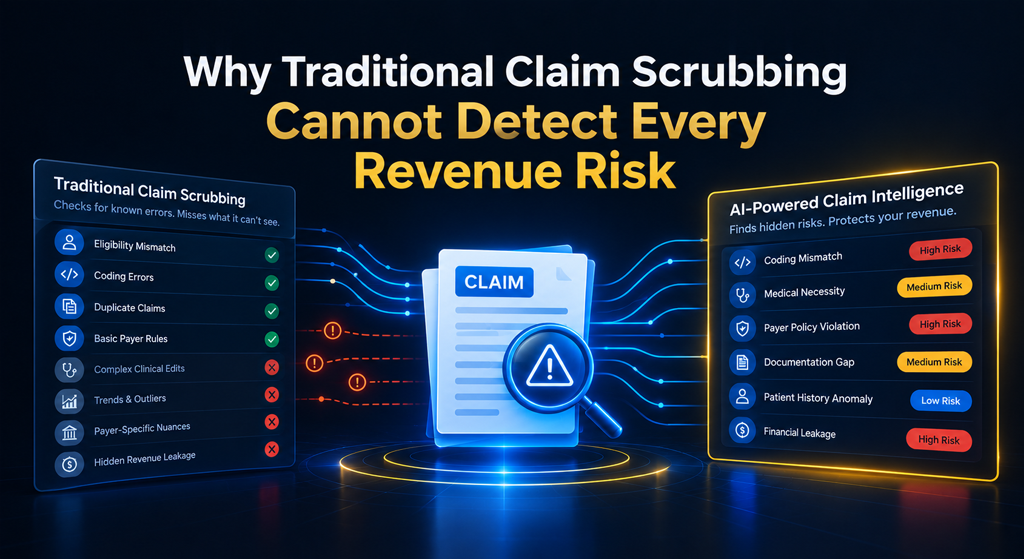
Why Traditional Claim Scrubbing Cannot Detect Every Revenue Risk
Traditional claim scrubbing is useful for identifying missing fields, invalid codes, formatting problems, and other rule-based errors. However, a claim can pass these checks and still contain a clinical or administrative inconsistency. Consider a hospital that submits a claim with a valid diagnosis code, an active insurance policy, and the required provider information. A conventional validation system may find no obvious error. Yet the clinical documentation may not adequately support the billed service, or the payer may require additional evidence for that procedure.
These issues require more than field-level validation. They require the system to understand how clinical evidence, coding decisions, coverage requirements, and historical payer responses relate to one another.
The financial consequences are significant. Experian Health’s 2025 State of Claims survey found that 41% of respondents reported claim denial rates of 10% or higher. The report also identified inaccurate or incomplete data, authorization issues, and patient registration problems among the major challenges facing providers. These findings reinforce the importance of identifying risk before submission rather than relying exclusively on downstream denial management.
Therefore, advanced AI claim optimization should complement traditional claim scrubbing with contextual analysis, predictive risk scoring, and explainable recommendations.
How AI Connects Clinical Documentation, Coding, and Payer Requirements
1. Clinical documentation intelligence identifies missing evidence
Clinical documentation contains important information about diagnoses, medical necessity, procedures, treatment decisions, and patient conditions. However, healthcare organizations may store this information in different formats across electronic health records, scanned documents, and clinical notes.
AI models use natural language processing to extract clinical concepts and compare them with billing data. They flag missing documentation supporting billed procedures. It can then flag the claim for review before submission.
Importantly, the model should distinguish between genuinely missing documentation and information that may simply be recorded elsewhere. It should not automatically invent clinical details or add unsupported diagnoses. The system should flag documentation gaps, reference supporting evidence, and direct clinicians or coding professionals to review them.
2. AI-assisted coding validation connects codes with clinical evidence
Accurate coding requires more than selecting a code that appears relevant to a diagnosis. The code must be supported by the documentation and comply with applicable coding guidelines. AI claim optimization compares encounter documentation, diagnosis codes, procedure codes, modifiers, and coding rules to identify potential discrepancies.
An automated validation model can detect mismatches between documented services and the codes selected during charge capture. Alternatively, it may flag a modifier that appears inconsistent with the available procedure details.
The system can then provide an explanation and supporting evidence for a qualified coding professional to review. This approach helps HIM and coding teams prioritize significant discrepancies rather than manually reviewing every claim equally. It also supports compliant reimbursement by focusing on documentation accuracy rather than maximizing coding intensity.
3. Patient record reconciliation detects cross-system inconsistencies
Patient information frequently moves between registration platforms, EHR systems, practice management software, and billing applications. During these transfers, inconsistent demographic details, subscriber identifiers, coverage information, or encounter dates can create avoidable claim problems.
AI-powered data reconciliation can compare relevant fields across authorized systems and identify conflicts before submission. For example, the patient’s registration record may contain one insurance identifier while the billing system contains another. The model flags discrepancies, identifies conflicting records, and routes each case to the appropriate registration or billing team.
However, AI should not automatically assume that one source is correct. The system needs clear data ownership, source timestamps, and confidence thresholds to determine when corrections require human verification.
4. Payer-specific intelligence identifies coverage and policy risks
A clinically accurate claim can still face reimbursement problems if it does not meet the applicable payer’s requirements. These requirements may involve authorization, medical necessity, covered services, coding combinations, supporting documentation, or submission rules. Moreover, policies can vary by payer, plan, service, and effective date.
A payer-aware claim intelligence system can evaluate the proposed claim against the applicable policy information available to it. It can then flag potential authorization gaps, documentation requirements, or coding conflicts. The system must use current, version-controlled rules and record each rule’s source and effective date. When it cannot verify a requirement, it should flag the uncertainty instead of treating an assumption as a confirmed payer rule.
5. Historical claim outcomes improve future risk detection
Historical claim data provides another important source of intelligence. Previous denials, successful appeals, claim adjustments, and payer responses can reveal recurring patterns that static validation rules may overlook. A model identifies denial patterns by analyzing historical data linking missing documentation, service types, payers, and coding characteristics.
Before submission, the system can compare a new claim with these patterns and estimate its risk. It can also identify the factors contributing most strongly to that estimate. However, historical correlation does not prove that a specific claim will be denied. Consequently, predictions should guide investigation rather than replace payer policy checks, professional judgment, or final claim validation.
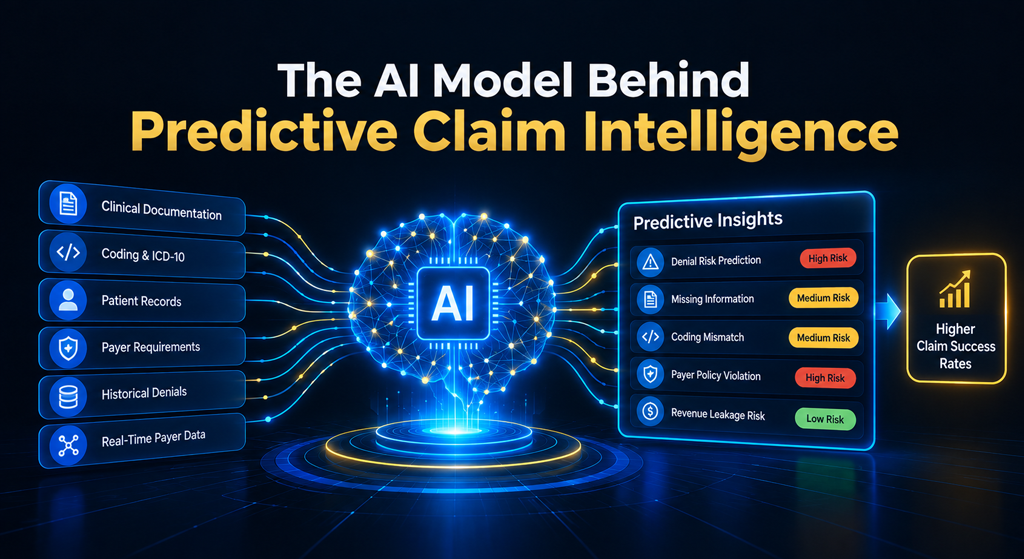
The AI Model Behind Predictive Claim Intelligence
An effective claim intelligence platform can combine several complementary techniques rather than relying on a single AI model. First, deterministic validation rules check known requirements, including required fields, code validity, formatting, and configured payer edits. Next, natural language processing extracts relevant information from clinical documentation. A reconciliation layer then compares that information with patient records, coding data, and claim fields.
A supervised machine learning model can estimate denial risk using appropriately labeled historical claims. Depending on the available data and use case, the model may use gradient-boosted decision trees or other suitable classification methods. Meanwhile, anomaly detection can identify unusual combinations or changes in claim patterns that deserve further investigation.
Finally, an explanation layer translates the findings into actions that HIM, coding, and revenue cycle teams can understand. The following workflow illustrates how these components can work together:
Clinical and administrative data → Data quality checks → Documentation and coding validation → Payer-rule evaluation → Predictive risk scoring → Human review or submission
The system scores claim risk, identifies contributing factors, presents supporting evidence, and recommends appropriate next steps for each claim. The system flags high-risk claims with missing authorization or incomplete documentation, distinguishing confirmed rule violations from predictive warnings requiring investigation.
What makes the model reliable?
Model reliability depends on representative training data, accurate outcome labels, and validation against claims that were not used for training. It also depends on monitoring performance across payers, service lines, coding categories, and changes in organizational workflows.
Healthcare organizations should evaluate precision, recall, calibration, false-positive rates, and the proportion of high-risk claims that staff can resolve before submission. They should also track whether the system creates unnecessary work or misses important errors. In addition, historical outcomes must be interpreted carefully. A previously paid claim is not necessarily compliant, and a previously denied claim may have been denied for reasons unrelated to the features available to the model.
Therefore, predictive performance must be measured alongside coding compliance, documentation quality, and actual operational outcomes.
How to Implement AI Claim Optimization Without Disrupting HIM Workflows
Successful implementation starts with a clearly defined revenue risk rather than an organization-wide AI deployment. First, identify the denial categories that create the greatest avoidable financial and administrative burden. Next, map the relevant data sources, including clinical documentation, coding systems, registration records, authorization information, claim edits, and historical remittance outcomes.
After that, select a focused use case, such as detecting documentation gaps or identifying recurring modifier-related errors. Establish a baseline using historical data, then test the model on a separate dataset and compare its findings with expert review. During the pilot, route high-confidence rule violations for correction and send uncertain predictions to trained staff. Capture their decisions and the final claim outcomes so that the organization can evaluate model performance over time.
Integration also matters. If a risk alert appears in a separate dashboard that staff rarely use, the model may identify problems without preventing them. Ideally, actionable findings should appear within existing HIM, coding, or revenue cycle workflows.
Finally, establish access controls, audit logs, appropriate data-retention policies, and vendor safeguards. HIPAA administrative simplification requirements govern standardized electronic healthcare transactions, while privacy and security obligations must also be addressed when protected health information is processed. Organizations should validate the applicable legal and contractual requirements for each implementation.
How Healthcare Organizations Can Measure Revenue Risk Reduction
AI claim optimization should be evaluated through measurable operational outcomes, not the number of alerts generated. A useful starting point is the pre-submission error detection rate, which measures how often the system identifies actionable issues before claims are sent. Organizations should also track the percentage of flagged issues that are confirmed during review, the number of preventable errors corrected before submission, and the first-pass acceptance rate.
Furthermore, teams should monitor denial rates by reason, payer, service line, and coding category. Rework hours, days in accounts receivable, time to claim submission, and the cost of correcting errors can reveal whether earlier intervention is improving the revenue cycle.
Financial impact should be calculated using actual results. For example, an organization can compare the cost of implementing and operating the model with verified reductions in rework, avoidable denials, and delayed reimbursement. It should avoid treating every flagged claim or prevented error as recovered revenue because the financial outcome depends on the underlying claim and the issue identified.
These measurements create a practical feedback loop. As teams correct data problems and investigate recurring risks, they can improve upstream workflows instead of repeatedly addressing the same errors after submission.
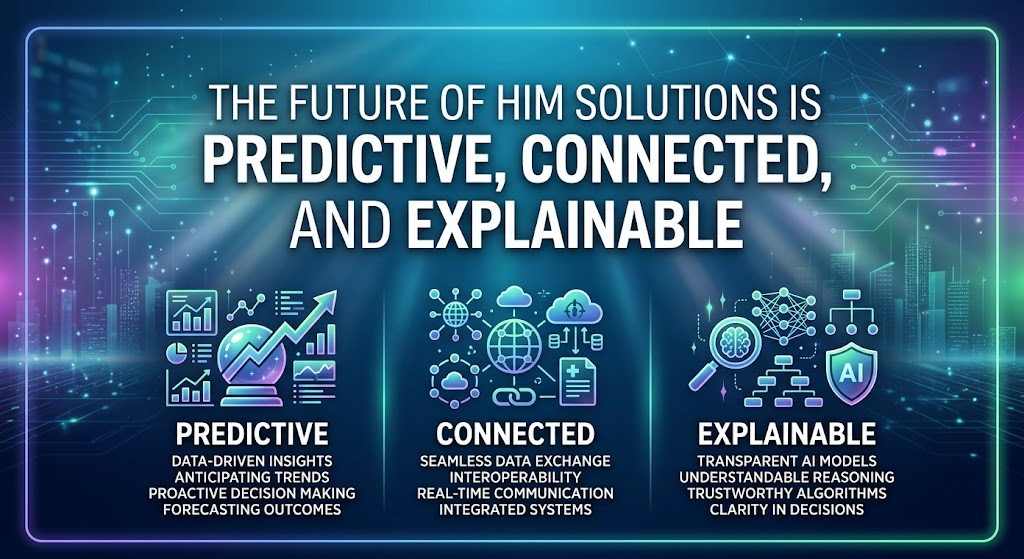
The Future of HIM Solutions Is Predictive, Connected, and Explainable
HIM teams have traditionally supported the integrity of clinical records and the accuracy of coded information. With connected AI systems, that role can extend into proactive revenue risk identification. The greatest opportunity lies in bringing together information that has historically been reviewed in isolation. Clinical documentation can inform coding validation. Coding and patient records can inform payer-rule checks. Historical claim outcomes can help prioritize cases that deserve additional attention.
Nevertheless, effective claim intelligence requires more than predictive scores. It requires trustworthy data, current payer requirements, explainable findings, secure integrations, and human oversight for decisions involving clinical documentation and coding judgment. For healthcare organizations seeking to reduce preventable claim errors, this represents a practical shift: from correcting problems after submission to identifying and resolving them while the claim is still being prepared.
Frequently Asked Questions
What are HIM solutions in healthcare revenue cycle management?
HIM solutions help healthcare organizations manage clinical records, documentation integrity, coding accuracy, and health information workflows. When connected with claim intelligence tools, they can also support earlier identification of documentation and coding risks that may affect reimbursement.
What is AI claim optimization?
AI claim optimization uses artificial intelligence, machine learning, documentation analysis, and rule-based validation to identify potential claim errors and prioritize corrective action before submission. Its purpose is to improve claim accuracy and support more efficient reimbursement workflows without replacing professional judgment.
How can AI detect claim denials before submission?
AI can identify risk indicators by comparing clinical documentation, diagnosis and procedure codes, patient records, authorization details, payer requirements, and historical claim outcomes. It can then flag confirmed discrepancies and estimate the likelihood of other potential problems for human review.
Can AI replace HIM and medical coding professionals?
No. AI can automate repetitive checks and help professionals prioritize complex cases. However, clinical documentation interpretation, coding judgment, compliance decisions, and corrections requiring professional expertise still need appropriate human oversight.
What data is required for predictive claim intelligence?
Depending on the use case, a system may require clinical notes, diagnosis and procedure codes, patient registration data, eligibility and authorization details, payer policy information, claim edits, remittance advice, and historical denial outcomes. Data should be limited to what is necessary for the approved purpose and handled under appropriate privacy and security controls.
Turn HIM Data Into Actionable Claim Intelligence With Aiclaim
Identifying revenue risk before submission begins with connecting clinical evidence, coding information, and payer requirements in a workflow that helps teams act before preventable errors become denials.
Aiclaim helps healthcare organizations explore AI-powered approaches to claim intelligence and claim optimization. If your organization is evaluating ways to strengthen pre-submission validation, identify recurring claim risks, and improve revenue cycle visibility, start by examining where documentation and claim data become disconnected.
Ready to explore AI-driven claim intelligence?
Visit Aiclaim.com to learn more about AI-powered healthcare claim management.
Get a Pre-Submission Claim Risk Assessment Checklist to evaluate documentation completeness, coding consistency, patient data accuracy, authorization readiness, and payer-rule validation across your current workflow.