
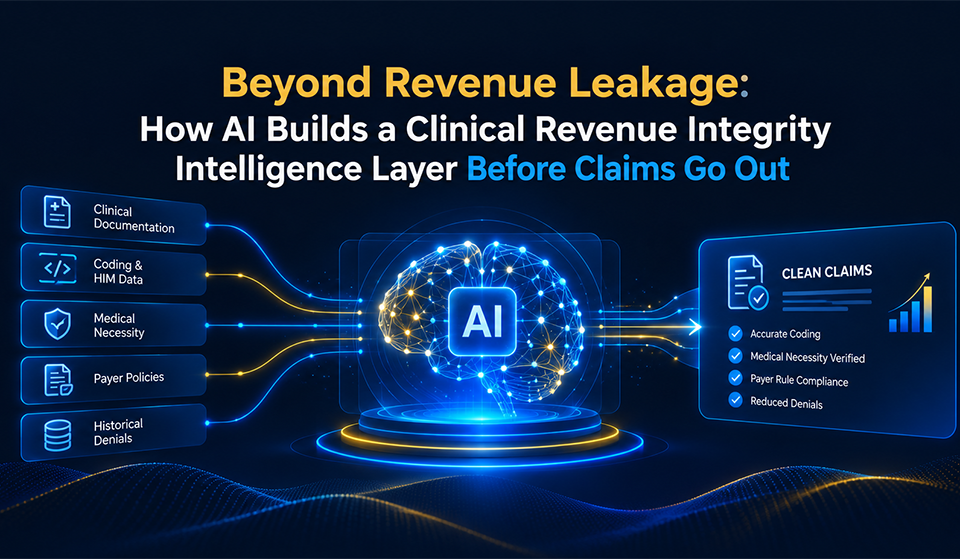
Beyond Revenue Leakage: How AI Builds a Clinical Revenue Integrity Intelligence Layer Before Claims Go Out

Healthcare organizations can lose revenue even when their billing teams follow established procedures, coding rules, and claim submission checklists. The underlying problem is often not a single billing mistake. Instead, it is the disconnect between clinical documentation, coding decisions, medical necessity requirements, payer policies, and historical denial patterns.
This is where clinical revenue integrity needs to evolve beyond traditional revenue leakage audits. Healthcare organizations can use AI to detect potential revenue risks during claim preparation, rather than after submission or payment.
According to Experian Health’s 2025 State of Claims survey, 41% of surveyed providers reported denial rates of 10% or higher. Additionally, 68% said submitting clean claims had become more challenging than the previous year. These findings demonstrate why healthcare organizations need stronger preventive controls instead of relying exclusively on post-submission corrections.
AI connects clinical evidence, coding, medical necessity, payer requirements, and historical outcomes to detect claim inconsistencies before submission. Consequently, organizations can improve claim accuracy, reduce avoidable rework, and make more informed financial decisions.
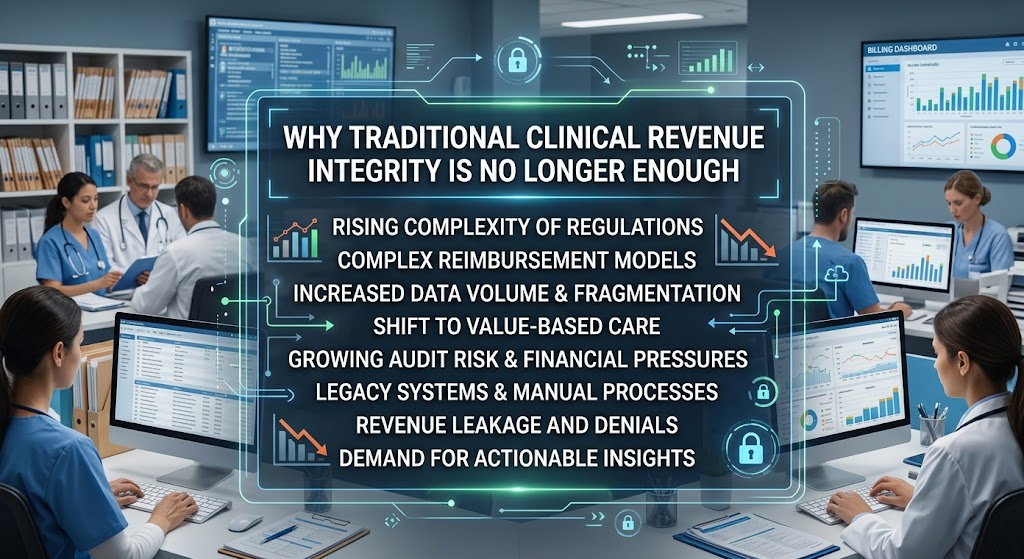
Why Traditional Clinical Revenue Integrity Is No Longer Enough
Traditional clinical revenue integrity programs often depend on periodic audits, manual coding reviews, claim scrubbing rules, and retrospective denial analysis. Although valuable, these processes may detect issues only after organizations invest time in documentation, coding, billing, and follow-up.
Correct coding cannot prevent denials when documentation is insufficient or payer requirements fail to support medical necessity. Traditional claim scrubbers validate required fields and code combinations but may overlook clinical evidence and payer. reimbursement requirements. As a result, the claim can pass basic technical checks while retaining a significant financial risk.
The solution is to move from isolated validation rules toward connected clinical and financial intelligence. Clinical revenue integrity continuously evaluates claim evidence, detects discrepancies, and guides teams to resolve issues before submission.
What Is an AI-Powered Clinical Revenue Integrity Intelligence Layer?
An AI-powered clinical revenue integrity intelligence layer is a decision-support system that connects clinical documentation, medical coding, payer policies, authorization information, and historical claim outcomes to identify potential financial and compliance risks before claims leave the organization.
Unlike a standalone claim scrubber, this intelligence layer evaluates relationships between information sources rather than checking only individual fields. For instance, the system can compare a documented diagnosis with the assigned ICD-10-CM code, examine whether the procedure aligns with the clinical record, verify applicable payer requirements, and identify documentation gaps associated with similar historical denials.
Importantly, AI should not automatically assume that a claim is incorrect simply because it differs from historical patterns. Instead, it should identify the evidence behind each warning, explain the potential risk, and recommend an appropriate next step for human review. This approach helps revenue integrity teams prioritize high-risk claims while allowing straightforward claims to move through established workflows.
How AI Connects Clinical Documentation, Coding, and Payer Intelligence
Clinical Documentation Intelligence Identifies Missing Evidence
Clinical documentation is the foundation of accurate coding, medical necessity evaluation, and defensible reimbursement. Nevertheless, important details may be distributed across physician notes, operative reports, diagnostic findings, discharge summaries, and other clinical records.
AI-powered natural language processing can extract relevant concepts from these documents and compare them with the information required to support a proposed claim. For example, a procedure may appear consistent with the diagnosis code, yet the available documentation may not clearly establish the clinical circumstances supporting the service. An AI model can flag the missing or conflicting evidence for a qualified reviewer.
The system should distinguish between information that is genuinely absent and information that may exist elsewhere in the medical record. Consequently, documentation teams can investigate specific gaps instead of repeatedly reviewing the entire chart. This process strengthens clinical documentation integrity while reducing unnecessary queries and last-minute claim corrections.
Coding Intelligence Connects Clinical Evidence With Billing Accuracy
Accurate coding requires more than selecting a code that resembles a diagnosis mentioned in the medical record. The assigned codes must follow applicable coding guidelines and reflect the documented clinical circumstances.
AI can compare extracted clinical concepts with proposed diagnosis and procedure codes, identify potentially incompatible combinations, and detect missing modifiers or other coding inconsistencies. For example, a claim may contain a procedure code and diagnosis code that appear individually valid. However, the documented circumstances may not adequately support their relationship. The intelligence layer can flag that discrepancy for coding review before submission.
However, AI recommendations must remain subject to current coding rules, official guidance, and qualified professional judgment. The objective is not to replace certified coding expertise. Instead, it is to help coding teams identify issues earlier and apply their expertise where it matters most.
Medical Necessity Intelligence Evaluates the Evidence Behind the Service
Medical necessity represents another critical area of clinical revenue integrity. A claim may contain accurate demographic information, valid codes, and complete authorization details while still facing a denial because the clinical record does not sufficiently support the billed service under applicable coverage requirements. An AI intelligence layer can compare relevant clinical documentation against the applicable medical necessity criteria and payer-specific policies available to the organization.
For example, if a payer requires particular clinical findings or supporting documentation for a service, the system can check whether the available record appears to contain the required evidence. When it identifies a potential gap, it should explain which criterion needs further review and direct the claim to the appropriate clinical or utilization management team.
Nevertheless, medical necessity is a clinical and coverage determination, not simply a pattern-matching exercise. Therefore, AI should support evidence-based review rather than independently invent missing documentation or make unsupported clinical conclusions.
Payer Policy Intelligence Adapts to Changing Requirements
Payer policies can vary by plan, service, location, effective date, authorization status, and applicable coverage rules. Consequently, a workflow that relies entirely on static claim validation rules may overlook relevant changes. A connected intelligence layer can maintain version-controlled payer requirements and match each claim against the applicable policy information.
For example, the system may identify that a service requires authorization under a particular plan or that supporting documentation needs further review. It can then check the available authorization record and flag discrepancies before submission.
To remain reliable, the system must use current, authoritative policy sources and preserve the effective dates of the rules applied. If the applicable policy cannot be verified, the system should report the uncertainty rather than present an outdated requirement as fact.
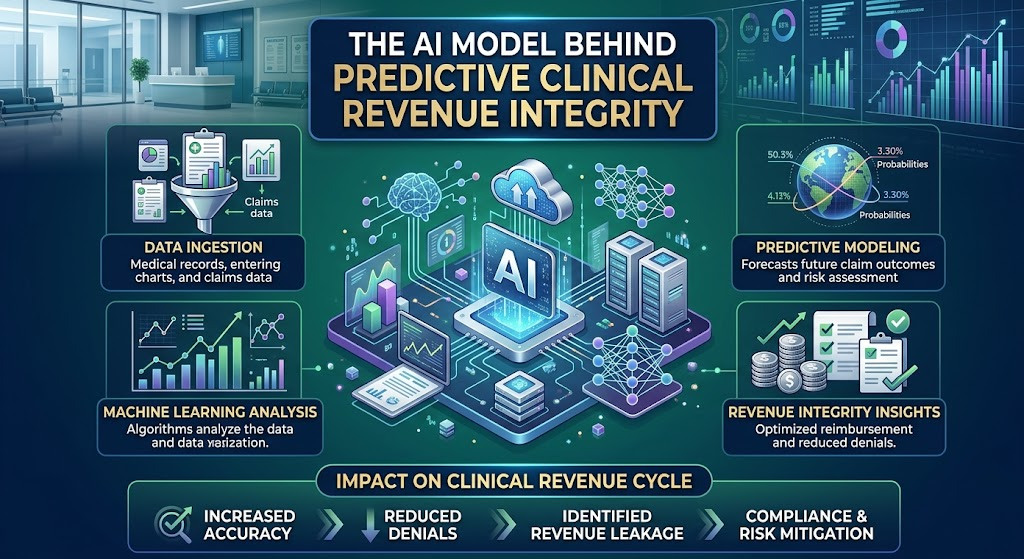
The AI Model Behind Predictive Clinical Revenue Integrity
A reliable clinical revenue integrity intelligence layer combines clinical language processing, rules-based validation, predictive modeling, and explainable AI. It extracts clinical evidence, connects EHR and claim data, and validates coding rules, required fields, and payer requirements before submission.
A machine learning model then evaluates historical claim outcomes and relevant features to estimate the probability of a particular risk, such as a documentation-related denial or coding discrepancy. Depending on the available data, suitable approaches may include gradient-boosted decision trees, logistic regression, or other validated classification models.
For example, a model might evaluate the relationship between procedure type, diagnosis, documentation completeness, payer, authorization status, and previously observed denial reasons. It can generate a risk score for prioritizing review, but that score must be calibrated and tested on representative data before operational use.
Finally, an explainability layer identifies the factors contributing to the prediction and recommends the next review step. The resulting output could distinguish a confirmed missing authorization from a probabilistic warning about incomplete clinical evidence. This separation is essential because a prediction is not proof of an error. Accordingly, organizations should measure model calibration, false-positive rates, missed risks, performance across specialties, and changes in denial patterns over time.
How Historical Denials Turn Into Preventive Intelligence
Historical denial data becomes significantly more useful when organizations connect it to the clinical and administrative circumstances that existed before submission. Suppose a health system repeatedly receives denials associated with insufficient documentation for a particular service. A retrospective report may reveal the denial category and financial impact. However, an intelligence layer can go further by identifying recurring documentation patterns associated with those outcomes.
The model can then flag similar risk patterns in new claims before submission. Meanwhile, coding and clinical documentation teams can use the findings to improve templates, clarify workflows, and address recurring process weaknesses. This creates a continuous feedback loop: claim outcomes inform the model, model findings guide preventive reviews, and corrected claims generate new evidence about which interventions work.
However, historical data must be carefully labeled. Changes in payer behavior, coding guidance, contract terms, or clinical practice can make older patterns unreliable. Regular monitoring and controlled model updates are therefore essential.
A Practical Example: Identifying Revenue Risk Before Submission
Consider a hypothetical outpatient procedure claim. The diagnosis and procedure codes pass standard validation, and the patient’s insurance coverage appears active. However, the clinical record contains incomplete supporting evidence, and the payer’s applicable policy requires additional documentation for the service.
A traditional workflow might allow the claim to proceed because its basic fields and code combinations are valid. The issue could surface only after a denial, creating additional work for billing, coding, and clinical teams. With predictive clinical revenue integrity, the system connects the documentation, coding information, payer requirements, and authorization record before submission.
It identifies the potential documentation gap, explains the relevant policy requirement, and routes the claim to a qualified reviewer. Once the reviewer confirms the issue, the appropriate team can address it using the existing clinical record and established documentation procedures. As a result, the organization has an opportunity to resolve the problem before it becomes a preventable denial. This is a workflow illustration, not a guaranteed outcome; actual results depend on data quality, policy accuracy, implementation, and staff adoption.
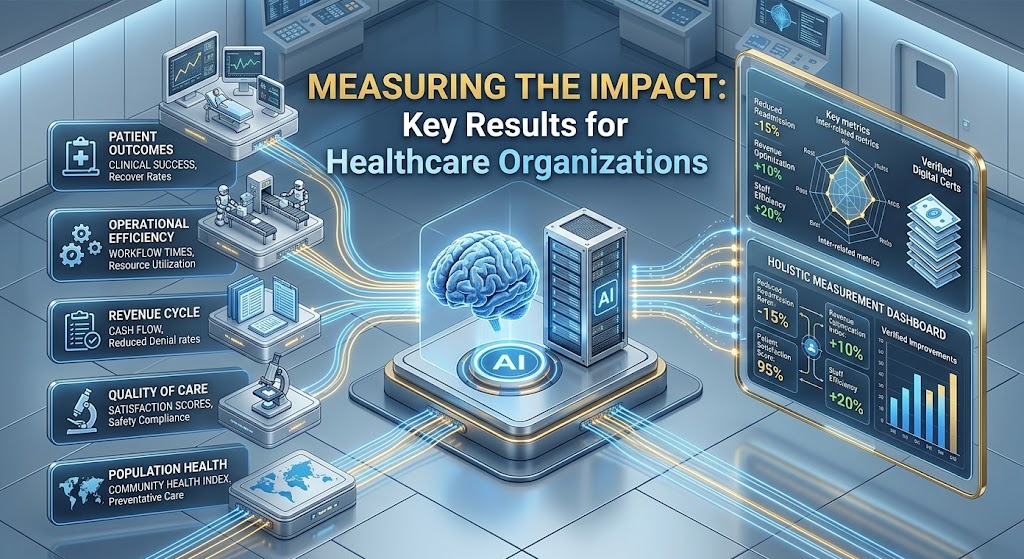
How Healthcare Organizations Should Measure Results
Implementing AI does not automatically improve clinical revenue integrity. Organizations need measurable evidence that the intelligence layer reduces risk without introducing unnecessary delays or compliance problems. The initial denial rate should be measured by claim volume and financial value, with consistent definitions across reporting periods. Healthcare Financial Management Association guidance emphasizes standardized denial metrics because reliable comparisons help organizations identify process weaknesses and evaluate improvement efforts.
Organizations should also track documentation-related denial rates, coding correction rates, medical necessity review outcomes, and the percentage of high-risk claims corrected before submission. Furthermore, teams should measure false-positive alerts, review turnaround time, staff workload, and the proportion of alerts that lead to meaningful interventions. These measures reveal whether the system is genuinely improving decisions or simply creating another queue for employees.
Financial performance should be evaluated using recovered or protected revenue supported by documented evidence, alongside implementation and operating costs. A pilot should establish a baseline and compare results across comparable claim populations before attributing improvements to AI.
Building Clinical Revenue Integrity With Governance and Human Oversight
Clinical revenue integrity involves sensitive patient information, financial decisions, coding accuracy, and payer compliance. Therefore, governance must be part of the architecture from the beginning. Organizations should establish appropriate access controls, encryption, audit trails, retention policies, and contractual safeguards for protected health information. They should also assess vendor security practices, data usage, and applicable HIPAA obligations before implementation.
Equally important, every high-impact recommendation should have a traceable explanation. Reviewers need to know which documentation, coding rule, payer policy, or historical pattern triggered an alert. The system must never fabricate clinical evidence, silently change codes, or encourage unsupported documentation changes. Instead, it should direct discrepancies to authorized staff and preserve the original record and review history.
By combining AI intelligence with professional oversight, healthcare organizations can strengthen revenue integrity without sacrificing clinical accuracy, compliance, or accountability.
The Future of Clinical Revenue Integrity Is Predictive, Connected, and Explainable
Clinical revenue integrity is evolving from retrospective auditing toward continuous, evidence-based risk prevention. As clinical documentation, coding, payer policies, and historical denial data become more connected, healthcare organizations can identify financial risks earlier and focus limited resources on the claims that need attention.
The competitive advantage will not come from adding another disconnected automation tool. Rather, it will come from building an intelligence layer that connects clinical evidence with financial outcomes, explains its recommendations, and learns from verified results.
For healthcare leaders, the next step is to identify where existing workflows lose visibility between clinical documentation and claim submission. A focused pilot can then establish baseline denial metrics, test AI-generated risk alerts, and measure whether preventive interventions deliver meaningful improvements.
Aiclaim helps healthcare organizations explore AI-powered claim intelligence and proactive denial prevention. Discover how predictive claim intelligence can support a stronger, more accurate revenue cycle before claims go out.
Ready to identify claim risks before submission? Visit Aiclaim.com to explore AI-driven claim management solutions or contact info@aiclaim.com to discuss your organization’s requirements.
Frequently Asked Questions About Clinical Revenue Integrity
What is clinical revenue integrity?
Clinical revenue integrity is the process of ensuring that healthcare claims accurately reflect documented services, supported diagnoses, applicable coding requirements, and relevant payer policies. Its purpose is to reduce preventable financial discrepancies while supporting compliant reimbursement.
How does AI improve clinical revenue integrity?
AI connects clinical documentation, coding data, payer requirements, and historical claim outcomes to identify potential errors and financial risks before submission. It can prioritize reviews, explain contributing factors, and help teams correct verified issues earlier.
How is predictive clinical revenue integrity different from claim scrubbing?
Traditional claim scrubbing primarily checks defined fields, code combinations, and validation rules. Predictive clinical revenue integrity adds contextual analysis and machine learning to identify patterns that may indicate documentation, medical necessity, or denial risks that basic edits cannot detect.
Can AI prevent all healthcare claim denials?
No. AI can help identify and prevent some avoidable denials, but it cannot eliminate every denial. Payer decisions, changing policies, incomplete source data, clinical judgment, and other external factors continue to affect claim outcomes.
How should healthcare organizations start implementing AI for clinical revenue integrity?
Organizations should begin with a defined problem, such as documentation-related denials or medical necessity review delays. They should establish baseline metrics, validate data quality, pilot explainable AI alerts, maintain human oversight, and measure results before expanding the system.
Get the Clinical Revenue Integrity Readiness Checklist: 15 Controls to Evaluate Before Claim Submission. Use it to assess documentation completeness, coding validation, medical necessity evidence, payer policy alignment, denial feedback, and AI governance.