
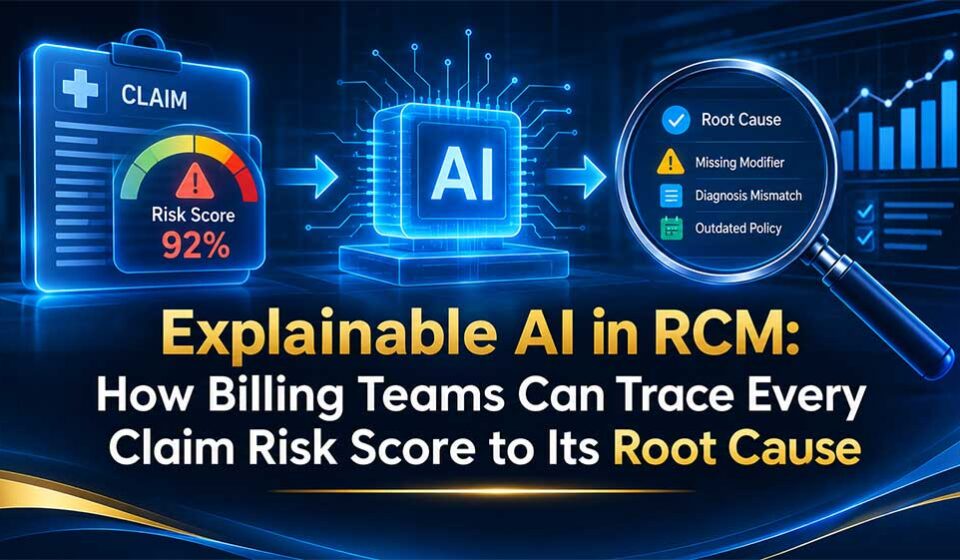
Explainable AI in RCM: How Billing Teams Can Trace Every Claim Risk Score to Its Root Cause

A claim receives an 87% denial risk score. The billing team sees the warning, but an important question remains unanswered: What exactly makes this claim risky, and what needs to be corrected before submission? Is the problem an incomplete modifier? Does the diagnosis fail to support the billed procedure? Is the patient’s coverage inactive? Or has a payer recently changed its reimbursement policy?
Without these answers, even an advanced AI system can create another operational problem. Instead of reducing manual work, it forces billing professionals to investigate recommendations they cannot understand. This is where explainable AI in revenue cycle management (RCM) becomes essential. Healthcare organizations need more than predictive scores. They need evidence-backed explanations, traceable model decisions, and corrective recommendations that billing teams can actually use.
AI-powered medical billing software must explain not only which claims are likely to be denied, but also why the risk exists, which evidence supports the prediction, and how the organization can prevent the problem.
Why Traditional AI Claim Risk Scores Are Not Enough
Predictive analytics has changed how healthcare organizations approach claim management. Machine learning models can evaluate historical denials, payer behavior, coding patterns, eligibility information, and claim characteristics to identify potential reimbursement problems.
However, prediction without explanation creates a serious gap between technology and operational decision-making. Consider a billing department processing thousands of claims every day. An AI model identifies 300 claims as high risk. Although the team knows which claims require attention, it cannot determine which issues deserve immediate intervention.
Consequently, staff members may spend valuable time reviewing claims that do not require corrections while overlooking the actual causes of preventable denials. The financial consequences are significant. Experian Health’s 2026 State of Claims survey found that 75% of providers reported increasing claim denials, while 40% said at least 10% of their claims were denied. Furthermore, 78% reported more frequent payer policy changes.
These findings highlight why healthcare organizations need more transparent predictive systems rather than another layer of automated alerts. An effective AI solution should connect every risk score to identifiable claim evidence and a practical resolution pathway.
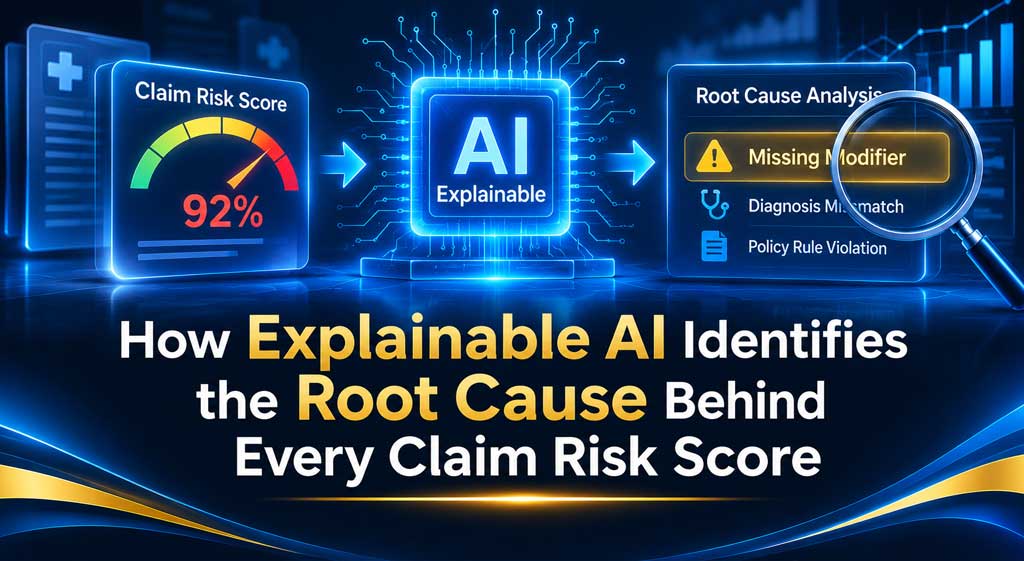
How Explainable AI Identifies the Root Cause Behind Every Claim Risk Score
Explainable AI, commonly called XAI, makes machine learning decisions understandable to the people responsible for acting on them. Instead of presenting a risk score as an isolated number, the system identifies the variables that influenced the prediction and explains how they contributed to the outcome.
For example, consider a hypothetical outpatient claim receiving an 87% denial risk score. The model may identify a diagnosis-to-procedure mismatch, an absent required modifier, and a payer-specific documentation requirement as contributing risk factors.
Rather than displaying only the final score, an explainable system presents the evidence behind each finding.
1. Feature-Level Analysis: Identifying What Increased Claim Risk
Machine learning models evaluate multiple claim attributes simultaneously. These attributes, known as features, can include procedure codes, diagnosis codes, modifiers, payer identifiers, eligibility responses, authorization status, provider information, and historical denial patterns.
Feature attribution techniques such as SHAP (SHapley Additive exPlanations) can help identify how individual variables influence a model’s prediction. For instance, a claim might receive the following illustrative risk breakdown:
| Risk contributor | Model contribution |
|---|---|
| Diagnosis-procedure inconsistency | +34 points |
| Missing required modifier | +25 points |
| Payer-specific documentation gap | +18 points |
| Eligibility information uncertainty | +10 points |
These figures are hypothetical model contributions, not industry benchmarks or universal probabilities. Nevertheless, this level of visibility helps billing teams understand which attributes require investigation. More importantly, the system should distinguish between confirmed data defects and statistical warning signals. A historical association does not automatically prove that a claim contains an error.
2. Evidence-Based Validation: Connecting Predictions to Actual Claim Data
Identifying influential features is only the beginning. Billing professionals also need to understand the evidence supporting each warning. An explainable AI engine should connect its findings to relevant source information, including the submitted 837 claim, eligibility transactions, authorization records, coding data, payer policy versions, and applicable documentation.
For example, when a model identifies a possible modifier issue, the system should show the procedure code, submitted modifier, relevant coding requirement, and source used for validation. Similarly, when coverage uncertainty increases claim risk, the system should display the eligibility response, verification timestamp, and relevant coverage details.
This approach transforms a prediction into an actionable investigation. Furthermore, it reduces the risk of staff accepting an incorrect AI recommendation simply because the system presents it with a high confidence score.
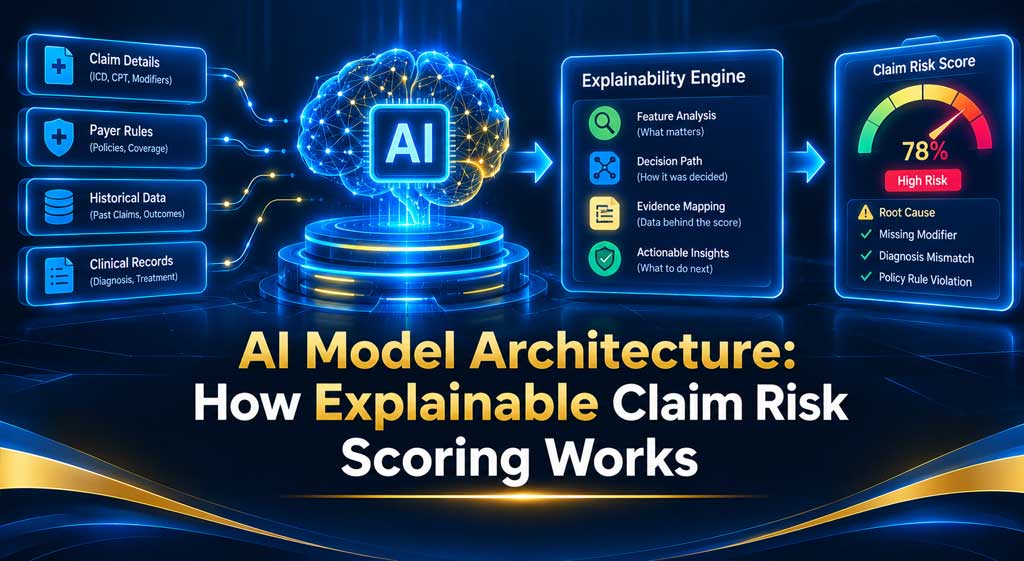
AI Model Architecture: How Explainable Claim Risk Scoring Works
Reliable explainability requires more than adding a description beside a prediction. The underlying AI architecture must preserve the relationship between input data, model decisions, supporting evidence, and recommended actions.
Combining Machine Learning With Rule-Based Validation
An advanced AI-powered medical billing software platform can combine multiple analytical techniques. First, supervised machine learning models, such as gradient-boosted decision trees, can learn from historical claim outcomes and identify patterns associated with denials. Second, natural language processing (NLP) can extract relevant information from payer policies, remittance advice, authorization records, and supporting documentation.
Third, deterministic rules can validate specific requirements, including code combinations, required modifiers, eligibility fields, and applicable claim formatting standards. Finally, an explainability layer can use SHAP values, feature attribution, and evidence mapping to communicate why the model generated a particular risk prediction.
The resulting workflow connects four important stages: claim data ingestion, predictive risk assessment, evidence-based explanation, and corrective action.
Why Model Confidence and Prediction Probability Must Be Separated
One common mistake in AI-driven billing is treating every risk score as a guaranteed denial probability. A model predicting an 87% denial probability does not establish that the payer will deny the claim. Its reliability depends on the quality of training data, model calibration, payer-specific patterns, and how closely the current claim resembles the historical examples.
Therefore, healthcare organizations should evaluate calibration, precision, recall, false-positive rates, and performance across different payer categories. Additionally, models should identify situations where the available evidence is incomplete or outside their validated operating conditions.
When confidence is insufficient, the appropriate response is human review rather than an unsupported automated recommendation.
From AI Risk Detection to Corrective Action: Closing the RCM Workflow Gap
Identifying a problem without explaining how to resolve it leaves billing teams with another unfinished task. Therefore, explainable AI should connect every meaningful risk signal to a specific corrective workflow. Consider a claim flagged for a potential diagnosis-procedure mismatch. Instead of simply marking the claim as high risk, the system should identify the relevant diagnosis and procedure fields, explain the inconsistency, and direct the appropriate coding professional to review the supporting clinical documentation.
Likewise, when an eligibility issue appears, the system should recommend re-verification using the appropriate payer source rather than assuming the patient has inactive coverage. For authorization-related concerns, the platform should identify missing or inconsistent authorization information and route the claim for verification.
This distinction is critical because not every risk can be resolved through automated editing. Coding changes must be supported by documentation, while coverage and authorization issues may require payer confirmation. A well-designed system therefore combines AI recommendations with human approval, role-based workflows, and a documented resolution history.
Creating an Auditable AI Decision Trail for Healthcare Billing
Explainability becomes especially valuable when healthcare organizations need to investigate why a claim was flagged, why a correction was made, or why an AI recommendation was rejected. However, an explanation displayed on a dashboard is not sufficient for a complete audit.
An effective AI audit trail should preserve the original claim data, relevant source evidence, model version, prediction timestamp, risk score, feature contributions, recommended action, reviewer identity, approval status, and final claim outcome. For example, if a claim initially receives a high-risk score but is corrected before submission, the organization should be able to compare its original and revised versions.
Likewise, if the payer subsequently denies the claim, auditors should be able to determine whether the model identified the underlying issue, whether the recommended action was followed, and whether the available evidence supported the original prediction. Version control is equally important. Payer requirements and machine learning models change over time. Consequently, an audit should preserve the policy and model versions applicable when the original prediction was generated.
This creates accountability across billing, coding, compliance, and technology teams.
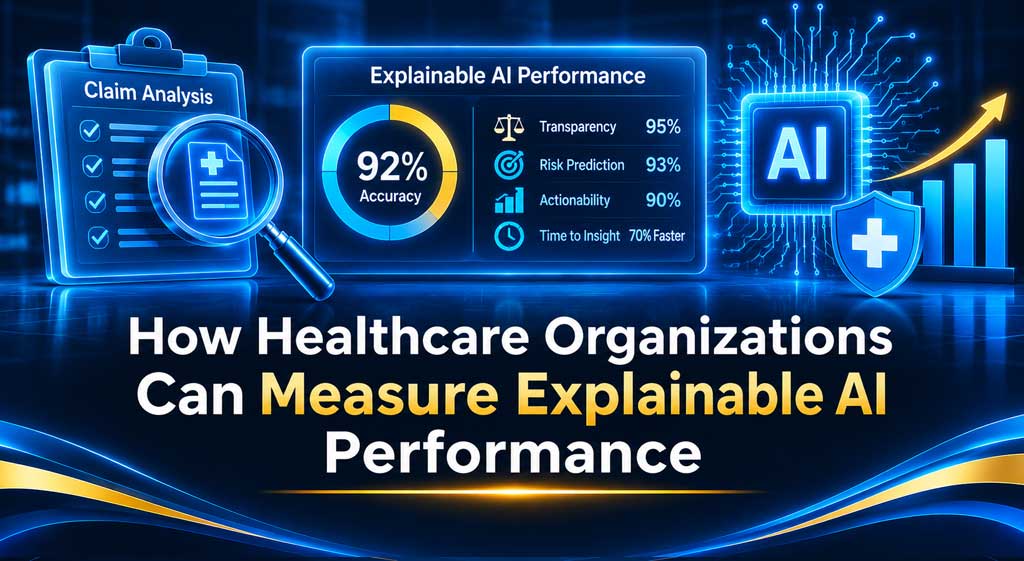
How Healthcare Organizations Can Measure Explainable AI Performance
An AI system should not be evaluated solely by the number of claims it processes or the speed at which it generates predictions. Instead, healthcare leaders should measure whether its explanations improve operational decisions and financial outcomes. First, explanation accuracy matters. The reasons presented to billing professionals must accurately reflect the factors that influenced the model’s prediction.
Second, risk prediction performance should be measured using precision, recall, calibration, and false-positive rates. These metrics help organizations understand whether high-risk alerts are genuinely useful. Third, operational performance should include average claim review time, correction turnaround time, first-pass acceptance rate, and avoidable denial trends.
Finally, financial performance should consider net collection rates, recovered revenue, preventable rework costs, and the financial impact of incorrect automated recommendations. Organizations should also compare results across payers, specialties, locations, and claim categories. Otherwise, strong overall performance may conceal poor predictions for specific operational groups.
The goal is not simply to make AI more accurate. It is to make its decisions more understandable, measurable, and useful.
What Healthcare Leaders Should Look for in Explainable AI-Powered Medical Billing Software
Selecting an AI platform requires a deeper evaluation than checking whether it offers automated coding, denial prediction, or claim scrubbing. Healthcare executives should examine whether the software can trace predictions to source-level claim evidence, distinguish confirmed errors from predicted risks, and explain the contribution of individual model features.
Additionally, the platform should support model version tracking, payer-specific validation, role-based approvals, secure audit records, and integration with existing billing and claims workflows. Interoperability is another important consideration. Native support for healthcare transaction standards such as X12 837 can reduce unnecessary formatting and data transformation steps.
Most importantly, vendors should demonstrate how their system handles uncertain predictions, incorrect recommendations, and changes in payer requirements. The NIST AI Risk Management Framework emphasizes characteristics such as validity, reliability, transparency, accountability, explainability, privacy, and fairness. Similarly, the ONC HTI-1 Final Rule introduced algorithm transparency requirements for predictive decision support interventions within applicable certified health IT.
Although these frameworks and requirements do not automatically apply to every medical billing product, they provide valuable reference points when evaluating responsible AI implementation.
The Future of RCM: Moving From Black-Box Predictions to Accountable Claim Intelligence
The next stage of revenue cycle automation will not be defined by how many claims an AI system can process without human involvement. Instead, its value will depend on whether healthcare organizations can understand, verify, and act on its recommendations. A billing team should never have to choose between trusting an unexplained AI prediction and ignoring a potentially important warning.
Explainable AI provides a more practical approach by connecting predictive analytics with evidence, corrective workflows, and measurable accountability. For healthcare providers, billing companies, and payers, this means moving beyond reactive denial management toward a more intelligent and transparent claims operation.
Aiclaim is advancing AI-driven claim intelligence to help healthcare organizations identify potential claim risks before submission and make better-informed revenue cycle decisions.
With ClearClaim, Aiclaim brings predictive claim intelligence into the claims workflow, helping organizations identify potential denial risks and improve pre-submission claim review.
Want to understand the risks hiding inside your healthcare claims before they become denials?
Explore Aiclaim’s AI-powered claim intelligence solutions and discover how explainable risk assessment can strengthen your revenue cycle.
Book a Free Demo: https://www.aiclaim.com/
Email: info@aiclaim.com
Website: https://www.aiclaim.com/
Frequently Asked Questions About Explainable AI in RCM
What is explainable AI in revenue cycle management?
Explainable AI in RCM refers to artificial intelligence systems that provide understandable reasons and supporting evidence for their claim risk predictions. It helps billing professionals identify potential coding errors, eligibility issues, authorization gaps, and payer-specific reimbursement risks.
How does AI-powered medical billing software explain claim risk scores?
AI-powered medical billing software can use feature attribution techniques, historical claim patterns, payer policy information, and rule-based validation to identify factors influencing a risk prediction. It can then connect those findings to source claim data and recommend appropriate corrective actions.
What is the difference between AI claim prediction and explainable AI?
AI claim prediction estimates the likelihood of a claim-related outcome, such as a denial. Explainable AI goes further by identifying the factors influencing that prediction and providing supporting evidence that helps billing professionals evaluate the recommendation.
Can explainable AI help reduce healthcare claim denials?
Yes. Explainable AI can help identify potential claim defects before submission, prioritize high-risk claims, and direct staff toward appropriate corrections. However, its effectiveness depends on data quality, model performance, payer-specific validation, and appropriate human oversight.
What AI algorithms are used for explainable claim risk scoring?
Common approaches include gradient-boosted decision trees, logistic regression, random forests, SHAP feature attribution, and natural language processing. These techniques can be combined with deterministic coding and payer-rule validation to produce more transparent claim assessments.
Why is an AI audit trail important in medical billing?
An AI audit trail records the evidence, model version, risk prediction, recommendation, reviewer actions, and claim outcome. This helps healthcare organizations investigate decisions, monitor model performance, establish accountability, and support internal compliance reviews.