
Healthcare organizations lose billions of dollars every year because of medical billing errors, denied claims, delayed reimbursements, and revenue leakage. Moreover, as healthcare regulations become more complex, providers are struggling to maintain billing accuracy while managing growing patient volumes. Consequently, hospitals, clinics, and medical practices are now turning toward Artificial Intelligence (AI) to solve these challenges before claims are even submitted.
Today, AI-powered medical billing systems are transforming the healthcare revenue cycle by identifying errors in real time, reducing denials, improving coding accuracy, and accelerating reimbursements. Instead of relying entirely on manual reviews, healthcare providers can now use intelligent automation to detect hidden billing issues instantly.
In this guide, you will learn how AI identifies billing errors before claim submission, why it matters for healthcare organizations, and how AI-driven billing automation improves revenue cycle management while reducing operational stress.
Why Billing Errors Are a Major Problem in Healthcare
Medical billing errors are more common than many healthcare providers realize. In fact, even small mistakes in coding, patient information, insurance verification, or documentation can lead to claim denials and payment delays.
Additionally, billing teams often work under pressure with large volumes of patient records, which increases the risk of human error. As a result, healthcare organizations experience:
- Increased claim denials
- Revenue leakage
- Delayed reimbursements
- Compliance risks
- Higher administrative costs
- Increased staff workload
- Poor patient financial experience
Furthermore, denied claims require rework, which consumes valuable time and resources. According to industry reports, healthcare providers lose billions annually due to preventable billing and coding mistakes.
Therefore, healthcare organizations are now focusing on AI-powered claim management solutions to reduce billing risks proactively.
What Is AI-Powered Medical Billing?
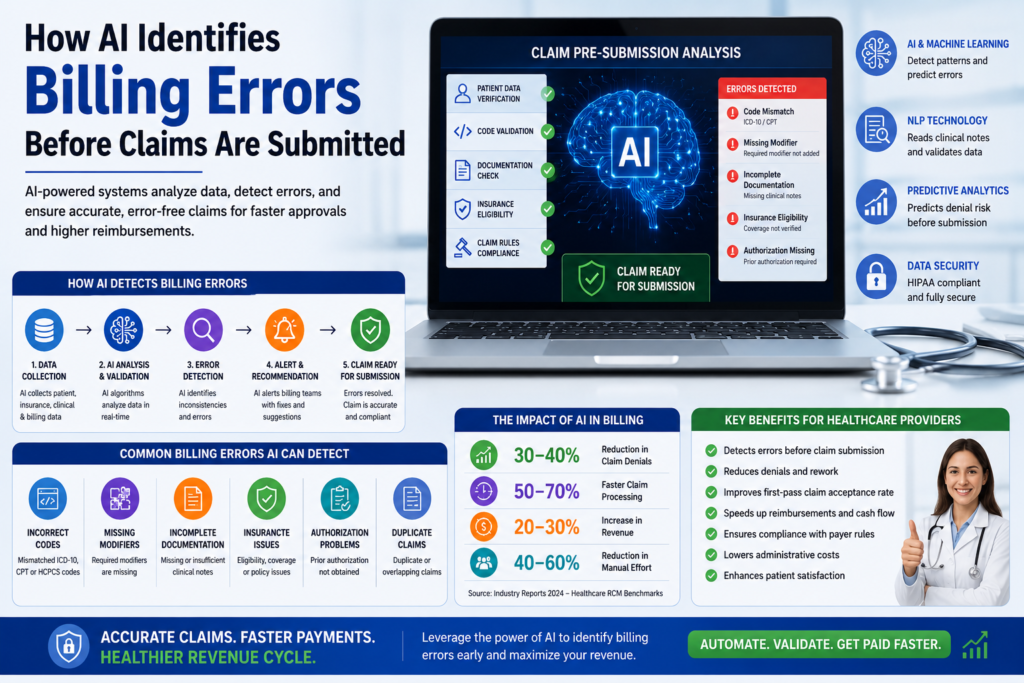
AI-powered medical billing uses advanced technologies such as:
- Machine Learning (ML)
- Natural Language Processing (NLP)
- Predictive Analytics
- Robotic Process Automation (RPA)
- Intelligent Data Validation
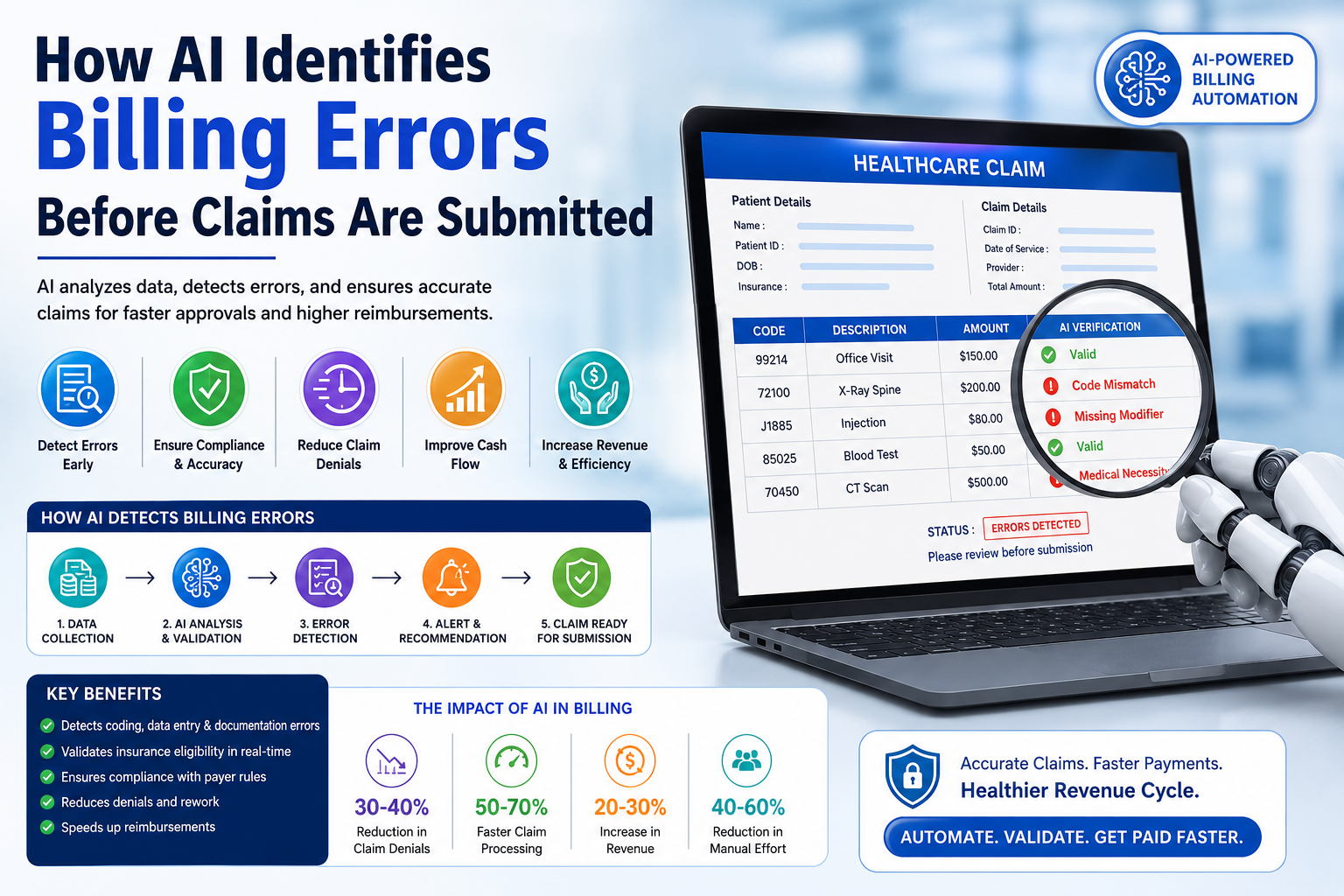
These technologies work together to analyze billing data, patient records, insurance details, and coding patterns before claims are submitted.
As a result, AI systems can automatically identify:
- Incorrect medical codes
- Missing patient information
- Duplicate claims
- Eligibility issues
- Documentation inconsistencies
- Compliance risks
- Prior authorization problems
Most importantly, AI detects these issues in real time, which helps healthcare providers correct errors before claim submission.
Why Traditional Billing Processes Fail
Traditional medical billing workflows depend heavily on manual reviews. However, manual processes are often slow, inconsistent, and prone to human mistakes.
For example:
- Staff may enter incorrect ICD-10 or CPT codes
- Insurance information may be outdated
- Required modifiers may be missing
- Documentation may not support billed procedures
Although experienced billing teams try to minimize errors, manual systems cannot efficiently manage growing healthcare complexities.
Moreover, payer rules constantly change. Therefore, staying updated manually becomes difficult for healthcare organizations.
This is exactly where AI-driven billing automation creates a significant advantage.
How AI Identifies Billing Errors Before Claims Submission
1. AI Detects Incorrect Medical Coding
Medical coding errors are one of the leading causes of claim denials. Fortunately, AI can analyze patient documentation and automatically identify coding inconsistencies.
Using Natural Language Processing (NLP), AI systems review:
- Physician notes
- Clinical documentation
- Treatment details
- Diagnostic records
Then, AI compares this information against billing codes to ensure accuracy.
For example, if a billed procedure does not match the documented diagnosis, AI immediately flags the issue before submission.
As a result:
- Coding accuracy improves
- Denial rates decrease
- Compliance risks reduce
- Revenue cycle efficiency increases
2. AI Validates Patient Eligibility Automatically
Insurance eligibility issues often lead to rejected claims. However, AI-powered systems can automatically verify patient insurance information in real time.
AI checks:
- Coverage status
- Policy validity
- Service eligibility
- Authorization requirements
- Payer-specific rules
Consequently, billing teams can identify coverage problems before claims are submitted.
This proactive approach helps providers:
- Avoid unnecessary denials
- Reduce reimbursement delays
- Improve patient satisfaction
- Streamline front-office operations
3. AI Identifies Missing Documentation
Incomplete documentation is another major reason for claim denials. Therefore, AI systems continuously analyze medical records to ensure required documents are attached properly.
AI can identify:
- Missing physician signatures
- Incomplete treatment records
- Unsupported diagnoses
- Missing authorization forms
- Incomplete patient data
Additionally, AI provides real-time alerts to billing staff, allowing corrections before submission.
As a result, healthcare providers https://www.aiclaim.com/for-providerscan improve claim acceptance rates significantly.
4. AI Detects Duplicate Claims
Duplicate claim submissions can create compliance issues and payment delays. Fortunately, AI algorithms can quickly detect duplicate billing patterns across large datasets.
AI compares:
- Patient identifiers
- Dates of service
- Procedure codes
- Provider information
- Claim histories
If duplicate claims are identified, the system automatically flags them for review.
Therefore, organizations can:
- Avoid compliance violations
- Prevent payment disputes
- Reduce administrative burden
- Maintain cleaner claim submissions
5. AI Predicts Potential Claim Denials
One of the most powerful benefits of AI is predictive analytics.
Instead of simply detecting current errors, AI can predict which claims are likely to be denied before submission.
AI analyzes:
- Historical claim data
- Payer behavior
- Denial patterns
- Coding trends
- Documentation quality
Then, predictive models assign risk scores to claims.
For example:
- High-risk claims receive immediate attention
- Billing teams can fix issues proactively
- Claims are optimized before submission
Consequently, providers can improve first-pass claim acceptance rates dramatically.
The Role of Machine Learning in Billing Accuracy
Machine Learning allows AI systems to continuously improve over time.
Unlike static software, AI learns from:
- Previous denials
- Payment outcomes
- Coding corrections
- Insurance rule changes
- Billing workflows
As more data is processed, the AI becomes smarter and more accurate.
Therefore, healthcare organizations benefit from:
- Continuous optimization
- Faster claim processing
- Reduced manual intervention
- Better financial performance
Moreover, machine learning helps organizations adapt quickly to evolving payer requirements.
Real-Time AI Claim Scrubbing Explained
AI claim scrubbing is one of the most important advancements in healthcare billing automation.
Traditionally, claim scrubbing involved manual verification processes. However, AI-powered claim scrubbing automates this entire workflow.
AI instantly reviews:
- CPT codes
- ICD-10 codes
- HCPCS codes
- Modifiers
- Insurance rules
- Documentation alignment
Additionally, AI systems cross-check payer-specific requirements before submission.
As a result:
- Claims become cleaner
- Errors reduce significantly
- Submission speed improves
- Revenue cycles accelerate
Latest Real-Time Data on AI in Medical Billing
Recent healthcare industry reports show the growing impact of AI in revenue cycle management.
Key Statistics
- Healthcare claim denial rates can exceed 15% in many organizations
- AI-powered billing systems can reduce denial rates by up to 30–40%
- Automated claim scrubbing improves first-pass acceptance rates significantly
- Healthcare organizations using AI report faster reimbursements and lower administrative costs
- AI automation reduces repetitive billing tasks and improves operational efficiency
Furthermore, healthcare providers adopting AI-driven billing systems are gaining competitive advantages through:
- Faster cash flow
- Better compliance
- Reduced staffing pressure
- Improved scalability
How AI Improves Revenue Cycle Management
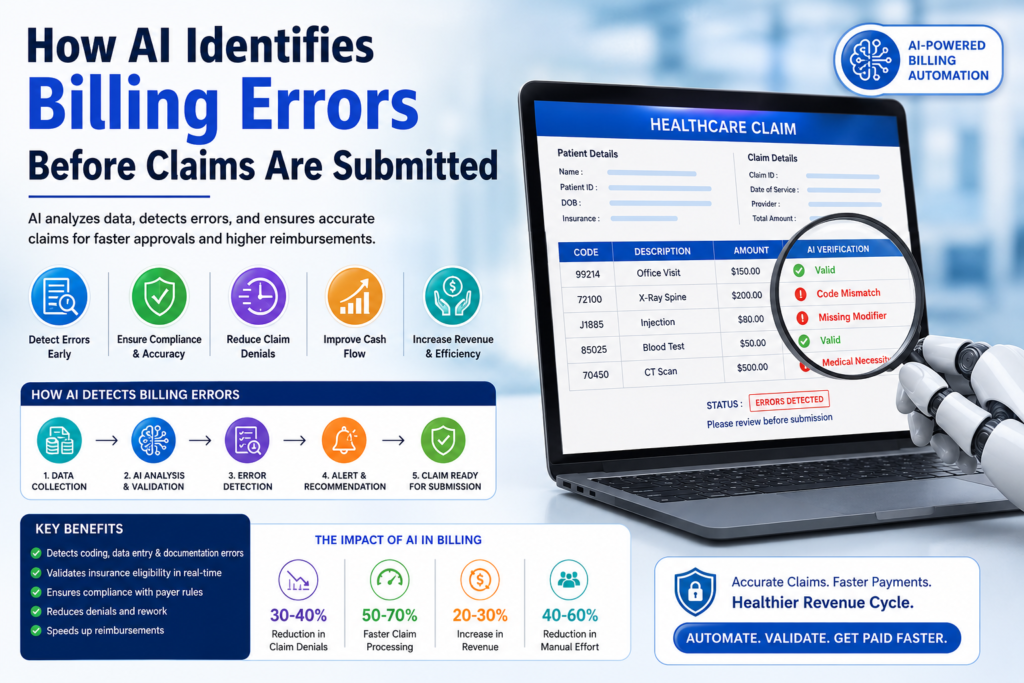
AI does not only identify billing errors. In addition, it transforms the entire healthcare revenue cycle.
AI Improves:
Faster Claim Submission
AI automates repetitive billing tasks, which accelerates workflows.
Better Denial Prevention
Predictive analytics identifies high-risk claims before submission.
Improved Coding Accuracy
AI validates coding consistency using clinical documentation.
Reduced Administrative Costs
Automation minimizes manual review workloads.
Better Financial Visibility
AI analytics provide real-time revenue insights.
Consequently, healthcare organizations can improve profitability while enhancing operational performance.
Common Billing Challenges AI Solves
Healthcare providers face multiple billing challenges daily. Fortunately, AI addresses many of these issues effectively.
AI Solves:
- Incorrect coding
- Missing modifiers
- Duplicate billing
- Eligibility verification errors
- Prior authorization delays
- Compliance issues
- Revenue leakage
- Documentation inconsistencies
- Delayed reimbursements
- Manual processing inefficiencies
As healthcare regulations continue evolving, AI becomes increasingly essential for sustainable revenue cycle management.
Why Small Practices Need AI Billing Solutions
Many small healthcare practices believe AI is only for large hospitals. However, small clinics can benefit significantly from AI automation as well.
Small practices often struggle with:
- Limited billing staff
- Rising denial rates
- Revenue instability
- Administrative overload
Therefore, AI-powered billing solutions help small providers:
- Reduce operational stress
- Improve reimbursement speed
- Minimize coding errors
- Increase financial stability
Additionally, cloud-based AI billing platforms are becoming more affordable and scalable for independent practices.
AI and Compliance in Healthcare Billing
Healthcare compliance is becoming increasingly complex. Consequently, billing mistakes can lead to audits, penalties, and legal risks.
AI helps improve compliance by:
- Monitoring billing patterns
- Identifying suspicious claims
- Validating coding accuracy
- Ensuring documentation consistency
- Tracking regulatory updates
As a result, healthcare organizations can reduce compliance risks while improving operational confidence.
Future of AI in Healthcare Billing
The future of medical billing will be heavily driven by intelligent automation.
Emerging AI technologies will continue improving:
- Real-time billing analysis
- Automated coding
- Predictive denial management
- Intelligent payer communication
- Revenue forecasting
- Autonomous claim processing
Moreover, AI systems will become more personalized and adaptive, helping healthcare organizations optimize revenue cycle performance continuously.
Therefore, organizations that adopt AI early will gain long-term operational and financial advantages.
How Aiclaim Helps Healthcare Providers Reduce Billing Errors
Aiclaim provides AI-powered healthcare claims automation solutions designed to help providers reduce billing errors, improve claim accuracy, and accelerate reimbursements.
Aiclaim solutions support:
- Intelligent claims processing
- AI-based denial prediction
- Automated document analysis
- Revenue cycle optimization
- Predictive analytics
- Real-time reporting
- Healthcare workflow automation
Additionally, healthcare providers can improve operational efficiency while minimizing manual workloads through intelligent AI-driven automation.
Best Practices for Implementing AI Billing Solutions
To maximize AI billing success, healthcare organizations should:
1. Improve Data Quality
Accurate patient and billing data improve AI performance.
2. Train Billing Teams
Staff should understand AI-assisted workflows properly.
3. Monitor AI Performance
Continuous optimization ensures long-term efficiency.
4. Integrate With Existing Systems
AI should work seamlessly with EHR and billing platforms.
5. Focus on Compliance
Organizations must maintain HIPAA and payer compliance standards.
Following these best practices helps healthcare providers achieve stronger financial outcomes.
Final Thoughts
Healthcare billing errors continue creating major financial and operational challenges for providers worldwide. However, AI-powered medical billing solutions are transforming the industry by identifying billing errors before claims are submitted.
Through machine learning, predictive analytics, intelligent automation, and real-time claim validation, AI helps healthcare organizations:
- Reduce claim denials
- Improve billing accuracy
- Accelerate reimbursements
- Strengthen compliance
- Increase revenue cycle efficiency
Furthermore, as healthcare systems become more complex, AI-driven billing automation will become essential for sustainable growth and profitability.
Organizations that invest in AI today will be better prepared to reduce operational risks, improve financial performance, and deliver better patient experiences in the future.
Frequently Asked Questions
How does AI identify billing errors?
AI analyzes patient data, medical codes, insurance details, and clinical documentation to detect inconsistencies before claim submission.
Can AI reduce healthcare claim denials?
Yes. AI-powered predictive analytics can identify high-risk claims and reduce denial rates significantly.
What are the benefits of AI in medical billing?
AI improves coding accuracy, accelerates reimbursements, reduces manual work, and enhances revenue cycle efficiency.
Is AI medical billing suitable for small practices?
Yes. Many affordable cloud-based AI billing solutions help small clinics reduce errors and improve cash flow.
How does AI improve compliance?
AI monitors billing patterns, validates documentation, and helps organizations follow payer and regulatory requirements more accurately.