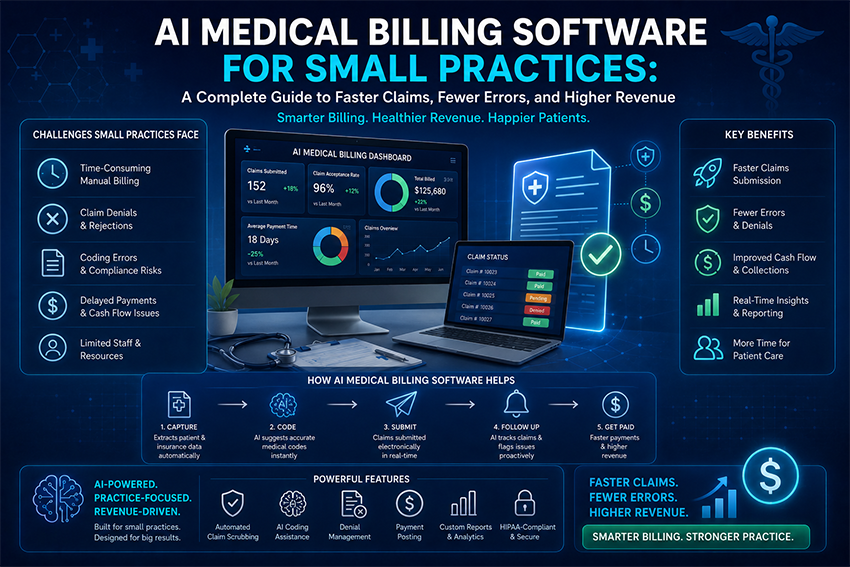
AI Medical Billing Software for Small Practices: A Complete Guide to Faster Claims, Fewer Errors, and Higher Revenue

Healthcare practices today face increasing pressure to manage billing accurately while maintaining excellent patient care. Small medical practices, in particular, often struggle with claim denials, coding errors, delayed reimbursements, staff shortages, and rising administrative costs. As a result, many providers are now turning toward AI medical billing software to simplify operations and improve financial performance.
Artificial intelligence is no longer a futuristic concept in healthcare revenue cycle management. Instead, it has become a practical solution that helps physicians, clinics, and healthcare providers automate repetitive tasks, reduce billing inefficiencies, and accelerate insurance claim approvals. More importantly, AI-driven billing systems enable small practices to compete with larger healthcare organizations without significantly increasing operational expenses.
At Aiclaim, healthcare providers can access advanced AI-powered revenue cycle management solutions designed specifically to improve claims processing, billing accuracy, denial prevention, and reimbursement efficiency.
Why Small Practices Struggle With Medical Billing
Small healthcare practices often operate with limited staff and tighter budgets. While providers focus on patient care, administrative teams usually handle multiple responsibilities simultaneously. Consequently, billing departments become overwhelmed with insurance verification, coding updates, claim submissions, payment tracking, and denial management.
Unfortunately, even a small billing error can create serious revenue disruptions. For example, incorrect CPT coding, missing patient information, eligibility issues, or delayed submissions frequently result in denied claims. Over time, these problems reduce cash flow and increase administrative burdens.
Additionally, healthcare regulations and insurance payer requirements continue evolving rapidly. Therefore, small practices must constantly adapt to changing compliance standards while maintaining operational efficiency.
Traditional medical billing systems often rely heavily on manual work. Although manual processes may work temporarily, they typically lead to:
- Increased claim rejection rates
- Slower reimbursement cycles
- Higher operational costs
- Human coding errors
- Delayed patient billing
- Staff burnout
- Poor revenue visibility
Because of these challenges, many healthcare providers are adopting AI-powered medical billing software to automate and optimize the entire revenue cycle process.
What Is AI Medical Billing Software?
AI medical billing software uses artificial intelligence, machine learning, predictive analytics, and automation technologies to improve healthcare billing operations. Unlike traditional billing systems, AI-driven platforms continuously learn from historical billing patterns, payer responses, and claim outcomes.
As a result, these intelligent systems can automatically identify billing errors, predict claim denials, optimize coding accuracy, and accelerate reimbursement processes.
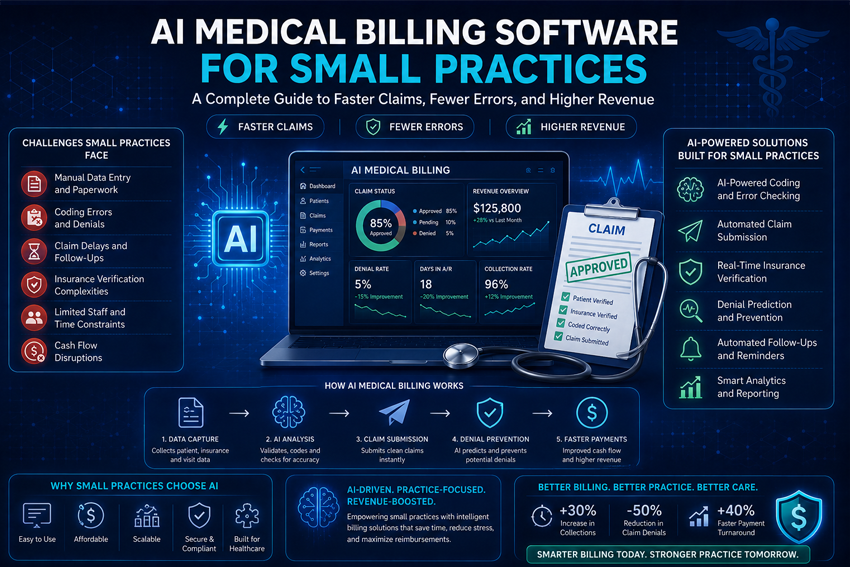
Modern AI billing platforms typically support:
- Automated claims processing
- Intelligent medical coding
- Denial prediction and prevention
- Eligibility verification automation
- Payment posting automation
- Revenue cycle analytics
- Fraud detection
- Prior authorization support
- Real-time reporting dashboards
More importantly, AI systems help healthcare providers make faster and smarter financial decisions based on real-time insights.
How AI Medical Billing Software Improves Revenue Cycle Management
Faster Claims Processing
One of the biggest advantages of AI-powered billing systems is automation. Traditionally, billing staff manually entered patient data, verified insurance eligibility, reviewed coding information, and submitted claims. However, AI software can now automate many of these repetitive tasks.
For instance, AI algorithms can instantly analyze patient records, validate insurance information, and identify incomplete claim details before submission. Consequently, practices experience fewer delays and significantly faster claim approvals.
Moreover, automated workflows reduce processing time, allowing staff members to focus on patient communication and complex billing issues instead of repetitive administrative work.
Healthcare practices using AI-driven claims automation often experience improved first-pass claim acceptance rates and shorter reimbursement cycles.
Reduction in Medical Billing Errors
Billing mistakes remain one of the leading causes of claim denials. Even experienced billing teams occasionally submit incorrect coding, duplicate claims, or incomplete documentation. Unfortunately, these errors directly affect practice revenue.
AI medical billing software helps solve this problem by continuously monitoring billing patterns and identifying inconsistencies in real time.
For example, intelligent coding systems can:
- Detect missing modifiers
- Identify incorrect CPT or ICD-10 codes
- Flag duplicate submissions
- Verify documentation accuracy
- Ensure payer-specific compliance
Because the software analyzes massive datasets instantly, it significantly reduces human error while improving coding precision.
Furthermore, AI-driven systems continuously learn from previous claims and payer feedback. Therefore, the platform becomes smarter over time and improves billing performance automatically.
Improved Denial Management
Claim denials are one of the biggest financial challenges for small healthcare practices. In many cases, providers lose revenue simply because denied claims are not corrected and resubmitted quickly.
AI-powered denial management systems can proactively identify claims that are likely to be denied before submission. This predictive capability helps practices address potential issues early.
For instance, AI systems analyze:
- Historical denial trends
- Insurance payer patterns
- Coding inconsistencies
- Authorization requirements
- Documentation gaps
As a result, providers can prevent denials instead of reacting to them later.
Additionally, AI software prioritizes denied claims based on recovery potential, helping billing teams focus on high-value accounts first.
At Aiclaim Medical Billing Solutions, healthcare organizations can leverage AI-powered denial management strategies to reduce revenue leakage and improve collections.
The Role of AI in Medical Coding Accuracy
Medical coding directly affects reimbursement accuracy. However, coding errors continue increasing due to frequent regulatory changes and complex payer guidelines.
AI-powered coding systems simplify this process by automatically analyzing clinical documentation and suggesting accurate CPT, ICD-10, and HCPCS codes.
Unlike manual coding systems, AI-driven platforms process large volumes of patient records quickly while maintaining high accuracy levels.
Moreover, natural language processing technology allows AI systems to understand physician notes and extract relevant coding information automatically.
Consequently, small practices benefit from:
- Faster coding workflows
- Improved coding accuracy
- Reduced compliance risks
- Lower denial rates
- Increased reimbursement efficiency
This automation becomes especially valuable for practices managing high patient volumes with limited administrative staff.
AI-Powered Eligibility Verification for Small Practices
Insurance eligibility verification is another time-consuming process for healthcare providers. If patient coverage information is incorrect, claims often get denied immediately.
AI medical billing software automates eligibility verification by checking patient insurance information in real time before appointments or claim submissions.
As a result, practices can:
- Prevent eligibility-related denials
- Reduce front-desk workload
- Improve patient billing transparency
- Accelerate reimbursement timelines
Additionally, automated verification systems improve patient satisfaction because providers can discuss coverage details and financial responsibilities upfront.
This proactive approach reduces confusion, payment delays, and billing disputes later in the revenue cycle.
How AI Helps Small Practices Reduce Operational Costs
Hiring large billing teams can be expensive for small healthcare practices. Besides salaries, providers must also manage training costs, software upgrades, compliance requirements, and staffing challenges.
AI-driven billing platforms reduce operational costs by automating repetitive administrative tasks.
For example, AI software can automate:
- Claims submissions
- Payment posting
- Insurance verification
- Coding validation
- Reporting generation
- Follow-up reminders
Consequently, practices can operate more efficiently without significantly expanding administrative teams.
Furthermore, automation reduces staff burnout and improves overall workplace productivity.
Instead of spending hours correcting rejected claims, billing teams can focus on strategic financial management and patient engagement.
AI Medical Billing Software Enhances Patient Experience
Modern healthcare patients expect transparency, convenience, and faster service. Unfortunately, billing delays and claim confusion often create frustration for patients.
AI-powered billing systems improve patient experiences by streamlining financial communication and reducing administrative delays.
For instance, intelligent platforms can:
- Generate accurate patient statements
- Provide automated payment reminders
- Offer transparent billing breakdowns
- Reduce claim processing delays
- Improve payment tracking
As a result, patients experience fewer billing surprises and faster issue resolution.
Additionally, practices benefit from improved patient trust and stronger long-term relationships.
Real-Time Analytics and Financial Insights
Traditional billing systems often provide limited visibility into revenue cycle performance. However, AI medical billing software delivers real-time analytics that help practices make data-driven decisions.
These insights may include:
- Claim approval rates
- Denial trends
- Revenue performance
- Collection timelines
- Payer behavior analysis
- Coding accuracy metrics
Because providers can access live financial dashboards, they can quickly identify inefficiencies and optimize operations proactively.
Moreover, predictive analytics helps practices forecast future revenue patterns and prepare for financial challenges before they escalate.
At Aiclaim Healthcare AI Solutions, providers can explore advanced AI-driven revenue optimization strategies tailored for modern healthcare practices.
Why AI Medical Billing Software Matters in 2026
Healthcare revenue cycle management is evolving rapidly. Insurance regulations, payer requirements, and administrative complexities continue increasing every year.
At the same time, staffing shortages and rising operational expenses create additional pressure on small practices.
Because of these industry changes, AI-powered billing automation is becoming essential rather than optional.
In 2026 and beyond, healthcare providers that continue relying entirely on manual billing systems may struggle with:
- Slower reimbursement cycles
- Higher denial rates
- Increased staffing costs
- Reduced operational efficiency
- Competitive disadvantages
Conversely, practices adopting AI-driven solutions gain faster workflows, better financial visibility, and stronger revenue performance.
Therefore, investing in intelligent billing technology is no longer just a technology upgrade. Instead, it has become a strategic business decision for long-term growth.
Choosing the Right AI Medical Billing Software
Not all AI billing platforms offer the same capabilities. Therefore, small healthcare practices should carefully evaluate software features before implementation.
The ideal AI medical billing solution should provide:
Intelligent Automation
The platform should automate repetitive administrative tasks while minimizing manual intervention.
Denial Prevention Tools
Predictive denial analytics and claim scrubbing capabilities are essential for maximizing reimbursements.
Real-Time Reporting
Practices need access to actionable revenue insights and performance dashboards.
Compliance Support
HIPAA compliance and payer regulation updates must be integrated into the system.
Scalability
The software should support practice growth without requiring major operational changes.
Integration Capabilities
AI billing systems should integrate smoothly with EHR, EMR, and practice management platforms.
Healthcare providers should also prioritize vendors offering ongoing support, customization, and AI optimization services.
The Future of AI in Medical Billing
Artificial intelligence will continue transforming healthcare administration over the next decade. Future AI billing systems are expected to become even more autonomous, predictive, and intelligent.
Emerging innovations may include:
- Fully automated claims processing
- Voice-enabled clinical documentation
- AI-powered patient engagement
- Predictive financial forecasting
- Advanced fraud detection systems
- Autonomous revenue cycle management
As machine learning technologies evolve, billing platforms will continuously improve operational efficiency and financial accuracy.
Consequently, small healthcare practices will gain access to enterprise-level billing capabilities without requiring massive infrastructure investments.
Why Healthcare Providers Trust Aiclaim
Healthcare providers need more than just software. They need intelligent solutions that improve financial performance while reducing administrative complexity.
Aiclaim AI Revenue Cycle Solutions helps healthcare organizations streamline claims management, optimize billing operations, reduce denials, and improve reimbursement efficiency using advanced AI-driven technologies.
With a strong focus on automation, compliance, and operational performance, Aiclaim supports healthcare providers in building smarter and more scalable revenue cycle systems.
Whether your practice struggles with coding errors, denied claims, delayed reimbursements, or administrative inefficiencies, AI-powered medical billing solutions can help create sustainable financial growth.
Conclusion
AI medical billing software is transforming how small healthcare practices manage revenue cycle operations. By automating repetitive tasks, improving coding accuracy, reducing claim denials, and accelerating reimbursements, artificial intelligence enables providers to focus more on patient care and less on administrative burdens.
Moreover, AI-driven billing platforms help small practices compete more effectively in an increasingly complex healthcare environment.
As healthcare continues evolving, providers that embrace intelligent automation will be better positioned for long-term financial success.
For healthcare organizations looking to modernize their billing systems and improve operational efficiency, AI-powered revenue cycle management solutions from Aiclaim offer a smarter path toward faster claims processing, higher collections, and sustainable growth.
Small practices can reduce billing errors by using AI medical billing software that automatically checks coding accuracy, missing details, and claim compliance before submission.
Using AI-powered claim automation helps practices submit cleaner claims faster, reducing manual mistakes and improving first-pass claim acceptance rates.
AI denial prediction tools analyze patient data, payer rules, and coding patterns to identify high-risk claims before they are submitted.
AI medical billing software accelerates reimbursements, automates payment tracking, and reduces delays caused by rejected or incomplete claims.
AI automation reduces manual tasks such as data entry, eligibility verification, coding review, and claim follow-ups, allowing staff to focus on patient care.