How Predictive Analytics Helps Prevent Healthcare Claim Denials and Increase Revenue Cycle Efficiency

Healthcare organizations lose billions of dollars every year because of claim denials. Although providers continuously improve billing workflows, denial rates still continue to rise due to coding inaccuracies, eligibility issues, missing documentation, payer policy changes, and administrative inefficiencies. Consequently, healthcare revenue cycle management (RCM) teams are now turning toward predictive analytics to proactively prevent denials before claims are even submitted.
As healthcare systems become increasingly data-driven, predictive analytics is rapidly transforming how providers manage claims processing, denial prevention, reimbursement optimization, and operational efficiency. More importantly, AI-powered predictive analytics solutions are helping hospitals, clinics, and medical billing companies identify high-risk claims in real time, reduce revenue leakage, and improve first-pass claim acceptance rates.
Because of these advantages, predictive analytics in healthcare claims management is no longer considered optional. Instead, it is becoming a critical technology for organizations seeking financial stability, operational scalability, and faster reimbursements.
What Is Predictive Analytics in Healthcare Claims Management?
Predictive analytics in healthcare claims management refers to the use of artificial intelligence (AI), machine learning (ML), historical claims data, and statistical algorithms to forecast the likelihood of claim denials before claims are submitted to insurance payers.
Unlike traditional claims processing systems that react after a denial occurs, predictive analytics proactively identifies potential denial risks in advance. Therefore, healthcare providers can correct issues early and prevent costly reimbursement delays.
How Predictive Analytics Works in Healthcare RCM
Predictive analytics platforms analyze massive healthcare datasets, including:
- Historical claims data
- Insurance payer patterns
- CPT and ICD coding history
- Patient eligibility records
- Documentation quality
- Authorization requirements
- Revenue cycle workflows
- Provider billing behaviors
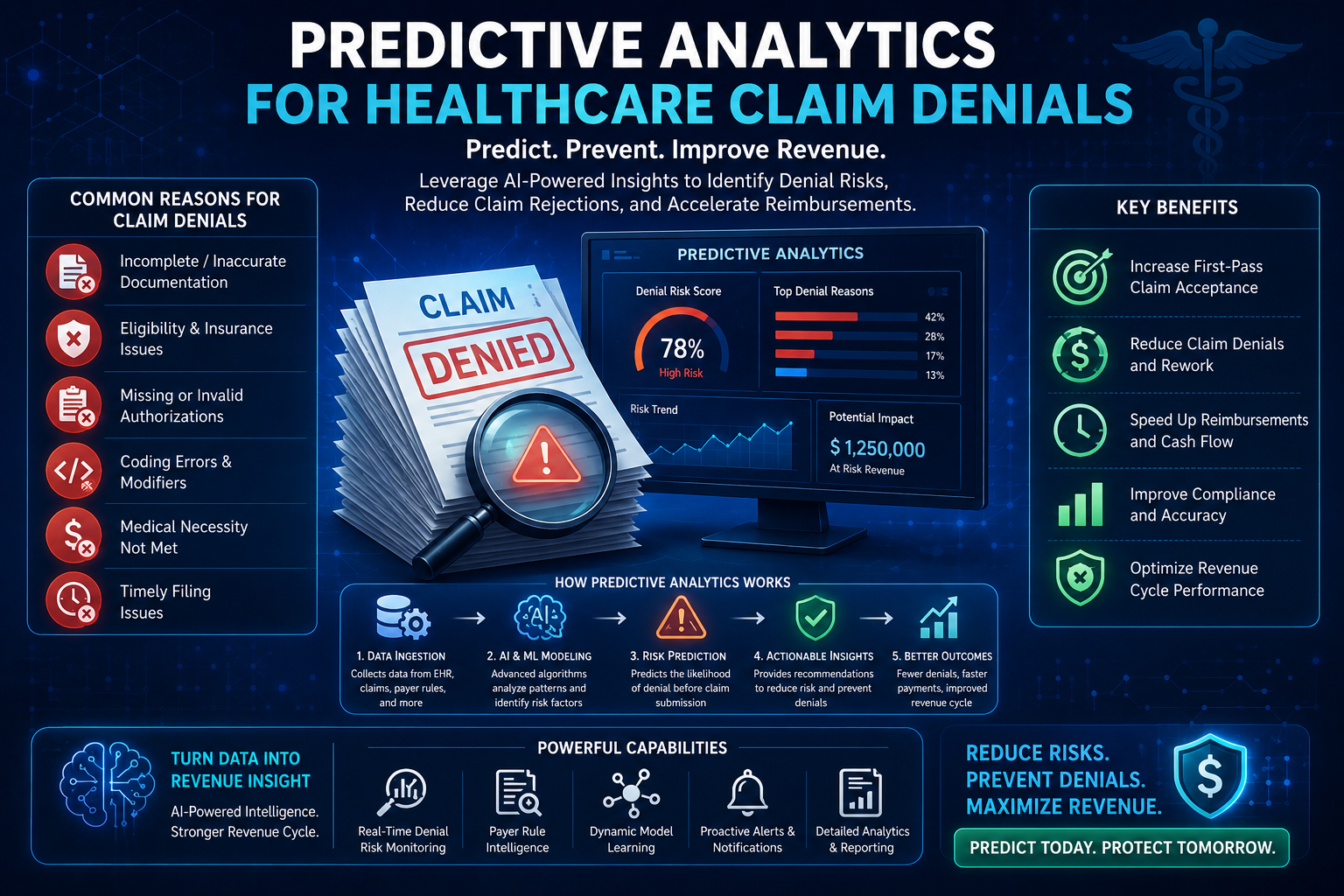
After analyzing these datasets, AI algorithms identify patterns associated with denied claims. Subsequently, the system generates real-time risk scores and alerts for claims likely to be rejected.
As a result, billing teams can take immediate corrective action before submission.
Why Healthcare Claim Denials Continue to Increase
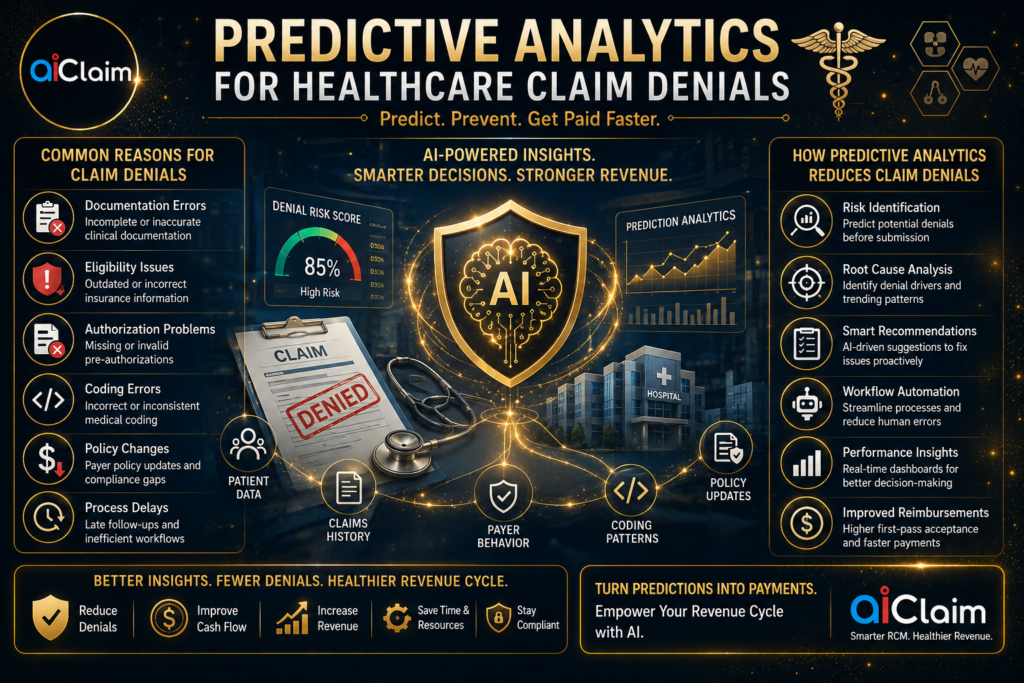
Although healthcare organizations continue to invest heavily in advanced revenue cycle management technologies, denial rates are still steadily increasing across the healthcare industry. Moreover, as insurance payer requirements become increasingly complex and continuously evolve, healthcare providers are finding it more difficult to maintain clean claim submissions. In addition, growing administrative burdens, frequent policy updates, coding inaccuracies, and documentation challenges are further contributing to higher denial volumes. As a result, several industry studies now indicate that healthcare claim denial rates have risen significantly over the past few years, thereby creating substantial financial pressure on hospitals, clinics, and medical billing organizations. Consequently, healthcare providers are actively seeking AI-powered predictive analytics solutions to proactively reduce denials, improve reimbursement accuracy, and optimize overall revenue cycle efficiency.
Common Causes of Healthcare Claim Denials
1. Incorrect Medical Coding
Coding errors continue to remain one of the most significant causes of healthcare claim denials across the revenue cycle management process. Even small inaccuracies or minor discrepancies in ICD-10, CPT, or HCPCS codes can quickly trigger insurance payer rejections, delayed reimbursements, and additional administrative rework. Furthermore, as coding regulations and payer requirements continuously evolve, maintaining coding accuracy becomes increasingly challenging for healthcare providers and billing teams. In addition, inconsistent coding practices across multiple departments, lack of standardized documentation, and insufficient coding audits further increase the overall risk of claim denials. Consequently, healthcare organizations often experience revenue leakage, increased operational costs, and slower cash flow due to preventable coding-related errors.
2. Missing or Incomplete Documentation
Insurance companies require highly detailed and accurate clinical documentation to properly validate medical necessity and approve healthcare claims. However, when patient records contain incomplete information, missing documentation, inaccurate clinical notes, or insufficient treatment details, claims are far more likely to face immediate denials or payment delays. Moreover, as payer compliance requirements continue to become increasingly stringent, healthcare providers must ensure that every claim submission is supported by comprehensive and well-structured documentation. Otherwise, even minor documentation gaps can trigger claim rejections, repeated audits, and reimbursement complications. Consequently, healthcare organizations often experience delayed reimbursements, rising administrative workloads, increased operational costs, and significant revenue cycle inefficiencies due to documentation-related denials.
3. Eligibility Verification Errors
Patient insurance eligibility frequently changes due to policy updates, coverage modifications, employment transitions, expiration dates, or payer-related adjustments. Therefore, if healthcare providers rely on outdated or inaccurate eligibility information during the claims submission process, the likelihood of claim rejections and reimbursement delays increases significantly. Furthermore, even small discrepancies in patient coverage details, policy status, or insurance verification records can trigger immediate denials from insurance payers. As a result, healthcare organizations often face additional administrative burdens, increased claim rework, delayed cash flow, and unnecessary revenue cycle disruptions. Consequently, real-time eligibility verification has become increasingly essential for reducing claim denials, improving billing accuracy, and accelerating reimbursement processes.
4. Prior Authorization Failures
Many healthcare procedures, treatments, diagnostic services, and specialty medications require prior authorizations before claims can be approved by insurance payers. However, as payer guidelines and authorization requirements continue to evolve frequently, healthcare providers often struggle to keep up with changing policies and compliance standards. Consequently, missing approvals, incomplete authorization documentation, delayed submissions, or incorrect authorization details can quickly lead to claim denials and reimbursement delays. Furthermore, authorization-related denials continue to increase because manual verification processes are often time-consuming, inconsistent, and highly prone to administrative errors. As a result, healthcare organizations experience increased operational inefficiencies, additional claim rework, delayed cash flow, and rising administrative costs across the revenue cycle management process.
5. Payer Policy Changes
Insurance companies frequently update reimbursement policies, billing guidelines, coding requirements, and compliance regulations to align with changing healthcare standards and payer strategies. As a result, healthcare billing teams often struggle to remain fully compliant with continuously evolving payer rules and documentation requirements. Furthermore, frequent policy modifications increase the complexity of claims processing workflows, thereby making it more difficult for providers to maintain clean and accurate claim submissions. In addition, manual monitoring of payer updates can be time-consuming, inefficient, and highly prone to human error. Consequently, even small compliance gaps or overlooked policy changes can trigger claim denials, delayed reimbursements, increased administrative burdens, and significant revenue leakage. Because of these growing challenges, healthcare organizations increasingly require intelligent AI-powered systems capable of continuously monitoring denial risks, tracking payer policy updates in real time, and proactively identifying potential claim issues before submission.
How Predictive Analytics Prevents Healthcare Claim Denials
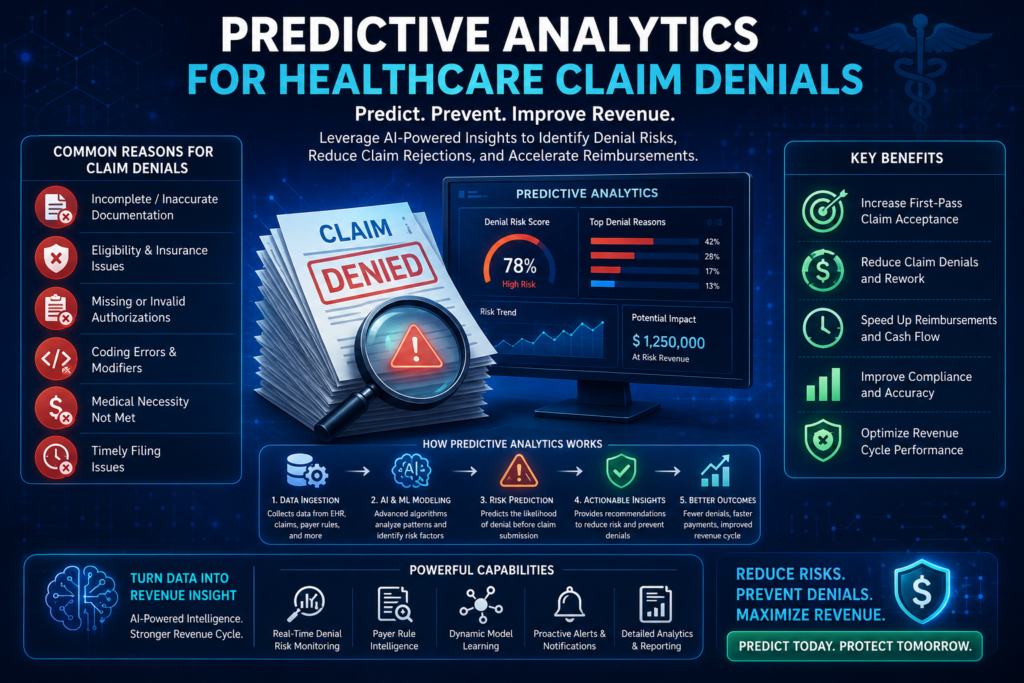
Predictive analytics significantly improves denial prevention by identifying risk factors before claim submission. Furthermore, AI-powered systems continuously learn from new data, which enhances accuracy over time.
Real-Time Denial Prediction
One of the biggest advantages of predictive analytics is real-time denial prediction.
AI algorithms analyze claims instantly and determine:
- Probability of denial
- Root causes of potential rejection
- Recommended corrective actions
- Payer-specific risk patterns
Therefore, revenue cycle teams can resolve issues before claims reach insurance payers.
Automated Error Detection
Predictive analytics systems automatically identify:
- Coding inconsistencies
- Missing patient information
- Documentation gaps
- Eligibility problems
- Duplicate claims
- Invalid modifiers
As a result, healthcare providers reduce manual review workloads while simultaneously improving claims accuracy.
AI-Based Risk Scoring Models
Modern denial prevention systems assign risk scores to claims using machine learning algorithms.
These AI models evaluate:
- Historical denial patterns
- Claim complexity
- Payer behavior
- Provider performance
- Clinical documentation quality
Consequently, high-risk claims receive priority review before submission.
AI and Machine Learning Algorithms Behind Predictive Analytics
Predictive analytics platforms rely heavily on advanced artificial intelligence (AI) and machine learning technologies to significantly improve healthcare claim denial prediction accuracy and revenue cycle performance. By continuously analyzing massive volumes of historical claims data, payer behaviors, coding trends, patient records, and reimbursement patterns, these intelligent systems can proactively identify potential denial risks before claims are submitted. Furthermore, AI-driven predictive analytics models continuously learn and adapt from new data inputs, thereby enabling healthcare organizations to improve forecasting precision over time. As a result, providers can reduce claim denials, enhance billing accuracy, accelerate reimbursements, and optimize overall revenue cycle management efficiency. Moreover, advanced machine learning algorithms help healthcare organizations automate risk analysis, detect hidden billing patterns, and streamline denial prevention strategies more effectively than traditional manual processes.
Supervised Machine Learning Models
Supervised learning algorithms train on historical claims data to identify patterns linked to denied claims.
These models include:
- Decision Trees
- Random Forest Algorithms
- Logistic Regression
- Gradient Boosting Machines
- Neural Networks
Because these algorithms continuously learn from new claims data, prediction accuracy improves significantly over time.
Natural Language Processing (NLP)
Natural Language Processing helps AI systems analyze unstructured medical documentation.
NLP can:
- Interpret physician notes
- Detect missing documentation
- Identify medical necessity issues
- Validate coding consistency
Therefore, healthcare providers reduce documentation-related denials.
Predictive Risk Modeling
Predictive risk models forecast denial probabilities using historical payer behaviors and patient demographics.
As a result:
- High-risk claims are flagged instantly
- Billing teams receive automated alerts
- Reimbursement delays decrease substantially
Benefits of Predictive Analytics in Healthcare Claims Processing
Predictive analytics provides substantial financial and operational benefits for healthcare organizations.
1. Reduced Claim Denials
AI-powered predictive systems identify denial risks early, which significantly lowers denial rates.
Consequently:
- Revenue leakage decreases
- Cash flow improves
- Administrative burden reduces
2. Higher First-Pass Claim Acceptance Rates
First-pass acceptance rates improve because claims are validated before submission.
As a result:
- Fewer rework cycles occur
- Faster reimbursements are achieved
- Billing productivity increases
3. Faster Revenue Cycle Performance
Predictive analytics accelerates claims processing workflows by automating validation tasks.
Therefore:
- Claims move faster through the reimbursement cycle
- Days in Accounts Receivable (AR) decrease
- Financial performance improves
4. Lower Administrative Costs
Manual denial management consumes significant operational resources.
However, predictive analytics automates:
- Claim reviews
- Risk identification
- Documentation validation
- Workflow optimization
Because of automation, organizations reduce staffing costs and operational inefficiencies.
5. Improved Compliance and Accuracy
Healthcare regulations continuously evolve. Therefore, compliance errors can easily trigger denials.
Predictive analytics platforms continuously monitor:
- Coding updates
- Payer policy changes
- Regulatory requirements
Consequently, healthcare providers maintain higher compliance accuracy.
Real-Time Healthcare Industry Data and Denial Trends
Healthcare denial management is becoming one of the largest financial challenges in revenue cycle management.
Recent industry reports indicate:
- Nearly 15% of healthcare claims are initially denied
- More than 60% of denied claims are recoverable
- Denial rework costs providers billions annually
- Administrative costs continue rising due to manual claim corrections
- AI-powered denial prevention can reduce denial rates by up to 40%
Additionally, organizations implementing predictive analytics solutions report:
- Faster reimbursement cycles
- Improved operational efficiency
- Higher clean claim rates
- Increased revenue capture
Because healthcare margins continue shrinking, predictive analytics is becoming essential for sustainable financial growth.
Predictive Analytics Use Cases in Healthcare RCM
Automated Eligibility Verification
AI systems verify patient eligibility in real time before appointments and claim submission.
As a result:
- Eligibility-related denials decrease
- Registration errors reduce
- Patient billing accuracy improves
Coding Accuracy Optimization
Predictive analytics platforms analyze coding patterns and identify potential inaccuracies before submission.
Therefore:
- Coding-related denials decline
- Audit risks decrease
- Compliance improves
Prior Authorization Management
AI automation tracks authorization requirements and alerts staff about missing approvals.
Consequently:
- Authorization-related denials reduce significantly
- Workflow delays decrease
Fraud Detection and Risk Analysis
Predictive analytics can identify abnormal billing patterns associated with fraudulent activity.
As a result:
- Compliance risks lower
- Financial losses reduce
- Payer audits decrease
Challenges of Implementing Predictive Analytics in Healthcare
Although predictive analytics offers substantial benefits, implementation still presents several challenges.
Data Quality Issues
AI models require high-quality structured data. However, inconsistent healthcare records can reduce prediction accuracy.
Therefore, organizations must improve data governance practices.
Integration With Legacy Systems
Many healthcare organizations still rely on outdated legacy billing systems that lack modern API compatibility, real-time data exchange capabilities, and seamless interoperability with advanced AI-powered technologies. As a result, integrating predictive analytics platforms, automated claims management solutions, and intelligent revenue cycle management systems often becomes significantly more complex and time-consuming. Furthermore, legacy infrastructures frequently create data silos, workflow inefficiencies, and limited system scalability, which can further complicate implementation processes. Consequently, healthcare organizations may experience longer deployment timelines, increased integration costs, operational disruptions, and delayed return on investment when attempting to modernize their claims processing and denial management workflows.
Staff Training Requirements
Revenue cycle management teams must clearly understand how predictive analytics systems operate in order to effectively utilize AI-driven insights, denial prediction models, and automated workflow recommendations. Furthermore, as healthcare organizations increasingly adopt advanced AI technologies for claims processing and denial prevention, employees must continuously adapt to evolving digital workflows and intelligent automation tools. Therefore, ongoing employee training, technical education, and workflow optimization programs are essential for ensuring successful system adoption and long-term operational efficiency. In addition, proper training helps billing teams improve decision-making accuracy, maximize predictive analytics performance, reduce operational errors, and enhance overall revenue cycle management outcomes. Consequently, healthcare organizations that prioritize continuous workforce training are more likely to achieve higher claim acceptance rates, faster reimbursements, and stronger financial performance.
Regulatory and Data Privacy Concerns
Healthcare organizations must comply with:
- HIPAA regulations
- Data privacy standards
- Security requirements
As a result, predictive analytics platforms require strong cybersecurity frameworks.
Future of Predictive Analytics in Healthcare Claims Management
The future of predictive analytics in healthcare looks increasingly advanced as AI technologies continue evolving.
Hyper-Automation in Revenue Cycle Management
AI-driven hyper-automation will streamline:
- Claims submission
- Eligibility verification
- Denial prevention
- Payment reconciliation
Therefore, healthcare organizations will achieve greater operational efficiency.
Real-Time AI Decision Intelligence
Future AI systems will provide:
- Instant reimbursement predictions
- Dynamic payer policy updates
- Automated workflow recommendations
Consequently, denial prevention strategies will become more proactive.
Generative AI in Healthcare Claims Processing
Generative AI technologies are beginning to enhance:
- Documentation generation
- Coding recommendations
- Clinical summarization
- Workflow automation
Because of these innovations, healthcare RCM operations will become increasingly intelligent and scalable.
Best Practices for Healthcare Organizations Using Predictive Analytics
Invest in AI-Driven RCM Platforms
Organizations should adopt scalable AI-powered revenue cycle management systems capable of continuous learning and automation.
Build Strong Data Governance Strategies
Accurate predictive analytics depends heavily on clean and structured healthcare data.
Therefore:
- Standardize documentation
- Improve coding accuracy
- Maintain consistent records
Continuously Monitor Denial Trends
Healthcare organizations should regularly analyze:
- Payer denial patterns
- Workflow inefficiencies
- Coding trends
- Reimbursement performance
As a result, predictive models remain highly accurate.
Strengthen Collaboration Between Clinical and Billing Teams
Effective communication and collaboration between healthcare providers, clinical teams, and billing staff play a critical role in improving documentation quality, coding accuracy, and overall claims management efficiency. Furthermore, when physicians, coders, and revenue cycle teams work together closely, they can identify documentation gaps, resolve coding discrepancies, and ensure that claims are submitted with complete and accurate information. As a result, healthcare organizations can significantly improve claim accuracy, strengthen compliance with payer requirements, and streamline reimbursement workflows. Consequently, denial risks decrease substantially, administrative rework is minimized, reimbursement cycles become faster, and overall revenue cycle performance improves more efficiently.
How Aiclaim Helps Healthcare Organizations Prevent Claim Denials
Aiclaim provides AI-powered healthcare claims automation solutions designed to help organizations reduce claim denials, improve reimbursement rates, and optimize revenue cycle performance.
Aiclaim solutions include:
- Intelligent claims processing
- AI-driven denial prediction
- Automated eligibility verification
- Predictive analytics dashboards
- Medical coding optimization
- Real-time workflow monitoring
- Fraud detection systems
- Revenue leakage prevention
Because of advanced AI algorithms and predictive analytics capabilities, healthcare providers can proactively identify risks, accelerate reimbursements, and improve financial performance.
Healthcare organizations can also explore:
Conclusion
Predictive analytics is rapidly transforming healthcare claims management by enabling organizations to prevent denials before they occur. Unlike traditional reactive denial management approaches, AI-powered predictive analytics provides proactive insights that improve operational efficiency, reimbursement speed, compliance accuracy, and financial performance.
As healthcare billing complexity continues increasing, organizations that adopt predictive analytics solutions will gain a significant competitive advantage. Furthermore, AI-driven denial prevention systems help providers reduce administrative burdens, improve clean claim rates, and strengthen revenue cycle performance.
Because healthcare organizations face growing financial pressure, predictive analytics is becoming an essential strategy for achieving sustainable revenue growth and operational excellence.
Ultimately, the future of healthcare claims processing will depend heavily on intelligent AI systems capable of predicting, preventing, and optimizing every stage of the revenue cycle.