
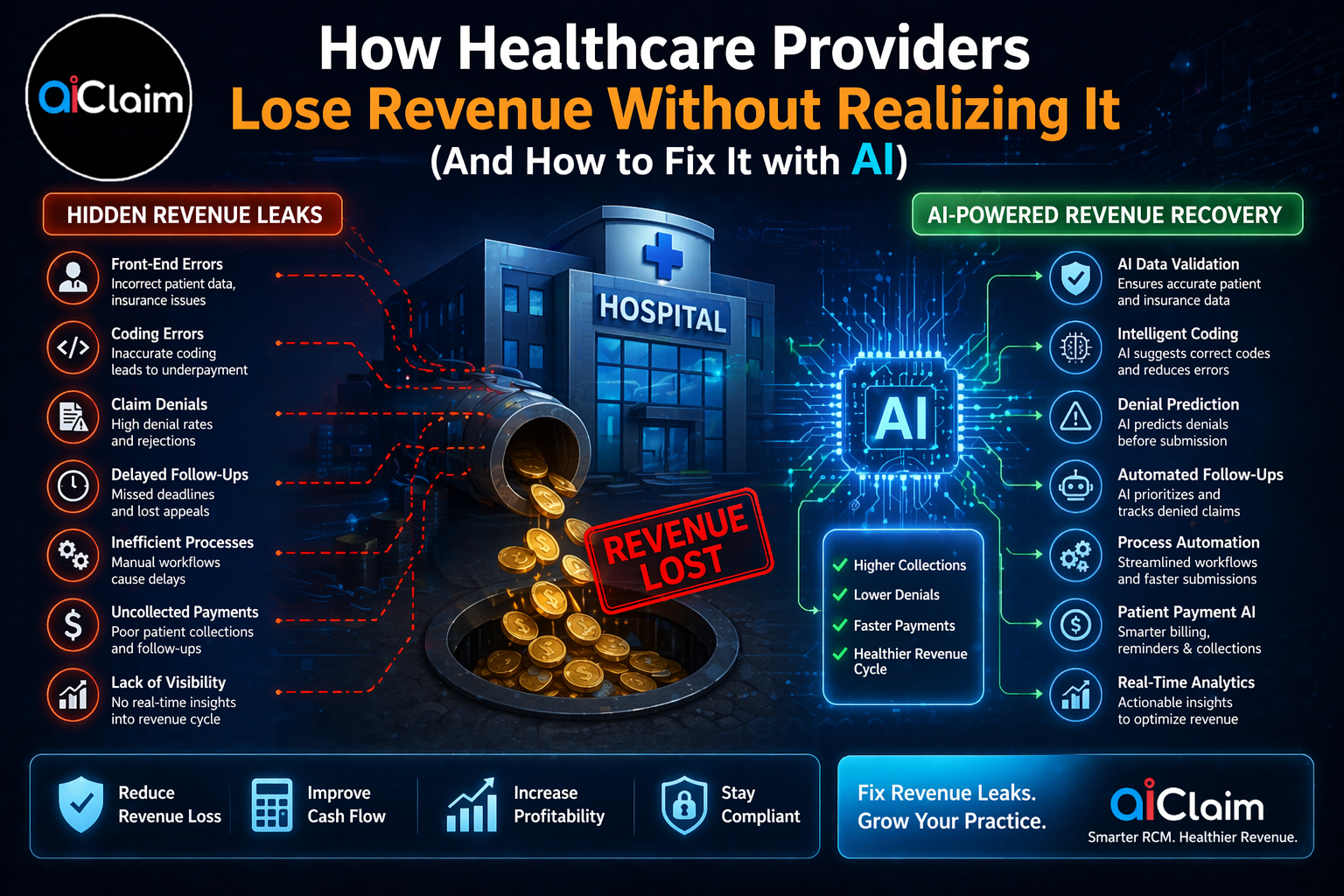
How Healthcare Providers Lose Revenue Without Realizing It (And How to Fix It with AI)

Healthcare providers today operate in an increasingly complex financial environment, where even small inefficiencies can quietly turn into significant revenue losses over time. While many organizations focus on increasing patient volume or expanding services, they often overlook a more critical issue—revenue leakage happening within their existing operations.
In reality, healthcare organizations are not just losing money due to external challenges like insurance policies or regulatory changes. Instead, a substantial portion of revenue loss originates from internal inefficiencies, unnoticed errors, and outdated processes that continue to operate unchecked. As a result, providers unknowingly leave a significant amount of earned revenue uncollected.
Therefore, understanding where and how this revenue loss occurs is not just important—it is essential for long-term financial sustainability. At the same time, adopting intelligent solutions such as AI-driven platforms like Aiclaim can help identify, prevent, and recover these hidden losses effectively.
Understanding Revenue Leakage in Healthcare
To begin with, revenue leakage in healthcare refers to the loss of legitimate income due to inefficiencies across the entire revenue cycle. This includes everything from patient registration and insurance verification to coding, billing, and final payment collection. Although each step may seem minor in isolation, collectively they contribute to a significant financial gap.
Moreover, what makes revenue leakage particularly dangerous is its invisibility. Unlike obvious financial losses, these leaks occur gradually and often go unnoticed until a detailed audit is conducted. Consequently, healthcare providers may believe their systems are functioning efficiently, while in reality, they are losing a measurable percentage of revenue every single day.
In addition, traditional systems and manual workflows lack the capability to detect patterns or predict potential issues. Therefore, without advanced analytics or automation, these problems continue to persist, leading to cumulative losses that directly impact profitability.
Front-End Errors: Where Revenue Loss Begins
First and foremost, revenue leakage often starts at the very first point of interaction—the front desk. During patient registration, even a small error in demographic information or insurance details can create a ripple effect throughout the entire billing process. For instance, an incorrect policy number or a missing field may result in claim rejection or delay.
Furthermore, front-end staff are typically under pressure to process patients quickly, which increases the likelihood of mistakes. As a result, inaccurate data enters the system and travels through every subsequent stage of the revenue cycle. Eventually, this leads to denied claims, rework, and delayed payments.
Therefore, what appears to be a simple data entry issue can ultimately translate into substantial financial loss. Without proper validation mechanisms, these errors continue to occur repeatedly, making them one of the most overlooked yet impactful sources of revenue leakage.
Medical Coding Errors: Hidden Financial Impact
Moving forward, medical coding plays a crucial role in determining how much a healthcare provider gets reimbursed. However, coding errors remain one of the most common and costly issues in the revenue cycle. Whether it is undercoding, overcoding, or incorrect use of modifiers, each mistake directly affects the claim outcome.
In many cases, undercoding leads to lower reimbursements than what the provider is entitled to receive. On the other hand, overcoding can trigger audits and compliance risks, which may result in penalties. Consequently, both scenarios contribute to financial instability.
Additionally, manual coding processes are highly prone to human error, especially when dealing with complex medical procedures and evolving coding standards. Therefore, without intelligent assistance or automated validation, these errors persist and continue to drain revenue silently.
Claim Denials: The Largest Source of Revenue Loss
As we move deeper into the revenue cycle, claim denials emerge as the most significant contributor to financial loss. A denied claim not only delays payment but also increases administrative workload, as staff must investigate, correct, and resubmit the claim.
More importantly, not all denied claims are recovered. In fact, a large percentage of denied claims are never appealed due to time constraints, lack of resources, or insufficient tracking systems. As a result, healthcare providers lose revenue that was rightfully earned.
Furthermore, the reasons behind claim denials are often repetitive, such as missing documentation, lack of prior authorization, or incorrect coding. However, without proper analytics, these patterns remain unidentified. Consequently, the same mistakes continue to occur, creating a cycle of recurring revenue loss.
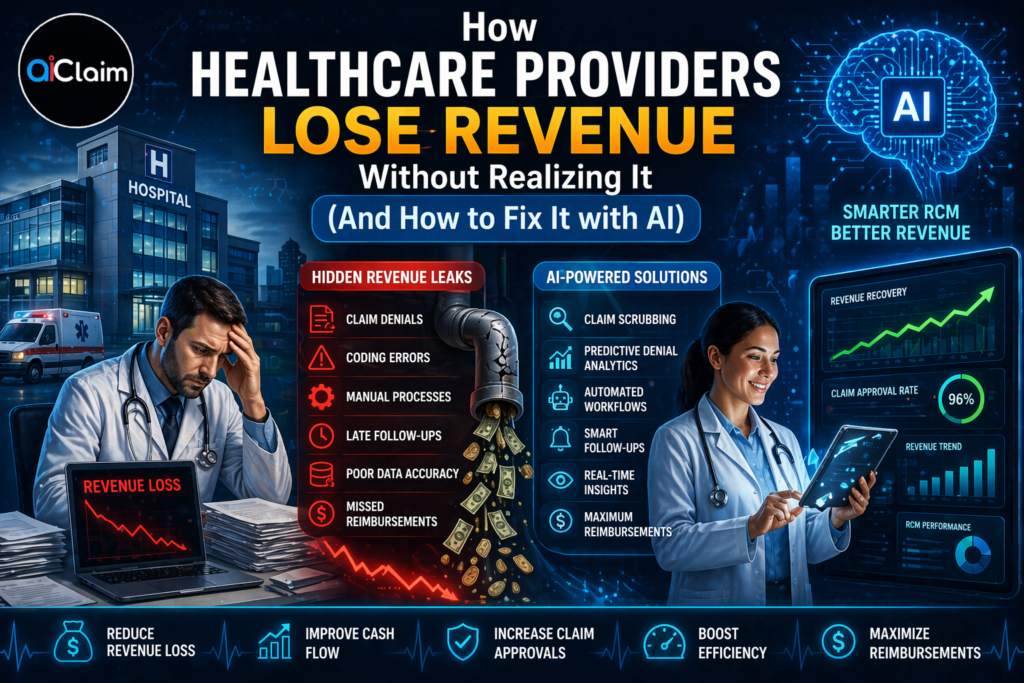
Inefficient Denial Follow-Up: Missed Recovery Opportunities
Although many denied claims can be corrected and resubmitted, inefficient follow-up processes prevent organizations from recovering this revenue. In many healthcare settings, denial management is still handled manually, which makes it difficult to prioritize high-value claims or track deadlines effectively.
As a result, staff may focus on low-impact claims while high-value opportunities remain unattended. Additionally, delayed follow-ups often lead to missed appeal windows, after which claims become unrecoverable. Therefore, what could have been recovered revenue turns into a permanent loss.
Moreover, without a structured system for denial management, organizations lack visibility into their recovery performance. Consequently, they are unable to measure success or identify areas for improvement, further compounding the problem.
Operational Inefficiencies: Slow Processes, Faster Losses
In addition to errors and denials, operational inefficiencies also play a major role in revenue leakage. Manual workflows, disconnected systems, and delayed claim submissions create bottlenecks that slow down the entire revenue cycle.
For example, when claims are not submitted on time, they may exceed payer deadlines, resulting in automatic rejection. Similarly, lack of coordination between departments can lead to duplicated work or missed steps, both of which contribute to inefficiency.
Therefore, even if individual processes are functioning correctly, the lack of integration and automation can still lead to significant financial loss. Over time, these inefficiencies accumulate, reducing overall productivity and profitability.
Lack of Real-Time Data: Operating Without Visibility
Another critical factor contributing to revenue loss is the absence of real-time data and analytics. Without accurate and timely insights, healthcare providers are essentially operating without a clear understanding of their financial performance.
For instance, if an organization cannot track its denial rate or identify trends, it becomes impossible to address the root cause of the problem. Similarly, without performance metrics, decision-making becomes reactive rather than proactive.
As a result, issues are only addressed after they have already caused damage. Therefore, the lack of visibility not only prevents problem detection but also delays corrective action, leading to prolonged revenue leakage.
Uncollected Patient Payments: The Final Revenue Gap
Even after successful claim processing, revenue loss can still occur at the final stage—patient payment collection. With the rise of high-deductible health plans, patients are now responsible for a larger portion of healthcare costs.
However, many providers lack effective systems for patient communication and payment collection. Consequently, bills remain unpaid, and follow-ups are either delayed or inconsistent. Over time, these unpaid balances turn into bad debt.
Furthermore, without transparent billing and flexible payment options, patients may find it difficult to fulfill their financial obligations. Therefore, improving the patient payment experience is essential for reducing revenue leakage at this stage.
How Aiclaim Uses AI to Prevent Revenue Loss
At this point, it becomes clear that traditional methods are no longer sufficient to address the complexities of modern healthcare revenue cycles. This is where AI-powered solutions like Aiclaim come into play.
Aiclaim leverages advanced algorithms to analyze data, detect errors, and predict potential issues before they occur. Unlike manual systems, AI continuously learns from historical data, enabling it to identify patterns and improve accuracy over time.
For example, Aiclaim can automatically validate patient information during registration, ensuring that errors are corrected before they impact the claim. Similarly, it can analyze coding data to detect inconsistencies and recommend corrections instantly.
Moreover, AI-driven denial prediction allows providers to identify high-risk claims and take preventive action. As a result, denial rates are significantly reduced, and first-pass acceptance rates improve.
In addition, Aiclaim provides real-time analytics, giving providers complete visibility into their revenue cycle performance. This enables faster decision-making and more effective resource allocation.
The AI Algorithm Behind Revenue Optimization
The effectiveness of Aiclaim lies in its intelligent, data-driven approach. The process begins with data collection, where the system gathers information from various sources, including patient records, claims history, and payer rules.
Next, the AI analyzes this data to identify patterns and detect anomalies. Based on this analysis, it predicts the likelihood of claim rejection and highlights potential risks. Subsequently, the system automatically suggests or implements corrections, ensuring that claims are optimized before submission.
Finally, the AI continuously learns from outcomes, refining its predictions and improving accuracy over time. This creates a self-improving system that adapts to changing conditions and consistently enhances performance.
How Healthcare Providers Can Stop Revenue Leakage
To effectively address revenue leakage, healthcare providers must adopt a proactive approach. This begins with conducting a comprehensive audit of the revenue cycle to identify weak points and inefficiencies.
At the same time, implementing automation and AI-driven solutions can significantly reduce manual errors and improve overall efficiency. Additionally, tracking key performance indicators such as denial rates and collection ratios provides valuable insights for continuous improvement.
Furthermore, enhancing patient communication and offering flexible payment options can improve collection rates and reduce bad debt. Ultimately, a combination of technology, strategy, and process optimization is required to eliminate revenue leakage.
Final Thoughts: Turning Loss into Opportunity
In conclusion, healthcare providers are not losing revenue due to a lack of demand, but rather due to hidden inefficiencies within their own systems. These losses, although often unnoticed, have a significant impact on financial performance.
However, by identifying the root causes and leveraging advanced solutions like Aiclaim, organizations can transform their revenue cycle into a highly efficient, profit-generating system. Instead of reacting to problems, they can prevent them altogether.
🚀 Take Action Now
If you want to uncover hidden revenue losses and improve your financial performance:
👉 Book a free audit:
https://www.aiclaim.com/appointment.php
👉 Check your coding accuracy:
https://www.aiclaim.com/medical-coding-audit.php