
Medical coding has become one of the most critical functions in healthcare revenue cycle management.Healthcare providers must accurately translate every diagnosis, treatment, procedure, and patient interaction into standardized ICD-10 codes to ensure proper reimbursement, maintain regulatory compliance, and support complete clinical documentation.. However, the increasing complexity of healthcare regulations, expanding ICD-10 code sets, and growing documentation requirements have made manual coding more challenging than ever.
Healthcare organizations are under constant pressure to improve coding accuracy while reducing claim denials, accelerating reimbursements, and maintaining compliance. At the same time, coding professionals face increasing workloads, staffing shortages, and frequent coding guideline updates that leave little room for error.
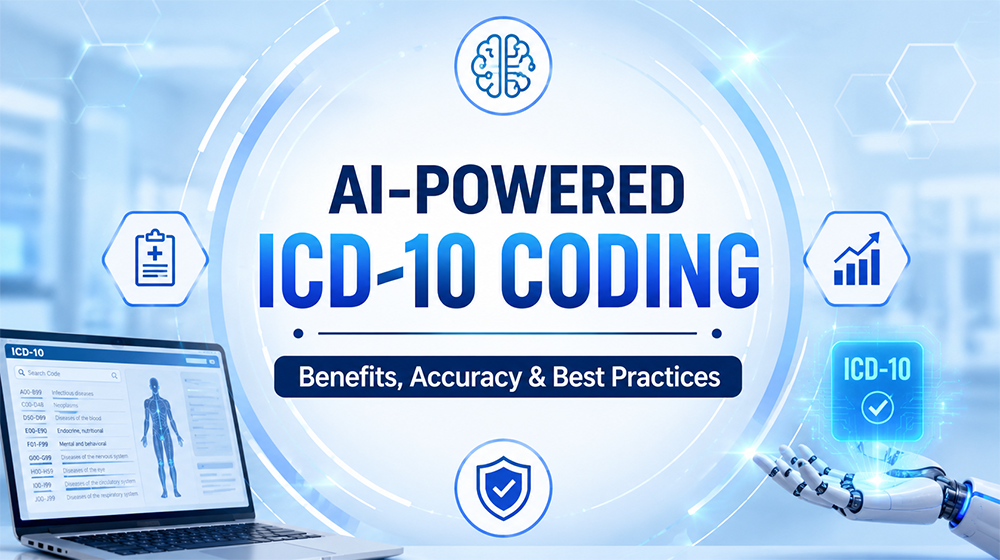
Artificial Intelligence (AI) is transforming this landscape. AI-powered ICD-10 coding solutions leverage advanced machine learning, Natural Language Processing (NLP), Large Language Models (LLMs), and predictive analytics to automate coding workflows, improve documentation quality, and significantly reduce coding errors. Instead of replacing certified medical coders, AI acts as an intelligent assistant that enhances productivity, increases coding consistency, and supports better clinical decision-making.
Organizations that integrate AI into their medical coding processes are experiencing measurable improvements in operational efficiency, revenue integrity, compliance, and patient care. As healthcare continues to embrace digital transformation, AI-powered ICD-10 coding is rapidly becoming a strategic investment rather than a technological luxury.
How AI Powers ICD-10 Coding
AI-powered ICD-10 coding refers to the use of artificial intelligence technologies to automatically analyze clinical documentation and recommend the most accurate ICD-10 diagnosis codes. Unlike traditional coding software that relies on rule-based systems, modern AI continuously learns from vast amounts of medical data and coding decisions to improve accuracy over time.
These intelligent systems process physician notes, laboratory reports, discharge summaries, radiology findings, pathology reports, operative notes, and electronic health records to understand the clinical context before assigning appropriate diagnosis codes.
Rather than searching through thousands of ICD-10 codes manually, healthcare professionals receive AI-generated coding recommendations supported by confidence scores and documentation references. Certified coders then review and validate these suggestions, significantly reducing manual effort while maintaining coding quality.
This collaborative approach combines human expertise with machine intelligence, creating a faster, more accurate, and highly scalable coding process.
Why Traditional ICD-10 Coding Is Becoming Increasingly Challenging
Healthcare organizations continue to struggle with coding accuracy because the complexity of ICD-10 continues to increase every year. The code set now contains more than 70,000 diagnosis codes, with regular annual updates reflecting new diseases, treatments, and documentation requirements.
Medical coders must interpret physician documentation that may contain abbreviations, incomplete notes, inconsistent terminology, or missing clinical details. Even experienced coders can interpret the same documentation differently, leading to inconsistencies in reimbursement and compliance.
Incomplete documentation often forces coders to query physicians, delaying claim submission and increasing administrative workloads. These delays directly affect cash flow while increasing accounts receivable days. Furthermore, healthcare organizations continue to face qualified medical coder shortages. As patient volumes increase, healthcare organizations expect medical coders to process more records without compromising quality. This growing workload causes fatigue and significantly increases the likelihood of coding errors.
Claim denials resulting from coding inaccuracies continue to cost healthcare providers millions of dollars annually through lost revenue, rework, delayed payments, and compliance risks.
How AI Transforms ICD-10 Coding Workflows
Artificial Intelligence fundamentally transforms medical coding by automating repetitive tasks and supporting human decision-making.
Advanced AI platforms validate clinical documentation by detecting missing details, incomplete diagnoses, unsupported codes, and conflicting information before claim submission. Modern AI models understand medical terminology in context rather than simply matching keywords. For example, they distinguish between confirmed diagnoses, suspected conditions, historical illnesses, ruled-out diseases, and family history.
Machine Learning algorithms continuously improve through ongoing feedback from certified coders. Every correction strengthens future coding recommendations, allowing the system to adapt to changing coding guidelines and organizational preferences.
As a result, healthcare providers accelerate coding turnaround times, improve documentation quality, and achieve higher first-pass claim acceptance rates.
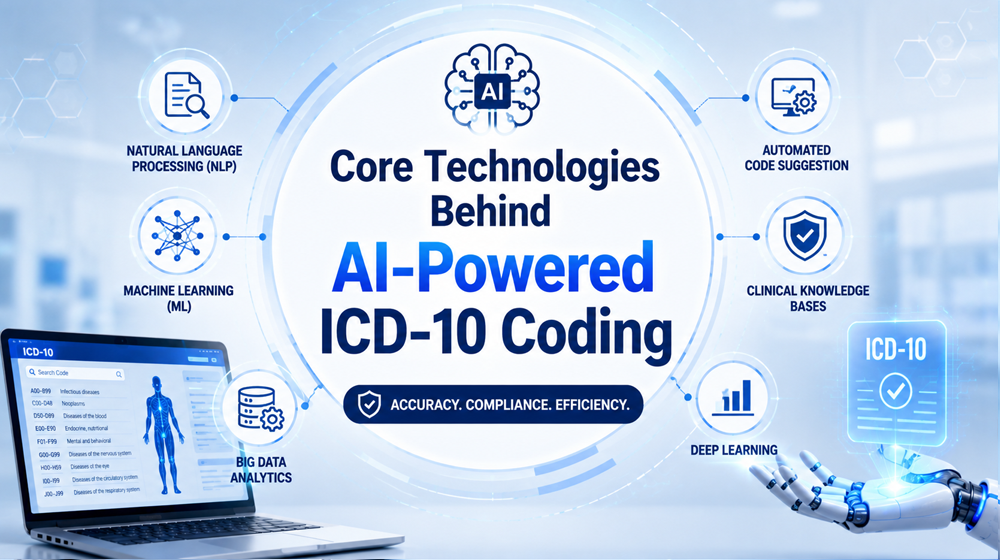
Core Technologies Behind AI-Powered ICD-10 Coding
Artificial Intelligence in medical coding combines multiple advanced technologies that work together to deliver highly accurate coding recommendations.
Natural Language Processing enables computers to understand physician narratives in much the same way experienced coders interpret clinical documentation. Instead of relying on structured data alone, NLP extracts valuable information from free-text clinical notes, making documentation analysis significantly more comprehensive.
Machine Learning algorithms learn from millions of historical coding examples to identify coding patterns, clinical relationships, and reimbursement trends. Unlike static software, these algorithms become more intelligent as they process additional healthcare data.
Large Language Models provide contextual understanding of complex medical language. They recognize clinical intent, distinguish subtle diagnostic differences, and interpret physician documentation with remarkable accuracy. Predictive Analytics identifies potential documentation deficiencies before they create reimbursement issues. These insights help physicians improve documentation quality while reducing coding queries.
Optical Character Recognition further enhances automation by converting handwritten or scanned medical documents into searchable digital text that AI can analyze efficiently. Together, these technologies create an intelligent coding ecosystem capable of supporting healthcare organizations across multiple specialties.
Key Benefits of AI-Powered ICD-10 Coding
AI-powered coding significantly improves coding accuracy.By analyzing complete patient documentation rather than isolated sections, AI reduces omissions and ensures diagnosis codes accurately reflect the patient’s clinical condition.
Improved accuracy directly contributes to fewer coding-related claim denials. Insurance companies increasingly scrutinize submitted claims for documentation consistency, medical necessity, and coding precision. AI helps healthcare providers meet these expectations before claims reach payers.
Operational efficiency also improves dramatically. Tasks that previously required twenty minutes can often be completed within just a few minutes using AI-assisted workflows. This allows certified coders to focus on complex cases requiring professional judgment rather than repetitive coding activities.
Healthcare organizations also benefit from enhanced compliance. AI continuously monitors coding practices against the latest ICD-10 guidelines, reducing the risk of regulatory violations and audit findings. Revenue integrity strengthens because diagnoses are documented more completely. Proper code assignment ensures providers receive appropriate reimbursement for services delivered while minimizing undercoding and overcoding risks.
Another valuable benefit is physician documentation improvement. AI identifies incomplete documentation and recommends additional clinical specificity before coding begins, reducing physician queries and accelerating claim processing. Ultimately, AI supports a more sustainable revenue cycle while reducing administrative burden across the organization.
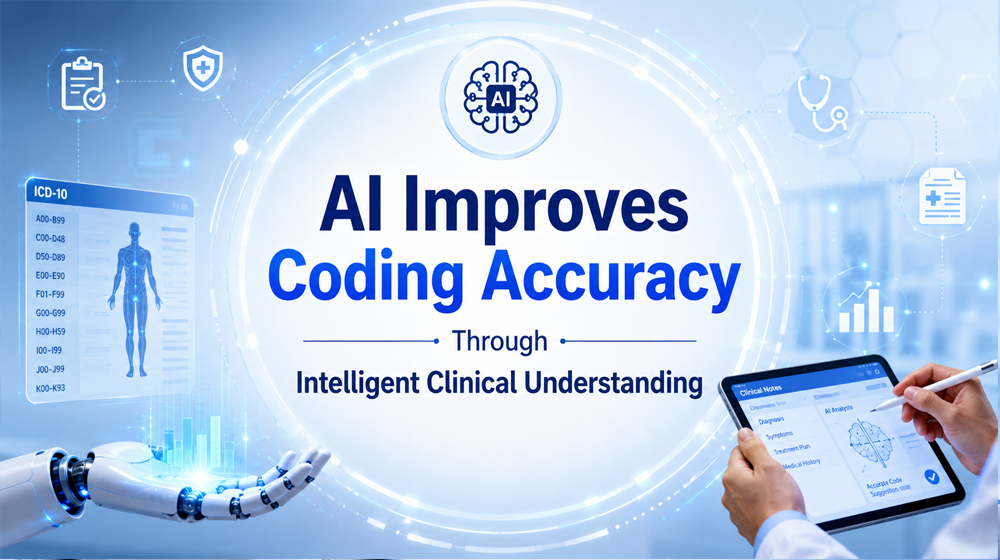
AI Improves Coding Accuracy Through Intelligent Clinical Understanding
Traditional coding software often struggles when physician documentation contains ambiguous language or multiple clinical conditions. AI overcomes this limitation by evaluating the entire patient record instead of isolated keywords.
For example, when documentation references diabetes, AI determines whether the patient has Type 1, Type 2, gestational diabetes, or secondary diabetes. It also identifies associated complications such as neuropathy, nephropathy, retinopathy, or chronic kidney disease.
Similarly, AI distinguishes between active infections and historical infections, postoperative complications and expected recovery, acute conditions and chronic diseases, ensuring appropriate ICD-10 code selection.
This contextual understanding dramatically reduces miscoding while improving documentation consistency across providers. As healthcare organizations increasingly adopt value-based care models, accurate diagnosis capture becomes essential for risk adjustment, quality reporting, and reimbursement optimization. AI helps organizations achieve these objectives through intelligent clinical interpretation rather than simple keyword recognition.
Reducing Claim Denials with AI-Powered ICD-10 Coding
One of the most expensive challenges healthcare organizations face is claim denials caused by coding inaccuracies. Even minor coding errors can trigger payment delays, additional administrative work, or complete claim rejection.
AI addresses this challenge proactively rather than reactively. Before a claim is submitted, AI evaluates coding accuracy, documentation completeness, medical necessity, diagnosis specificity, payer-specific requirements, and compliance rules. If inconsistencies are detected, the system alerts coding teams before submission.
This early intervention significantly increases first-pass claim acceptance rates while reducing costly rework. Organizations implementing AI-assisted coding often experience measurable reductions in denial rates because coding issues are resolved before reaching insurance companies. Moreover, AI continuously analyzes denial patterns, helping organizations identify recurring documentation problems and improve future coding performance.
AI Supports Regulatory Compliance and Audit Readiness
Healthcare regulations continue to evolve, making compliance increasingly complex. Coding errors can lead to payer audits, reimbursement recoupments, legal exposure, and reputational damage. AI assists compliance teams by automatically validating coding decisions against current ICD-10 guidelines and organizational coding policies.
Instead of relying solely on periodic audits, healthcare organizations benefit from continuous compliance monitoring throughout the coding workflow. Every recommended diagnosis code is supported by documented clinical evidence, creating transparent audit trails that simplify internal reviews and external audits. As regulations continue to evolve, AI models can be updated much faster than manual training programs, helping organizations remain compliant while minimizing operational disruption.
(Continued in the next response with the remaining sections, including Best Practices, AI Models, Implementation Strategy, Future Trends, FAQs, Conclusion )