How AI Eligibility Verification Software Reduces Claim Denials Before Submission

Healthcare providers lose billions of dollars every year because insurance claims are denied for reasons that could have been prevented before a patient even receives treatment. Industry reports consistently show that a significant percentage of denied claims originate from eligibility-related issues such as inactive coverage, incorrect insurance information, authorization gaps, policy limitations, and benefit mismatches. While many healthcare organizations continue relying on manual verification processes, those methods simply cannot keep pace with the growing complexity of payer rules and insurance policy updates.
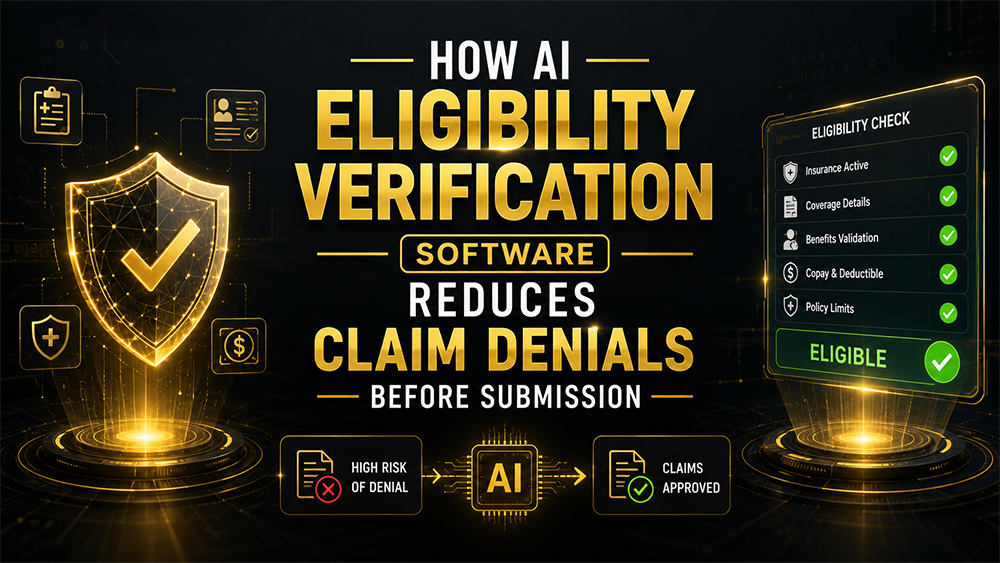
AI Eligibility Verification Software transforms this critical stage of the revenue cycle by identifying coverage issues before claims are created. Instead of discovering eligibility problems after services are delivered, healthcare organizations can verify insurance instantly, predict potential claim risks, recommend corrective actions, and prevent avoidable denials.
Organizations that implement AI-powered eligibility verification experience faster reimbursements, higher first-pass claim acceptance rates, lower administrative costs, improved patient satisfaction, and stronger financial performance. More importantly, staff members spend less time making repetitive phone calls and checking multiple payer portals, allowing them to focus on patient care rather than administrative tasks.
Why Eligibility Verification Is the Foundation of Revenue Cycle Management
Every successful reimbursement begins with accurate patient eligibility verification. If insurance information is incorrect, outdated, or incomplete, every downstream process becomes vulnerable to delays, denials, and revenue leakage.
Healthcare providers frequently encounter challenges such as expired insurance plans, incorrect subscriber details, missing referrals, inactive employer-sponsored coverage, secondary insurance coordination errors, and changing payer policies. Even highly experienced front-desk teams can overlook these issues because insurance requirements change frequently.
Consequently, claims are submitted with inaccurate information, forcing providers into lengthy appeals or costly rework. AI changes this process entirely by validating insurance eligibility before treatment begins. Instead of reacting to denials, healthcare organizations become proactive in preventing them.
Why Traditional Eligibility Verification No Longer Meets Modern Healthcare Needs
Manual insurance verification has become increasingly difficult as payer networks continue expanding and policy rules evolve. Front-office teams often navigate multiple payer websites, spend valuable time on telephone verification, manually enter patient information, interpret complex benefit documents, and verify authorization requirements individually.
Although experienced staff members work diligently, human limitations inevitably create risks Manual verification commonly results in:
Incorrect insurance selection, Coverage verification delays, Missing authorization requirements, Incomplete benefit validation, Outdated payer information,Human data entry mistakes, Delayed patient scheduling,Unexpected patient billing disputes
Moreover, staffing shortages have increased administrative workloads across healthcare organizations, making manual verification even less sustainable. As patient volumes continue growing, organizations require intelligent automation that scales without increasing staffing costs.
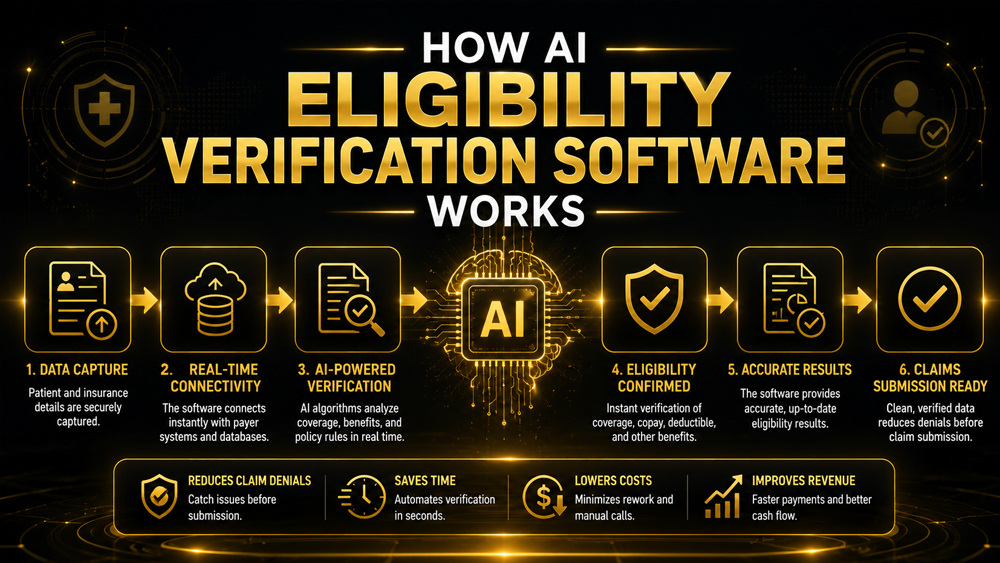
How AI Eligibility Verification Software Works
AI Eligibility Verification Software combines machine learning, robotic process automation, predictive analytics, natural language processing, and healthcare interoperability standards to automate insurance verification from start to finish.
When patient information enters the scheduling or registration system, AI immediately begins validating insurance details. The software securely connects with payer databases through APIs and HIPAA-compliant electronic transactions, verifies active coverage, checks benefit limitations, confirms deductible balances, reviews copay responsibilities, validates provider network participation, identifies authorization requirements, and evaluates policy exclusions.
Unlike traditional systems that simply return coverage status, AI interprets the entire insurance profile. The software also compares historical payer behavior, detects inconsistencies, identifies unusual patterns, predicts claim risks, and recommends corrective actions before claims are submitted. As a result, healthcare organizations gain actionable intelligence instead of raw insurance data.
AI Detects Eligibility Problems Before They Become Claim Denials
Many claim denials originate from issues that existed long before coding or billing began. AI identifies these hidden risks early. For example, the software detects inactive policies immediately after registration. It recognizes duplicate insurance records that may confuse payer sequencing. Furthermore, it flags missing referrals, expired authorizations, non-covered services, incorrect subscriber relationships, and payer-specific documentation requirements.
Machine learning continuously improves these predictions by learning from thousands or even millions of historical claims. Therefore, every processed claim makes the system smarter. Instead of repeating the same mistakes, healthcare organizations gradually reduce denial patterns across every department.
Machine Learning Continuously Learns from Every Insurance Verification
One of AI’s greatest advantages is continuous learning. Traditional eligibility systems follow fixed rules. AI systems learn from historical outcomes. Every approved claim, denied claim, corrected claim, appeal, authorization update, and payer response becomes valuable training data. As the AI model processes additional claims, it recognizes payer-specific behavior, identifies recurring denial patterns, understands regional insurance variations, and predicts eligibility risks with increasing accuracy.
Consequently, organizations receive increasingly intelligent recommendations over time rather than static verification results. This adaptive capability becomes especially valuable because insurance regulations, payer policies, and reimbursement requirements change continuously.
Real-Time Eligibility Verification Improves Patient Experience
Patients increasingly expect transparency before receiving healthcare services. Unexpected bills remain one of the biggest sources of dissatisfaction. AI eligibility verification provides real-time insurance validation during appointment scheduling or patient registration. Patients immediately understand their estimated financial responsibility, coverage limitations, deductible status, and authorization requirements.
Consequently, providers experience fewer appointment cancellations, fewer billing disputes, higher patient trust, and improved financial transparency. Meanwhile, front-office staff spend significantly less time resolving insurance confusion after services have already been delivered.
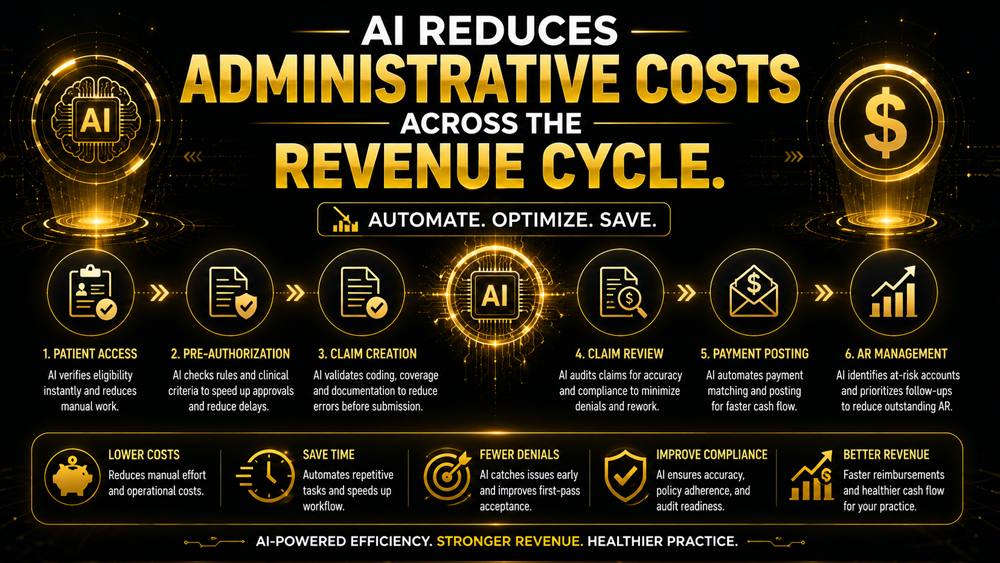
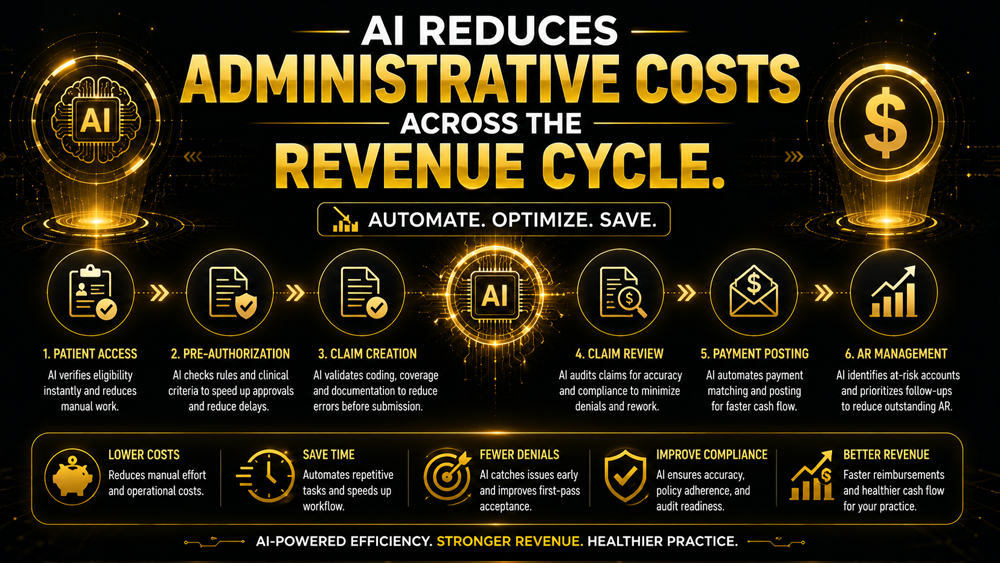
AI Reduces Administrative Costs Across the Revenue Cycle
Healthcare organizations spend countless administrative hours correcting preventable eligibility mistakes. Every denied claim requires investigation, resubmission, documentation review, payer communication, and follow-up.
Those activities increase labor costs while delaying reimbursement. AI eliminates much of this unnecessary work by preventing errors before claims enter the billing process. Automation reduces repetitive verification tasks, accelerates registration workflows, improves scheduling efficiency, decreases manual intervention, and enables billing teams to focus on higher-value responsibilities.
Industry research from organizations including CAQH continues to show that administrative automation saves healthcare organizations substantial operational costs annually while improving overall revenue cycle efficiency.
Predictive Analytics Helps Prevent Revenue Leakage
AI goes beyond simple verification. Predictive analytics estimates the probability of claim approval before submission. Instead of asking whether insurance is active, AI evaluates whether the claim itself is likely to succeed. The software considers historical denial patterns, payer-specific edits, authorization history, demographic inconsistencies, benefit limitations, diagnosis compatibility, and provider eligibility.
If risk increases beyond an acceptable threshold, AI recommends corrective actions immediately. Revenue cycle teams can resolve issues before claim submission instead of after denial. This predictive approach significantly improves first-pass acceptance rates while protecting organizational revenue.
Integration with Electronic Health Records Creates a Connected Workflow
Modern AI Eligibility Verification Software integrates seamlessly with Electronic Health Records (EHR), Practice Management Systems (PMS), Revenue Cycle Management platforms, clearinghouses, and payer networks.
As information flows between systems automatically, duplicate data entry decreases significantly.
Furthermore, providers gain complete visibility into patient eligibility throughout the care journey.
Clinical teams, scheduling staff, coders, billers, and financial counselors all access consistent eligibility information from a centralized platform.
This connected ecosystem improves collaboration while minimizing communication gaps that often contribute to claim denials.
AI Strengthens Compliance and Data Security
Healthcare organizations must protect patient information while complying with evolving regulatory requirements.
Leading AI eligibility verification platforms support HIPAA compliance, encrypted data transmission, role-based access control, audit logging, secure authentication, and continuous monitoring.
Many enterprise platforms also leverage explainable AI principles, allowing compliance teams to understand why specific eligibility decisions or risk predictions were generated.
This transparency strengthens governance while increasing confidence in AI-assisted decision-making.
Choosing the Right AI Eligibility Verification Software
Not every eligibility solution delivers the same value.
Healthcare organizations should evaluate platforms that provide real-time eligibility verification, predictive denial analytics, intelligent authorization validation, automated payer connectivity, API integration, customizable workflow automation, scalable cloud infrastructure, advanced reporting dashboards, and continuous machine learning improvements.
Organizations should also prioritize vendors that demonstrate measurable reimbursement improvements, transparent AI models, healthcare-specific expertise, and ongoing product innovation.
Selecting the right solution creates long-term operational advantages rather than simply replacing manual processes with basic automation.
The Future of AI Eligibility Verification
Healthcare reimbursement is becoming increasingly data-driven.
Artificial intelligence will continue expanding beyond eligibility verification into autonomous revenue cycle management, predictive authorization management, intelligent coding assistance, automated payer negotiations, denial prevention, payment forecasting, and financial optimization.
Generative AI, Agentic AI, and predictive intelligence will enable healthcare organizations to automate increasingly complex administrative workflows while maintaining regulatory compliance and improving patient experiences.
Organizations investing in AI today position themselves to adapt more quickly as healthcare reimbursement continues evolving.
Why Healthcare Organizations Are Moving Toward AI-Powered Eligibility Verification
Healthcare leaders recognize that preventing denials is significantly more profitable than correcting them.
AI Eligibility Verification Software enables organizations to identify insurance issues earlier, improve operational efficiency, reduce administrative burden, accelerate reimbursements, enhance patient satisfaction, and strengthen financial performance.
Rather than relying on manual processes that struggle to keep pace with modern payer complexity, AI delivers intelligent automation that continuously learns, improves, and scales alongside organizational growth.
As claim volumes continue increasing and reimbursement rules become more sophisticated, AI eligibility verification is rapidly becoming an essential component of high-performing revenue cycle management strategies.
Conclusion
Preventing claim denials begins long before claims are submitted. Accurate insurance verification forms the foundation of a healthy revenue cycle, yet manual processes often introduce costly errors that delay reimbursements and increase administrative workloads. AI Eligibility Verification Software changes this reality by combining machine learning, predictive analytics, automation, and real-time payer connectivity to identify risks before they become denials.
Healthcare organizations adopting AI-driven eligibility verification are seeing measurable improvements in first-pass claim acceptance, operational efficiency, patient financial transparency, and revenue performance. As AI continues to evolve, eligibility verification will become even more intelligent, enabling providers to prevent revenue leakage while delivering a smoother experience for both patients and staff.
For organizations seeking sustainable revenue growth, investing in AI-powered eligibility verification is no longer just a technology upgrade—it is a strategic decision that strengthens the entire revenue cycle.
Frequently Asked Questions
What is AI Eligibility Verification Software?
AI Eligibility Verification Software uses artificial intelligence, machine learning, and automation to verify patient insurance coverage, validate benefits, identify authorization requirements, and detect claim risks before submission.
How does AI reduce claim denials?
AI identifies eligibility issues such as inactive coverage, missing authorizations, incorrect subscriber information, benefit limitations, and payer-specific requirements before claims are submitted, reducing preventable denials.
Can AI integrate with existing healthcare systems?
Yes. Modern AI eligibility verification solutions integrate with EHRs, Practice Management Systems, clearinghouses, Revenue Cycle Management platforms, and payer APIs.
Is AI eligibility verification HIPAA compliant?
Enterprise healthcare AI platforms are designed with HIPAA-compliant security features including encryption, audit trails, role-based access controls, and secure data transmission.
Ready to Reduce Eligibility-Related Claim Denials?
Every preventable denial represents lost revenue, additional administrative work, and delayed patient payments. AI-powered eligibility verification helps your organization verify coverage instantly, detect hidden risks, and submit cleaner claims with greater confidence.
🎯 Book a Free AI Eligibility Assessment to discover where eligibility errors are impacting your revenue cycle.
🚀 Request a Live Demo to see how AI can automate insurance verification, predict claim risks, and improve first-pass claim acceptance.