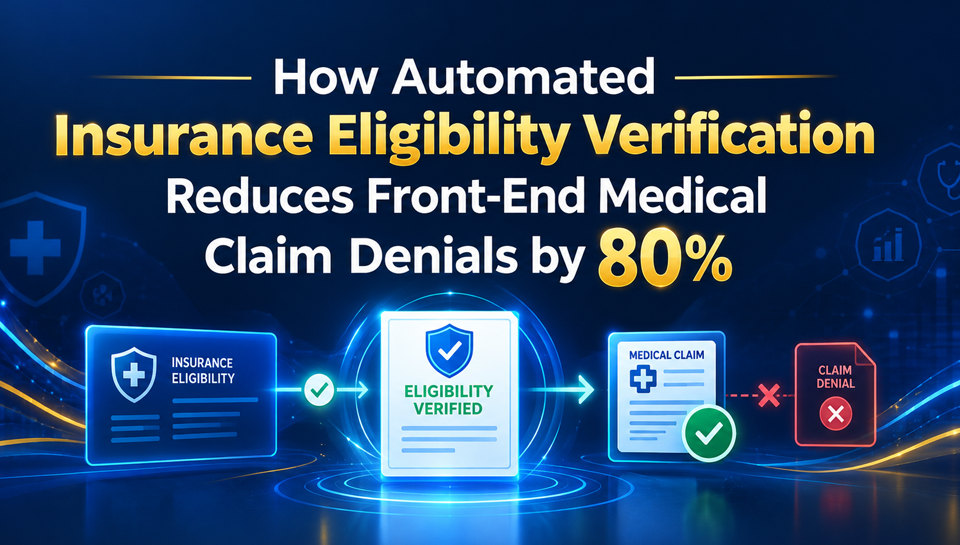
How Automated Insurance Eligibility Verification Reduces Front-End Medical Claim Denials by 80%

A medical claim can be denied before a provider ever gets the chance to prove that the care was medically necessary. Often, the problem starts much earlier when providers enter incorrect insurance information, verify inactive coverage, use outdated payer details, miss benefits, or fail to complete an eligibility check.
That is why automated insurance eligibility verification has become an important front-end revenue cycle management strategy. Instead of relying entirely on staff to manually check insurance information, healthcare organizations can use automation and AI to verify coverage earlier, identify risk, and correct errors before a claim reaches the payer.
In fact, recent Experian Health research highlights the scale of the problem. Incomplete or missing insurance registration data accounted for 32% of denials in 2025, making front-end data quality a major revenue cycle concern. Consequently, providers looking to reduce medical claim denials should not wait until a rejected claim reaches the billing team. The better approach is to identify eligibility problems during patient registration and resolve them before billing for services.
What Is Automated Insurance Eligibility Verification?
Automated insurance eligibility verification uses software, electronic payer transactions, rules engines, and increasingly artificial intelligence to confirm a patient’s insurance coverage and benefits before providers deliver healthcare services or submit claims.
Traditionally, staff may log into multiple payer portals, search for a patient, verify coverage, record benefit information, and then update the practice management or electronic health record system. However, checking hundreds or thousands of patients every day makes this process difficult for healthcare staff.
Automation changes that workflow. Using standardized electronic eligibility transactions, systems can send eligibility inquiries to payers and retrieve responses containing information about coverage, benefits, deductibles, copayments, coinsurance, and other relevant details. CMS recognizes the X12 270/271 eligibility transaction for exchanging eligibility and benefit information. CMS also provides HETS for real-time Medicare eligibility inquiries.
Therefore, automated verification does not simply replace a manual task. It creates an earlier financial checkpoint in the healthcare revenue cycle.
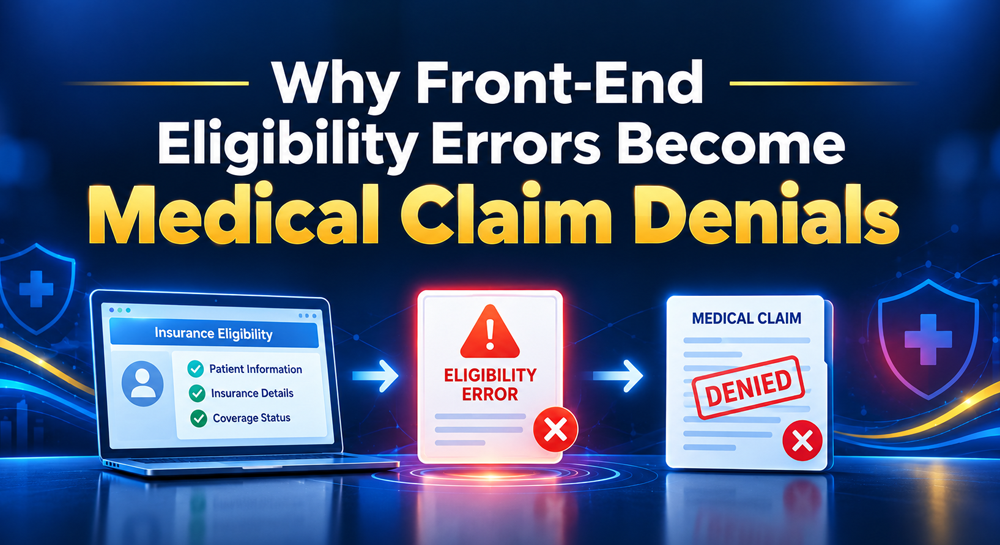
Why Front-End Eligibility Errors Become Medical Claim Denials
The biggest problem with eligibility-related denials is that they frequently originate during patient intake rather than during claim submission. For example, a patient may provide an old insurance card. Alternatively, staff may enter the member ID incorrectly. Patients may change employers, lose coverage, switch plans, or fail to provide accurate information about their secondary payer.
Meanwhile, payer requirements can change, and benefits may differ between plans even when the insurance company remains the same. As a result, a registration error can travel through the entire revenue cycle. The incorrect information enters the patient record. Then, providers create the claim using that information. Next, the claim reaches the payer. Finally, the payer identifies an eligibility problem and denies or rejects the claim.
At that point, the revenue cycle team must investigate the denial, contact the patient or payer, correct the information, resubmit the claim, and wait again for reimbursement. Therefore, the cost of an eligibility error is much greater than the few minutes required to verify coverage correctly at the beginning.
The Hidden Cost of Manual Insurance Eligibility Verification
Manual eligibility verification may appear manageable when patient volumes are low. However, the operational pressure increases rapidly as a healthcare organization grows. Staff members may need to check multiple payer portals, handle phone calls, interpret different payer responses, and manually enter information into another system.
Furthermore, manual workflows create inconsistency. One employee may verify coverage immediately, while another may check it several days before the appointment. Some records may receive detailed benefit verification, while others may receive only an active-or-inactive check.
Consequently, healthcare organizations can end up with a process that looks complete but still leaves important financial risks undetected. CAQH has also documented the economic opportunity associated with electronic eligibility and benefit verification. Its 2023 Index reported an estimated $9.8 billion annual cost-savings opportunity across medical and dental industries from greater electronic adoption, including an estimated 16 minutes of time savings per transaction for medical providers.
Therefore, automation is not simply about reducing administrative workload. It can also help redirect staff time toward exceptions that genuinely require human attention.
How AI-Powered Eligibility Verification Prevents Denials
Basic automation follows predefined instructions. AI-powered eligibility verification can go further by identifying patterns, prioritizing risk, and connecting information across the revenue cycle. For example, an AI-driven system can evaluate patient demographics, payer information, historical eligibility responses, appointment details, coverage changes, and previous claim outcomes.
The system can then assign a risk score to the verification. A simple example would be:
Eligibility Risk Score = Coverage Status + Data Accuracy + Payer Rules + Historical Risk + Benefit Mismatch
If the score indicates a high probability of a problem, the workflow can alert staff before they generate the claim. Additionally, machine learning models can identify recurring patterns. If a particular payer frequently returns eligibility mismatches for a certain plan type, the system can prioritize similar records for additional verification.
However, AI should not replace human judgment in every situation. Instead, the strongest model uses AI to identify risk while allowing trained revenue cycle professionals to handle complex exceptions. That combination creates a more practical approach to intelligent revenue cycle automation.
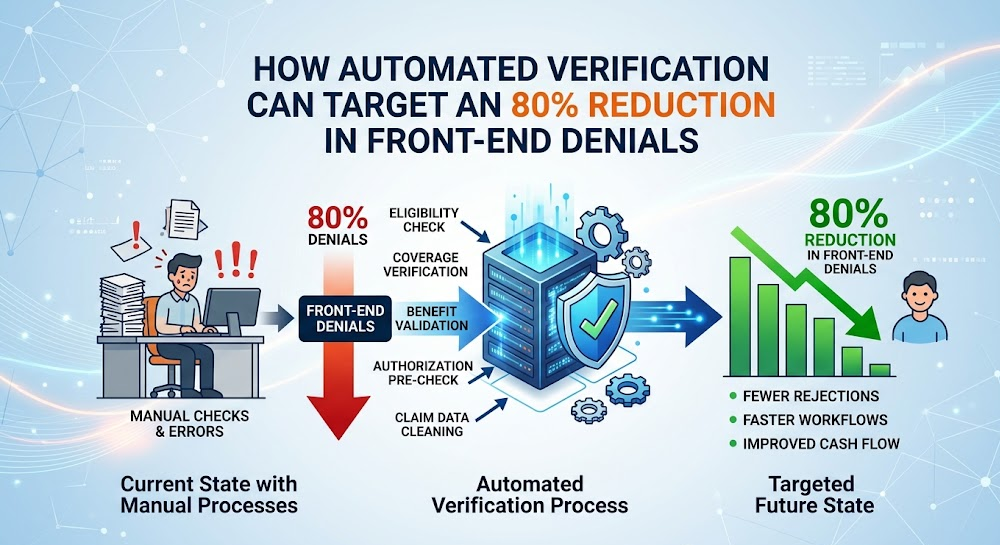
How Automated Verification Can Target an 80% Reduction in Front-End Denials
An 80% reduction should be viewed as a performance target rather than a universal guarantee. Actual results depend on payer mix, baseline denial rates, data quality, system integration, verification timing, and workflow adoption. Nevertheless, the pathway to an 80% reduction is straightforward.
First, the system verifies insurance before the patient’s appointment. Next, it identifies inactive coverage, incorrect member information, benefit mismatches, coordination-of-benefits issues, and other eligibility risks. Then, instead of allowing those errors to move into claims processing, the workflow routes them to staff or automatically requests updated information. Finally, once the information is corrected, the patient account is updated before claim creation.
This prevents the same error from becoming a downstream denial. Experian Health’s 2026 research continues to identify inaccurate patient information, manual processes, and eligibility verification problems as important contributors to claim denials. Therefore, the objective is not merely to verify more patients. The objective is to prevent bad information from entering the claim workflow.
What an Effective Automated Eligibility Workflow Looks Like
A strong workflow begins when an appointment is scheduled or patient information is entered. First, the system captures demographic and insurance information. Next, it submits an electronic eligibility inquiry to the appropriate payer. Then, the response is analyzed against the patient’s record.
If the coverage is active and the information matches, the account can move forward. However, if the system detects an inactive policy, demographic mismatch, missing benefit information, or potential coordination-of-benefits problem, it creates an exception. The staff member can then resolve the issue while there is still time to contact the patient or payer.
Afterward, the corrected information is stored in the patient’s record and used during downstream billing. This creates a continuous prevention loop rather than a reactive denial-management process. CMS explains that eligibility transactions are designed to provide information about an enrollee’s eligibility and coverage, including financial information such as deductibles, copayments, coinsurance, and service-specific coverage.
Why Real-Time Verification Matters
Timing is just as important as accuracy. A verification performed several weeks before an appointment may become outdated before the patient receives care. Coverage can change, policies can terminate, and patient circumstances can change. Therefore, healthcare organizations benefit from performing eligibility verification as close as practical to the date of service.
Real-time eligibility infrastructure supports this approach. CMS’s HETS environment, for example, supports real-time Medicare eligibility transactions using the 270/271 standard. As a result, real-time verification can help providers move from static insurance information toward a more current view of patient coverage.
The Business Impact Goes Beyond Denial Reduction
Reducing eligibility denials is only one benefit. When insurance information is accurate, patient responsibility can also be estimated more reliably. Consequently, patients can receive clearer financial information before treatment rather than receiving unexpected bills later. At the same time, billing teams spend less time researching preventable denials.
Front-office teams can also spend less time navigating payer websites and correcting avoidable registration errors. Furthermore, cleaner front-end data improves downstream revenue cycle processes because claims begin with more accurate information. This is why eligibility verification should be viewed as a revenue protection strategy rather than simply an administrative function.
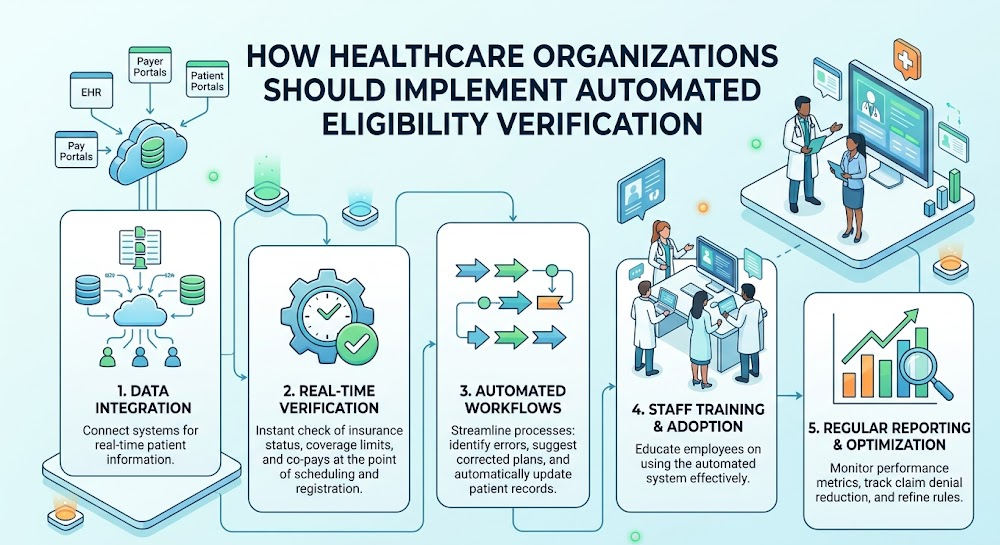
How Healthcare Organizations Should Implement Automated Eligibility Verification
Technology alone will not solve the problem. First, organizations should identify their most common eligibility-related denial reasons. This establishes a measurable baseline. Next, they should examine where those errors originate. For some organizations, the problem may be registration. For others, it may involve payer identification, outdated insurance information, coordination of benefits, or inconsistent verification timing.
Then, automation should be integrated into the existing workflow rather than creating another disconnected application. The system should also provide clear exception queues. Staff should immediately understand what failed, why it failed, and what action is required.
Most importantly, organizations should measure results continuously. Useful metrics include eligibility verification completion rate, eligibility-related denial rate, first-pass claim rate, verification turnaround time, staff intervention rate, corrected registration errors, and revenue recovered before claim submission.
That measurement framework makes it possible to determine whether an 80% reduction target is realistic for a specific organization.
What Healthcare Leaders Should Look for in an AI Eligibility Solution
Healthcare organizations should avoid choosing an eligibility platform based solely on the number of payer connections. Instead, the solution should fit the organization’s entire revenue cycle workflow. It should support electronic 270/271 transactions, integrate with existing EHR or practice-management systems, provide real-time or near-real-time verification, identify exceptions, maintain audit trails, and protect sensitive patient information.
Additionally, AI capabilities should be explainable. Revenue cycle teams need to understand why a patient account was flagged. A system that simply says “high risk” without explaining the underlying issue creates another operational problem. Therefore, the best solution combines automation, explainable AI, workflow integration, and human oversight.
Frequently Asked Questions About Automated Insurance Eligibility Verification
Can automated eligibility verification prevent medical claim denials?
Yes, it can prevent many eligibility-related denials by identifying coverage and insurance-data problems before claim submission. However, it cannot prevent every type of denial because coding, medical necessity, authorization, documentation, and payer-policy issues can occur independently.
How does AI improve insurance eligibility verification?
AI can analyze eligibility responses, patient information, payer patterns, historical outcomes, and other revenue cycle signals to identify accounts that require additional attention. Consequently, staff can focus on high-risk cases instead of manually reviewing every account.
Is real-time eligibility verification better than manual verification?
Generally, real-time electronic verification can reduce manual work and provide more current coverage information. However, organizations still need exception handling because payer responses and patient circumstances can vary.
How quickly can eligibility automation reduce denials?
Results depend on the organization’s baseline denial rate, payer mix, data quality, workflow integration, and staff adoption. Organizations should establish baseline metrics first and then measure changes after implementation rather than assuming a fixed improvement percentage.
Does eligibility verification improve patient experience?
Yes. When coverage and benefits are verified earlier, providers can communicate financial responsibility more clearly. Consequently, patients are less likely to encounter unexpected insurance-related billing problems after receiving care.
Turn Eligibility Verification Into a Revenue Protection Strategy
Front-end claim prevention starts before the claim exists. When incorrect insurance information is allowed to enter the revenue cycle, the organization eventually pays for that mistake through rework, delayed reimbursement, staff intervention, and preventable denials. However, automated insurance eligibility verification changes that equation.
By combining real-time eligibility transactions, workflow automation, AI-based risk detection, and human exception management, healthcare organizations can identify problems earlier and protect revenue before claims reach the payer. For organizations targeting an 80% reduction in front-end eligibility-related denials, the first step should not be buying another disconnected tool. Instead, it should be understanding where eligibility errors originate, measuring the financial impact, and designing an automated prevention workflow around those specific problems.
Want to identify where eligibility errors are affecting your revenue cycle?
Use an AI-driven eligibility and denial-prevention assessment to identify high-risk front-end workflows, prioritize preventable errors, and determine where automation can deliver the greatest financial impact.
Get your Revenue Cycle Automation Assessment and discover which front-end denial risks can be prevented before submission.
Healthcare organizations can use the checklist to assess insurance verification accuracy, registration data quality, payer response workflows, eligibility timing, exception handling, and denial-prevention opportunities.
Automated insurance eligibility verification uses electronic payer transactions, workflow automation, and AI to confirm patient coverage and benefits before services are billed.
The main benefit of automated eligibility verification is that it identifies incorrect, inactive, or incomplete insurance information before those errors become claim rejections or denials.
AI-powered eligibility verification improves the process by identifying high-risk accounts, recognizing recurring payer patterns, and prioritizing exceptions for revenue cycle staff.
An 80% reduction in front-end denials is a potential performance target, not a guaranteed industry result. The actual reduction depends on payer mix, data quality, workflow design, integration, and the organization’s starting denial rate.
The most effective approach combines real-time eligibility verification, accurate patient registration, AI-based risk detection, automated exception workflows, and human review.