

How to Evaluate AI Medical Billing Software in 2027: Beyond Automation Rates to Claim Accuracy and Revenue Impact

Healthcare organizations are investing in artificial intelligence to reduce billing costs, accelerate reimbursement, and improve revenue cycle performance. However, choosing the right technology is becoming more complicated. Many vendors promise faster claim processing, higher automation rates, and fewer manual interventions. Yet these improvements do not necessarily translate into better financial performance.
A billing platform might process thousands of claims automatically while overlooking payer-specific coding requirements, eligibility discrepancies, authorization gaps, or documentation inconsistencies. Consequently, healthcare organizations can end up automating existing billing problems instead of eliminating them.
The financial consequences are significant. According to Experian Health’s 2026 State of Claims survey, 75% of surveyed providers reported increasing claim denials, while 40% reported denial rates exceeding 10%. Furthermore, 78% said payer policies were changing more frequently.
These findings highlight an important purchasing decision for 2027: healthcare executives must evaluate AI medical billing software based on its ability to improve claim accuracy, reimbursement performance, and measurable financial outcomes—not simply the percentage of tasks it automates.
Why Automation Rates Are No Longer Enough to Evaluate AI Medical Billing Software
Automation measures operational activity, whereas revenue performance measures business results. Confusing these two outcomes can lead organizations toward expensive technology that delivers limited financial improvement. For example, consider a billing platform that automatically processes 85% of incoming claims. Although the automation rate appears impressive, the platform may still generate incorrect modifiers, overlook coverage restrictions, or fail to identify authorization mismatches.
As a result, billing teams spend additional time correcting claims, investigating denials, and contacting payers. Therefore, the actual financial benefit may be considerably lower than the vendor’s presentation suggests. Healthcare executives should examine whether automation improves first-pass acceptance, reduces preventable denials, accelerates collections, and decreases the cost of managing each claim.
The central evaluation question should be straightforward: Does the software make claims more accurate and improve the amount of revenue collected?
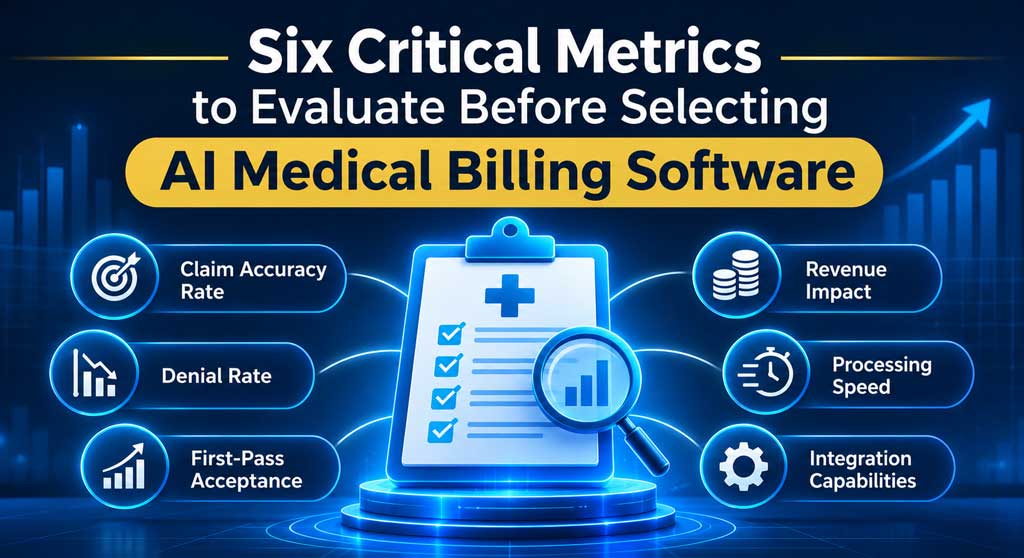
Six Critical Metrics to Evaluate Before Selecting AI Medical Billing Software
1. First-Pass Acceptance Rate: Can the Software Get Claims Right Before Submission?
First-pass acceptance measures the proportion of submitted claims accepted on their initial submission without rejection or correction. This metric provides a more meaningful indication of billing accuracy than processing speed alone. When software identifies missing information, incorrect codes, invalid modifiers, and payer-specific requirements before submission, it can help prevent avoidable rework.
However, executives should distinguish clearinghouse acceptance from final payer adjudication. A claim accepted by a clearinghouse can still be denied by the payer. Therefore, request historical performance data showing first-pass acceptance improvements across comparable claim types, specialties, and payer groups. Also, examine whether the vendor measures acceptance consistently and independently verifies its results.
2. Denial Rate: Can AI Identify Financial Risk Before Claims Reach Payers?
Reducing denials requires more than automatically identifying errors after rejection. Effective AI medical billing software should recognize patterns associated with potential reimbursement failures before submission. For instance, an AI model can examine historical denials, diagnosis and procedure combinations, eligibility information, authorization records, documentation, and payer-specific behavior.
A predictive system can then assign risk scores to individual claims. High-risk claims can receive additional review, while lower-risk claims can continue through automated workflows. However, executives should ask vendors to demonstrate actual prediction performance. A system that flags almost every claim as high-risk may appear cautious, but it creates unnecessary manual work. The objective is to identify genuinely problematic claims while maintaining a manageable false-positive rate.
3. Net Collection Performance: Does Automation Translate Into Recovered Revenue?
Net collection performance reveals whether improved billing operations generate meaningful financial returns. A vendor may demonstrate faster claim submission without proving that the organization collects more of its collectible revenue. Therefore, evaluate net collection rate alongside contractual adjustments, avoidable write-offs, underpayments, outstanding receivables, and recovery performance.
For example, if a platform identifies underpayments against expected reimbursement and prioritizes unresolved claims, revenue teams can investigate payment discrepancies before recovery opportunities become more difficult. Additionally, compare collection performance across equivalent reporting periods and payer categories. This approach helps executives distinguish genuine improvements from seasonal changes, payer mix differences, and unrelated operational factors.
4. AI Prediction Precision: Does the Model Identify the Right Claims?
Prediction accuracy is one of the most important areas to investigate when evaluating AI-powered billing technology. However, overall accuracy alone can be misleading, particularly when most claims are processed successfully. A model could predict that nearly every claim will be paid and still fail to identify the smaller group responsible for substantial financial losses.
Consequently, executives should request precision, recall, F1-score, false-positive rates, and performance across different payer and specialty categories. Precision measures how many claims flagged as high-risk actually experience the predicted problem. Recall measures how many genuinely problematic claims the model successfully identifies.
Furthermore, ask whether the vendor validates its models against historical claims and unseen data. Out-of-time testing is particularly valuable because it evaluates performance on claims from a later period rather than relying exclusively on familiar training data.
A reliable platform should also monitor model drift. When payer policies, coding requirements, or reimbursement patterns change, predictive performance can deteriorate unless the model is regularly evaluated and updated.
5. Integration Costs: What Will the Software Actually Cost to Implement?
Software subscription fees rarely represent the complete investment. Healthcare organizations must also consider EHR connectivity, practice management integration, clearinghouse connections, API development, X12 EDI compatibility, data migration, security reviews, staff training, and ongoing maintenance. For example, a platform that requires extensive customization to exchange 837 claim submissions and 835 remittance information may create additional implementation expenses.
Similarly, disconnected systems can introduce duplicate data entry, reconciliation problems, and workflow interruptions. Therefore, request a detailed implementation estimate covering initial configuration, integration, testing, training, support, and recurring infrastructure expenses. More importantly, establish who is responsible when data synchronization fails or claims are transmitted incorrectly.
6. Measurable ROI: Can the Vendor Prove Financial Improvement?
Return on investment should connect technology expenditure directly to operational and financial improvements. A practical evaluation should compare implementation costs and recurring expenses against measurable benefits, including reduced manual processing, fewer preventable denials, lower rework expenses, improved collections, and recovered underpayments.
A useful calculation is:
ROI = (Annual Financial Benefits − Annual Software and Operating Costs) ÷ Annual Software and Operating Costs × 100
For example, assume a healthcare organization generates $500,000 in verified annual financial benefits from improved billing operations and spends $200,000 on software, implementation, and ongoing operating expenses. Its illustrative annual ROI would be 150%. Nevertheless, executives should avoid counting the same financial benefit twice. Reduced rework costs and recovered revenue must be measured separately, with clear documentation supporting each calculation.

How AI Models Should Evaluate Claims Beyond Traditional Rule-Based Billing
Traditional claim scrubbing generally checks predefined billing conditions. Although these rules remain valuable, they cannot independently interpret every relationship between clinical documentation, payer behavior, historical denials, and reimbursement patterns. More advanced AI medical billing software can combine multiple analytical approaches.
Gradient-boosted decision trees can evaluate structured claim information and identify combinations associated with denial risk. Natural language processing can examine clinical documentation and identify inconsistencies between documented services and coded information. Anomaly detection can highlight unusual billing patterns, while predictive models estimate the likelihood of rejection, denial, or underpayment.
Furthermore, explainable AI can identify the factors influencing individual risk scores. Instead of simply labeling a claim as high-risk, the system should communicate whether the concern involves eligibility, coding, authorization, documentation, or payer-specific requirements. However, no algorithm guarantees accurate reimbursement. Model performance depends on data quality, representative training samples, validation methods, and continuous monitoring.
Healthcare organizations should therefore request real-world demonstrations using representative claims and independently verified outcomes.
Vendor Evaluation: Questions Healthcare Executives Should Ask Before Signing a Contract
A successful vendor evaluation must examine performance under actual operational conditions. Ask vendors to demonstrate how their software handles complex claims, changing payer policies, missing documentation, and conflicting eligibility information. Additionally, request evidence of performance across multiple specialties and payer categories. A model that performs well on one organization’s historical claims may not deliver equivalent results in another environment.
Examine data security, access controls, audit trails, model governance, integration responsibilities, and service-level agreements. Also, clarify data ownership, model retraining procedures, and whether human review remains available for uncertain decisions. Most importantly, insist on a controlled pilot with predefined success criteria. Establish baseline denial rates, first-pass acceptance, processing costs, collection performance, and prediction precision before implementation. This creates a defensible comparison between existing workflows and the proposed technology.
What Should Healthcare Organizations Prioritize When Choosing AI Medical Billing Software in 2027?
The strongest purchasing decision will not necessarily involve the platform with the highest automation percentage or the most impressive AI demonstration. Instead, organizations should prioritize technology that connects clinical documentation, coding accuracy, eligibility verification, claim submission, denial prediction, and reimbursement monitoring.
This integrated approach helps revenue cycle teams identify problems earlier rather than spending most of their time correcting errors after payer rejection. Furthermore, healthcare executives should evaluate whether the platform provides actionable intelligence instead of simply generating additional dashboards and alerts. Ultimately, the right solution should reduce administrative friction, improve claim quality, protect collectible revenue, and provide transparent evidence of financial performance.

How Aiclaim Helps Transform Claim Management Into Revenue Intelligence
Aiclaim focuses on moving healthcare organizations beyond reactive claim correction toward proactive claim intelligence. Through AI-powered claim analysis, predictive denial identification, and revenue cycle management capabilities, Aiclaim aims to help providers identify reimbursement risks before they become expensive operational problems.
Its ClearClaim solution is currently in Alpha and focuses on identifying potential claim issues before submission. Its capabilities include predictive denial risk assessment, with an indicated prediction accuracy target of up to 80%, subject to validation and performance conditions.
By examining potential issues such as missing modifiers and diagnosis mismatches, the platform aims to help billing teams prioritize high-risk claims for review. For healthcare organizations evaluating AI medical billing software, the objective is not simply to automate existing processes. It is to build a more intelligent billing operation where accurate claims, informed decisions, and measurable revenue improvement work together.
Explore Aiclaim’s AI-powered healthcare revenue cycle solutions at https://www.aiclaim.com/
Ready to evaluate your claim performance? Contact info@aiclaim.com to discuss your requirements and explore ClearClaim’s early-access capabilities.
Frequently Asked Questions About AI Medical Billing Software
What is the most important metric when evaluating AI medical billing software?
First-pass acceptance, denial rates, net collection performance, and prediction precision should be evaluated together. No single metric provides a complete picture of financial performance.
How can AI medical billing software reduce claim denials?
AI can analyze historical claims, coding information, eligibility, authorization records, and payer patterns to identify potential errors before submission. Consequently, billing teams can investigate high-risk claims earlier.
Is prediction accuracy more important than automation rates?
Prediction performance is often more informative when evaluating denial prevention. However, precision, recall, false-positive rates, and real-world financial outcomes should accompany overall accuracy.
How should healthcare organizations calculate AI billing software ROI?
Compare verified financial benefits against the complete cost of implementation and operation. Include measurable improvements in collections, reduced rework, preventable denials, and recovered revenue without double-counting benefits.
What should executives check before implementing AI billing technology in 2027?
Evaluate model validation, integration compatibility, data security, payer-specific performance, implementation costs, human oversight, and measurable pilot results before committing to a long-term contract.