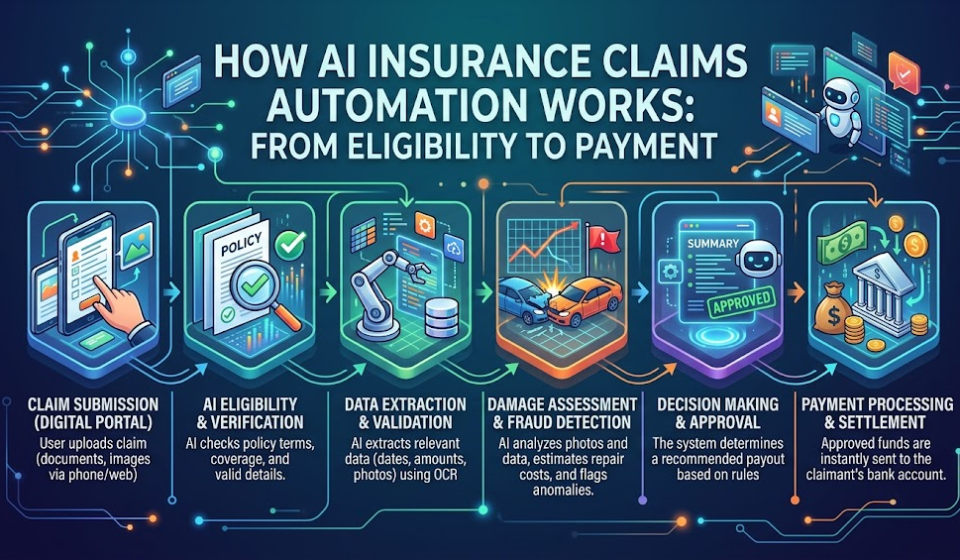
How AI Insurance Claims Automation Works: From Eligibility to Payment

Healthcare organizations are under growing pressure to process insurance claims faster while reducing denials, administrative costs, and revenue leakage. The problem is that a claim does not become clean simply because it is submitted electronically. Errors can enter much earlier, starting with patient eligibility, coverage details, coding, authorization, documentation, and payer-specific requirements.
That is where AI insurance claims automation is changing the revenue cycle. Instead of treating claims automation as a single step at the billing stage, modern AI systems can connect the entire workflow—from eligibility verification and claim creation to pre-submission validation, payer communication, denial management, remittance analysis, and payment posting.
The opportunity is significant. CAQH’s 2024 Index estimated that healthcare automation could avoid $222 billion in annual administrative costs, while another $20 billion in annual savings could be unlocked by moving administrative workflows to fully electronic processes.
At the same time, claim denials remain a major financial problem. HFMA reported that initial claim denials reached nearly 12% in 2024, increasing 2.4 percentage points year over year according to Kodiak Solutions data. Therefore, the real value of AI claims automation is not simply submitting claims faster. It is identifying problems before they become expensive downstream events.
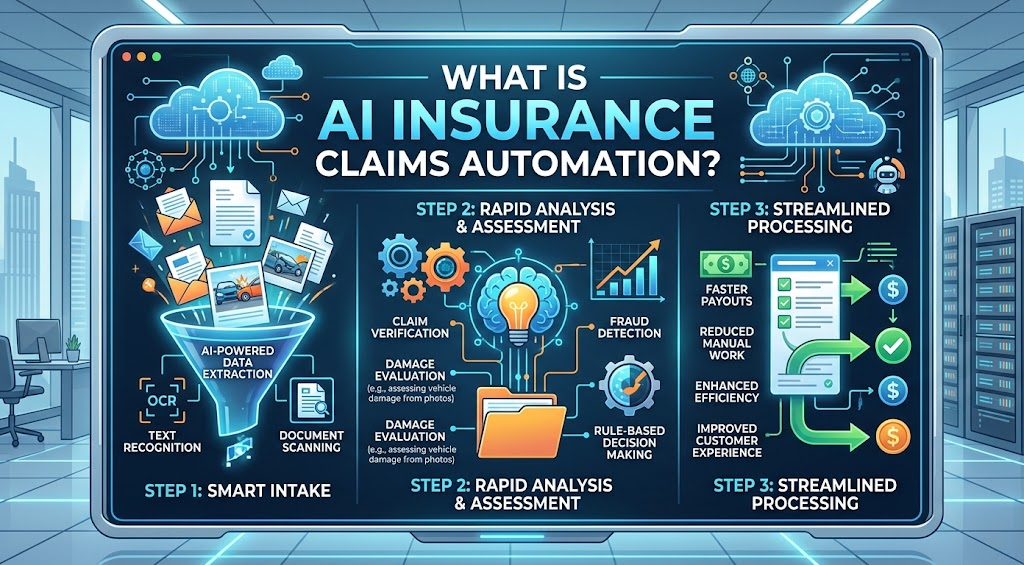
What Is AI Insurance Claims Automation?
AI insurance claims automation uses artificial intelligence, machine learning, natural language processing, rules engines, predictive analytics, and workflow automation to manage repetitive and decision-intensive insurance claim processes. Traditional automation generally follows predefined instructions.
For example, a rules-based system may check whether a member ID contains the correct number of characters. However, it may not understand that the patient’s coverage changed, that a procedure conflicts with the documented diagnosis, or that a particular payer frequently denies a specific claim pattern. AI adds another layer of intelligence.
A machine learning model can analyze historical claims, eligibility responses, coding patterns, payer behavior, remittance data, denial reasons, and other structured and unstructured information. It can then estimate the probability that a claim will encounter a problem and route the claim accordingly. Consequently, the workflow becomes predictive rather than purely reactive.
Why Traditional Insurance Claims Processing Creates Revenue Leakage
The biggest weakness in conventional claims processing is that organizations often discover errors after the claim reaches the payer. By that point, staff may need to investigate the denial, correct the claim, gather documentation, resubmit it, monitor the response, and potentially appeal the decision.
That process consumes time while delaying payment. HFMA’s claim integrity work emphasizes measuring initial denial rates, denial write-offs, time from denial to resolution, and the percentage of denials overturned because these metrics help organizations identify where claim integrity is breaking down.
The underlying problem usually begins earlier. A patient’s insurance may be inactive. The payer may require authorization. The provider may be out of network. A diagnosis may not support the procedure. A modifier may be missing. Documentation may not support medical necessity. Or the claim may contain information that conflicts with the payer’s current requirements.
Therefore, effective claims automation must look beyond the claim itself. It must understand the entire revenue cycle workflow.
How AI Insurance Claims Automation Works From Eligibility to Payment
AI Starts With Patient Eligibility and Insurance Verification
The first important step is confirming that the patient’s insurance information is accurate and usable before services are billed. Healthcare organizations traditionally verify eligibility through payer portals, phone calls, clearinghouses, or electronic transactions. Although electronic eligibility has become widespread, exceptions and incomplete information can still create downstream problems.
CMS supports the X12 270/271 eligibility transaction for determining beneficiary eligibility and obtaining information needed to prepare accurate Medicare claims. AI can make this process more intelligent by combining eligibility responses with patient and payer data.
For example, an AI-driven eligibility workflow can detect inconsistencies between the patient’s demographic information, member ID, payer, coverage dates, benefit information, and previous encounters. Instead of simply returning an eligibility response, the system can identify whether the information appears reliable enough to proceed.
If the system detects a potential problem, it can automatically create an exception for staff before the claim reaches the billing stage. This matters because preventing an eligibility-related claim error is generally more efficient than correcting the resulting denial. CAQH’s 2023 Index found that eligibility and benefit verification remained the largest savings opportunity among the transactions analyzed, with a potential medical-industry savings opportunity of $9.3 billion as electronic adoption increased.
AI Analyzes Coverage, Benefits, and Payer Requirements
Eligibility alone does not tell the complete story. A patient can have active insurance and still have coverage limitations that affect reimbursement. For example, a service may require prior authorization, fall outside the patient’s benefits, require a specific network relationship, or have cost-sharing requirements.
AI can combine eligibility responses with payer-specific rules, historical claims, authorization information, and benefit data to create a more complete claim-readiness profile. Natural language processing can also help interpret payer documents and unstructured information where appropriate.
As a result, the system can move from a simple question—”Is the patient insured?”—to a more useful question:
“Is this service likely to be reimbursed under the patient’s current coverage and payer requirements?”
That distinction is important for revenue cycle teams.
AI Identifies Authorization and Documentation Risks
Prior authorization is another major source of administrative friction. A claim can be clinically appropriate but still encounter payment problems if required authorization was not obtained or the submitted information does not match the authorization.
Modern interoperability standards are increasingly designed to support automated payer-provider workflows. For example, the HL7 Da Vinci Prior Authorization Support specification provides standardized mechanisms for submitting authorization information and supporting clinical data through FHIR-based workflows.
AI can sit on top of these workflows and analyze whether the available information appears complete. For instance, the system can compare the planned service, diagnosis, payer, authorization status, documentation, and historical patterns before allowing a claim to proceed.
If additional information is needed, the workflow can route the case to staff rather than allowing an incomplete claim to move forward. HL7’s current Da Vinci guidance also supports structured approaches for requesting and exchanging additional documentation and attachments.
AI Improves Coding and Claim Creation
Once eligibility and authorization risks are addressed, the next challenge is creating an accurate claim. This is where AI can analyze relationships between clinical documentation, diagnosis codes, procedure codes, modifiers, payer rules, and historical claim outcomes.
Machine learning models can identify patterns associated with rejected or denied claims. For example, a model may learn that a particular combination of procedure, diagnosis, modifier, provider specialty, payer, and place of service has historically generated a high rate of denials.
Rather than waiting for the payer to reject the claim, the system can flag the risk before submission. This is fundamentally different from conventional claim scrubbing. A traditional rules engine might ask:
“Does this claim violate a predefined rule?” An AI model can additionally ask:
“Based on similar historical claims, payer behavior, coding relationships, and available documentation, how likely is this claim to encounter a problem?” That predictive layer can help revenue cycle teams focus their attention where it matters most.
AI Predicts Claim Denials Before Submission
Denial prediction is one of the most valuable applications of AI insurance claims automation. A predictive model can use historical claims and outcomes to estimate denial risk. A typical architecture can include:
Input data → data normalization → feature engineering → ML prediction → risk score → explanation → workflow action → human review → claim submission
The input layer may include payer, provider, patient, diagnosis, procedure, modifier, authorization, eligibility, place of service, claim history, and previous denial information. The model can then generate a probability or risk category. However, a useful system should not simply produce a score. It should explain the likely reason for the risk. For example, instead of showing:
“High risk: 82%”
the system should ideally surface actionable signals such as:
“Modifier may be inconsistent with procedure.” “Diagnosis-procedure relationship differs from historical payer patterns.” “Authorization information is incomplete.” “Eligibility response contains a coverage discrepancy.” That makes AI useful to billing teams rather than turning it into another dashboard that staff must interpret manually.
AI Automates Electronic Claim Submission
After validation, the clean claim can move into electronic submission workflows. CMS describes electronic data interchange as the automated transfer of healthcare data using standardized transaction formats, including transactions between providers, clearinghouses, and health plans.
AI claims automation can work alongside EDI infrastructure rather than replacing it. The AI layer determines whether the claim is ready and identifies potential risks, while the transaction layer handles standardized exchange. This distinction is important for healthcare organizations evaluating AI vendors. A modern claims platform should not force organizations to abandon their existing clearinghouse, EHR, practice management system, or RCM infrastructure. Instead, AI should integrate into the existing ecosystem.
AI Monitors Claim Status After Submission
Submission is not the end of the claims workflow. A claim can remain pending, require additional information, be rejected, be denied, or move toward payment. AI can continuously monitor claim status and identify exceptions. Rather than requiring staff to manually check multiple payer systems, automated workflows can prioritize claims that need intervention.
For example, an AI system may recognize that a claim has remained unresolved longer than expected or that similar claims from the same payer are experiencing a particular issue. Consequently, staff can investigate exceptions instead of spending their day performing repetitive status checks.
AI Reads Remittance Advice and Explains Denials
Once the payer processes the claim, the organization receives payment information and, when applicable, denial or adjustment information. AI can analyze remittance data and classify the underlying reason. This becomes particularly valuable when denial information is difficult to interpret or when the same denial category has different operational causes.
The system can connect the remittance result with the original claim, eligibility information, coding, authorization, documentation, and payer history. As a result, the revenue cycle team can determine not only what happened, but also why it happened. This creates an important feedback loop. The denial becomes training data for future prevention.
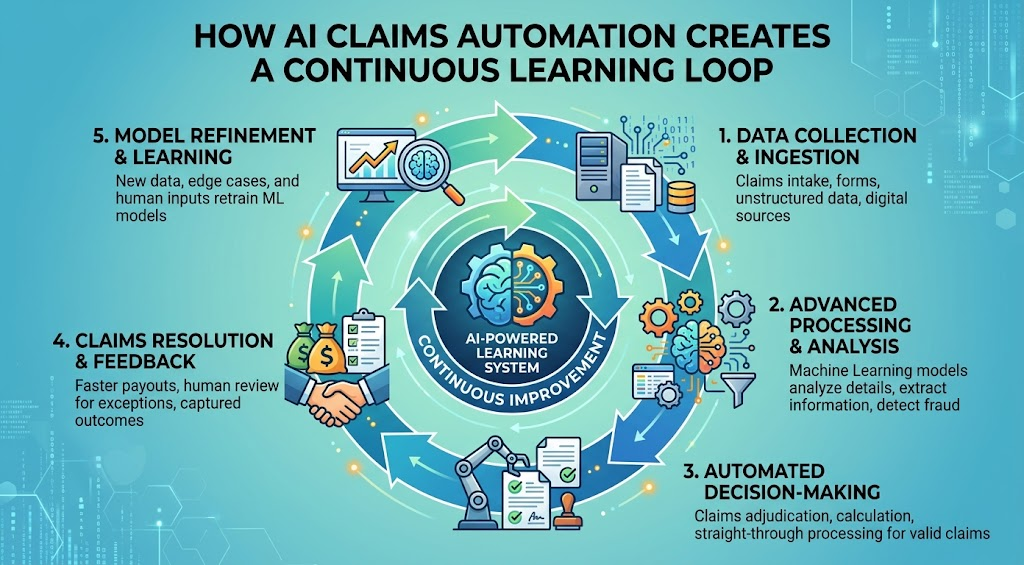
How AI Claims Automation Creates a Continuous Learning Loop
The most advanced AI insurance claims automation systems do not treat every claim as an isolated transaction. Instead, they continuously learn from outcomes. A simplified model looks like this:
Eligibility → Claim Creation → Risk Prediction → Submission → Adjudication → Payment/Denial → Root-Cause Analysis → Model Feedback → Future Prevention
Suppose 10,000 claims are processed. If 600 claims are denied and the system identifies that a significant portion share a particular payer, procedure, modifier, or documentation pattern, that information can become a new predictive signal. Over time, the model can improve its ability to identify similar risks before submission.
However, healthcare organizations should validate model performance continuously. AI predictions should be measured against actual outcomes, monitored for drift, and reviewed for unintended bias or incorrect recommendations. CMS has also emphasized the importance of guardrails around AI use in healthcare and equitable treatment when automated systems are involved.
What AI Insurance Claims Automation Means for Providers and Payers
For providers, the objective is straightforward: reduce avoidable denials, accelerate reimbursement, decrease manual work, and improve revenue visibility. For payers, intelligent automation can support more consistent processing, better data exchange, fraud and waste detection, and faster handling of administrative transactions.
The broader ecosystem is also moving toward greater interoperability. The current Da Vinci Payer Data Exchange guidance addresses the exchange of claims, encounter, clinical, and authorization information using standardized FHIR-based approaches. Therefore, organizations should evaluate AI claims automation as part of their broader interoperability and revenue cycle strategy rather than as an isolated billing tool.
What Should Healthcare Organizations Look for in an AI Claims Automation Platform?
The most important question is not whether a vendor says it uses AI. Instead, healthcare leaders should examine what the AI actually does. A meaningful platform should connect eligibility, authorization, coding, claim validation, submission, status monitoring, denial management, and payment intelligence.
It should also provide explainable predictions rather than unexplained scores. Integration is equally important. The solution should work with existing EHR, PM, RCM, clearinghouse, payer, API, and EDI environments. Finally, organizations should examine security, auditability, model governance, human oversight, performance monitoring, and measurable financial outcomes. AI should reduce operational complexity—not create another disconnected system for revenue cycle staff.
How Aiclaim Uses AI to Move Claims From Reactive to Predictive
Aiclaim approaches claims automation around a simple revenue cycle principle: identify the problem before the payer identifies it. Its AI-powered claims intelligence approach can analyze claim information before submission and identify potential denial risks. For revenue cycle teams, this means shifting from a reactive workflow—submit, deny, investigate, correct, resubmit—to a more predictive workflow:
verify → analyze → predict → correct → submit → monitor → learn
This approach is particularly relevant for organizations dealing with high claim volumes, growing denial workloads, payer complexity, and limited revenue cycle staffing. Aiclaim’s ClearClaim platform is designed around AI-powered denial prediction and pre-submission claim intelligence, helping organizations identify potential claim issues before they become costly downstream work.
Frequently Asked Questions About AI Insurance Claims Automation
What is AI insurance claims automation?
AI insurance claims automation uses machine learning, artificial intelligence, rules, data analysis, and workflow automation to streamline insurance claims from eligibility verification through claim submission, adjudication, denial management, and payment.
How does AI reduce insurance claim denials?
AI can analyze historical claim outcomes, payer patterns, coding relationships, eligibility information, authorization data, and other claim attributes to identify potential denial risks before submission. The goal is to correct preventable problems before they reach the payer.
Can AI verify insurance eligibility automatically?
Yes. AI can work with electronic eligibility transactions such as X12 270/271 and combine eligibility responses with other available patient, payer, and historical information. CMS recognizes the 270/271 transaction for eligibility-related Medicare workflows.
Can AI automate the entire claims process?
AI can automate significant portions of the claims workflow, but organizations should retain human oversight for exceptions, complex clinical or coding decisions, disputed claims, and situations where the model lacks sufficient information.
What is the difference between claims automation and AI claims automation?
Traditional claims automation generally follows predefined rules and workflows. AI claims automation can additionally learn patterns from historical data, predict risks, classify outcomes, and prioritize actions based on probabilities and contextual information.
How quickly can AI claims automation improve revenue cycle performance?
The timeframe depends on claim volume, data quality, integration complexity, payer mix, workflow maturity, and the specific automation being implemented. Organizations should establish a baseline before deployment and measure denial rate, clean-claim rate, days in A/R, manual touches, payment turnaround, and denial recovery after implementation.
The Future of AI Insurance Claims Automation
The next stage of healthcare claims automation will move beyond automating individual transactions. AI systems are increasingly becoming decision-support and workflow orchestration layers that connect eligibility, authorization, coding, claims, payer communication, remittance, and payment data.
At the same time, interoperability standards such as FHIR and the Da Vinci implementation guides are creating more structured ways for providers and payers to exchange administrative and clinical information. The organizations that benefit most will not necessarily be those that automate the largest number of tasks.
Instead, the focus will be on automating the right decisions at the right point in the revenue cycle.
That means identifying an eligibility problem before registration becomes a billing problem, identifying a coding issue before submission becomes a denial, and identifying a denial pattern before it becomes a recurring revenue leakage problem. Ultimately, AI insurance claims automation is about moving revenue cycle management from reactive correction to proactive prevention.
If your organization is still discovering most claim problems after payer adjudication, there is a significant opportunity to move intelligence upstream.
Ready to see where AI can identify claim risk before submission? Explore Aiclaim’s AI-powered claim intelligence and denial prevention approach.
See How AI Can Predict Claim Denials Before Submission →
Get the Healthcare AI Claims Automation Checklist: 25 Questions Providers and Payers Should Ask Before Choosing an AI Claims Platform.