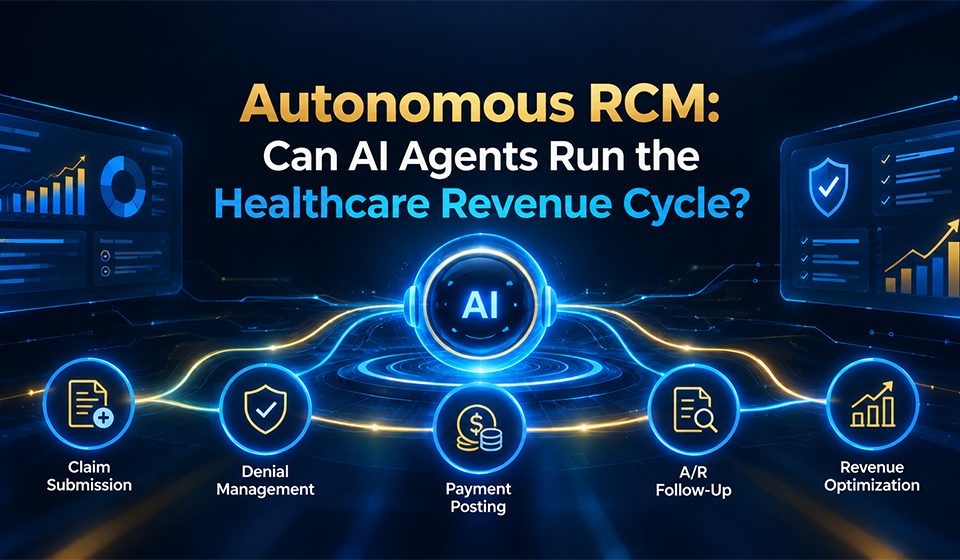

Healthcare revenue cycle management is moving beyond simple automation. Instead of asking software to complete one predefined task, providers are beginning to explore AI agents that can understand a workflow, make decisions, take action, monitor outcomes, and escalate exceptions when human judgment is required.
This shift is creating a new model: autonomous RCM. The opportunity is significant because healthcare organizations continue to lose revenue through eligibility errors, coding issues, prior authorization delays, claim denials, underpayments, and slow accounts receivable follow-up. HFMA reported that initial claim denial rates reached nearly 12% in 2024, while denial complexity continues to increase.
At the same time, AI adoption across revenue cycle operations is accelerating. Oliver Wyman’s 2026 Healthcare RCM Survey found that roughly 20% to 40% of surveyed organizations reported broad or enterprise-wide use of AI-enabled tools across different parts of the revenue cycle.
Therefore, the real question is no longer whether AI belongs in RCM. The more important question is whether AI agents can safely operate the revenue cycle with minimal human intervention. The answer is: AI agents can autonomously manage many RCM workflows, but fully autonomous RCM still requires human oversight, governance, exception handling, and measurable controls.
What Is Autonomous RCM?
Autonomous RCM is an AI-driven approach in which intelligent software agents continuously analyze revenue cycle data and perform appropriate actions without requiring staff to manually initiate every step. Traditional RCM automation generally follows predefined rules. For example, a system may verify insurance eligibility, submit a claim, or send a payment reminder when a specific condition is met.
Autonomous RCM goes further. An AI agent can evaluate patient, clinical, payer, claim, coding, and payment information. It can then determine what action should happen next. Furthermore, it can learn from historical outcomes and use predictive models to prioritize higher-risk claims or accounts.
For example, an autonomous RCM workflow could identify a high-risk claim before submission, determine that a modifier is missing, compare the claim against payer-specific patterns, recommend the appropriate correction, and route the claim for approval before submission. Consequently, the revenue cycle becomes more proactive instead of reactive.
Why Traditional RCM Still Creates Revenue Leakage
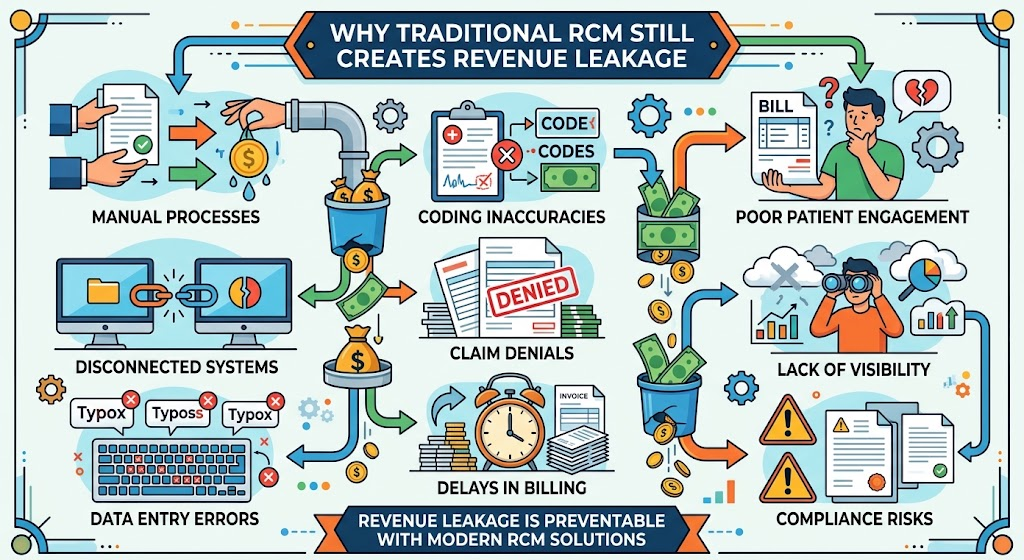
Healthcare organizations have invested heavily in EHRs, billing platforms, clearinghouses, payer portals, and RCM software. However, these systems often operate as disconnected components. As a result, staff may still move information between systems, investigate exceptions manually, search payer policies, review claim status, and determine which accounts deserve attention first.
That creates several costly problems. Eligibility errors can create front-end denials before the clinical encounter has even generated revenue. Coding inconsistencies can cause claims to fail payer edits. Prior authorization problems can delay reimbursement. Meanwhile, denied claims can remain unresolved because RCM teams must manually investigate thousands of accounts.
The financial impact can become substantial. HFMA reported in 2026 that hospitals can lose approximately 3% to 5% of net revenue through revenue leakage caused by inefficiencies, missed billing opportunities, and underpayments. Therefore, simply adding more staff does not solve the underlying problem. Organizations need systems that can identify risk earlier and act faster.
How AI Agents Change Revenue Cycle Management
AI agents introduce a decision-making layer into RCM automation. Instead of waiting for employees to determine what should happen next, an agent can evaluate the available data, select an appropriate action, execute the workflow, and monitor the result. A simplified autonomous RCM workflow looks like this:
Data → AI reasoning → Risk prediction → Decision → Action → Outcome monitoring → Learning
For example, an eligibility agent can identify an inactive policy. A claim intelligence agent can then evaluate the potential denial risk. A coding agent can identify documentation or code inconsistencies. Finally, a denial management agent can analyze the payer response and determine the next appropriate action.
Importantly, these agents should not operate as uncontrolled black boxes. A reliable autonomous RCM platform should combine machine learning, natural language processing, rules engines, retrieval-augmented generation, predictive analytics, workflow orchestration, and human approval controls. That combination allows AI to automate repetitive decisions while keeping high-risk decisions within defined governance boundaries.
Can AI Agents Run the Entire Healthcare Revenue Cycle?
Not safely—not yet. However, AI agents can potentially manage significant portions of the revenue cycle when organizations deploy them according to risk and workflow complexity. The strongest opportunity exists in repetitive, data-intensive, rules-driven workflows.
For instance, AI agents can support eligibility verification by checking coverage information and identifying inconsistencies. They can support prior authorization by determining documentation requirements and tracking authorization status. They can evaluate claims before submission for potential errors.
Likewise, AI agents can monitor claim acknowledgments, identify unusual payer responses, prioritize denied claims, analyze denial reasons, and recommend appropriate next actions. The critical distinction is between autonomous execution and autonomous accountability.
An AI agent can execute a workflow. However, healthcare organizations still need people to establish policies, monitor performance, manage compliance, investigate unusual cases, and approve decisions that carry significant financial or clinical consequences.
Therefore, the realistic goal is not “remove humans from RCM.” Instead, the goal is to remove unnecessary manual work while allowing RCM experts to focus on exceptions and strategic decisions.
Where AI Agents Can Automate the Revenue Cycle
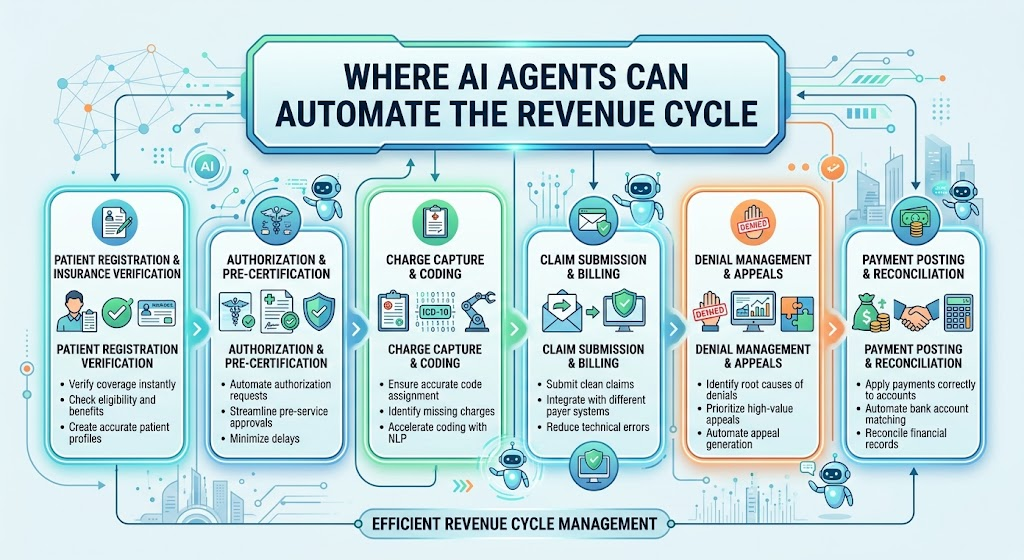
Patient Access and Eligibility Verification
The revenue cycle begins before a claim exists. If patient demographics, insurance information, member IDs, coverage status, or benefit information are incorrect, downstream claim problems become more likely. An AI eligibility agent can continuously evaluate available information and identify discrepancies before the patient encounter or claim submission.
Furthermore, CAQH data shows how expensive manual administrative transactions can be. Its transaction cost analysis places manual eligibility and benefit verification at $8.39 across the industry compared with $0.49 for electronic processing. Therefore, intelligent automation at the front end can reduce both administrative cost and downstream revenue leakage.
Coding and Claim Validation
Coding remains another important opportunity for AI agents. A coding intelligence agent can evaluate clinical documentation, diagnosis codes, procedure codes, modifiers, payer-specific requirements, and historical claim outcomes. Rather than simply identifying that something is wrong, an advanced agent can explain why the claim appears risky and recommend the next action.
For example, if a claim contains a diagnosis-procedure mismatch, the system can flag the issue before submission instead of allowing the payer to discover it later. This changes the economics of denial management because prevention generally occurs before the organization spends additional labor on appeals and follow-up.
Prior Authorization Automation
Prior authorization is becoming increasingly digital and data-driven. CMS has established requirements around electronic prior authorization and interoperability APIs, while its 2026 proposed rule expands attention to electronic prior authorization for drugs and proposes additional interoperability requirements.
Consequently, AI agents can play an important role in determining whether authorization may be required, identifying supporting documentation, tracking requests, and monitoring payer responses. However, organizations should connect these workflows to authoritative payer and clinical data rather than allowing an AI model to independently invent requirements.
Denial Prediction and Prevention
Denial management is perhaps one of the strongest use cases for autonomous RCM. Traditional denial management begins after the payer rejects a claim. Autonomous RCM aims to begin much earlier. A predictive model can analyze historical claims, payer behavior, diagnosis and procedure combinations, patient coverage, provider patterns, authorization data, and previous denial outcomes.
The model can then generate a risk score before submission. For example, a claim could receive a low, medium, or high denial-risk score. The workflow engine can then determine whether to submit automatically, request additional information, or send the claim to an RCM specialist. HFMA’s 2026 reporting specifically highlights the movement toward using AI to predict, prevent, and manage denials rather than relying only on post-denial recovery.
Accounts Receivable and Underpayment Detection
Autonomous RCM can also extend beyond claims. An AI agent can monitor unpaid claims, identify accounts approaching payer-specific thresholds, detect unusual payment patterns, and prioritize accounts based on expected financial impact. For example, instead of asking employees to work accounts in chronological order, an AI system can rank them based on expected recovery value, probability of payment, aging, payer behavior, and required intervention.
Consequently, RCM teams can spend more time on accounts where human intervention is most valuable.
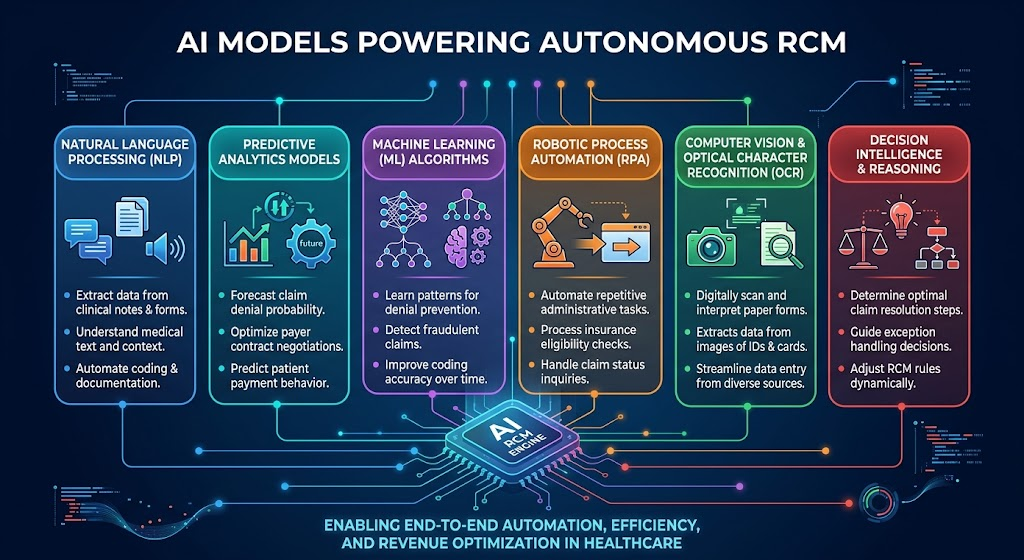
What AI Models Power Autonomous RCM?
Autonomous RCM does not depend on a single AI model. Instead, a mature architecture can combine multiple models for different tasks. Predictive machine-learning models can estimate denial probability, payment probability, and account risk. Natural language processing models can interpret clinical documentation, payer correspondence, denial descriptions, and remittance information.
Large language models can summarize complex cases and generate explanations for RCM specialists. Retrieval-augmented generation can connect AI responses to approved payer policies, internal knowledge bases, contracts, coding references, and operational documentation. Meanwhile, rules engines can enforce deterministic requirements where a probabilistic AI model should not make the final decision.
Finally, an orchestration layer can coordinate multiple specialized agents. This architecture is important because healthcare revenue cycle decisions require both intelligence and control.
What Does an Autonomous RCM Agent Actually Do?
A useful way to understand an AI agent is to look at its decision loop. The agent first observes data from the EHR, practice management system, clearinghouse, payer response, or other connected systems. Next, it interprets the information and identifies the objective.
Then, the agent evaluates possible actions using predictive models, rules, historical outcomes, and approved knowledge sources. Afterward, it executes the permitted action. Finally, it monitors the result and determines whether the workflow succeeded or requires escalation. For example, suppose a claim has a high probability of denial.
The agent can identify the likely cause, retrieve the relevant payer requirement, compare the claim against the requirement, recommend a correction, and route the claim to an employee if approval is necessary. That is fundamentally different from a simple rules-based alert.
The Biggest Risk: Letting AI Make Uncontrolled RCM Decisions
Autonomous RCM creates enormous potential, but healthcare organizations should not treat AI agents as unrestricted digital employees. The biggest risk comes from giving an AI system authority without sufficient controls. An agent could make an incorrect interpretation, use outdated payer information, misunderstand clinical documentation, or execute an inappropriate action.
Therefore, autonomous RCM requires governance. Organizations should define which decisions AI can make independently, which decisions require approval, which actions require additional verification, and which workflows should never be automated without human review. Audit trails are equally important.
Every important AI decision should be traceable to the information, model output, policy, rule, or workflow condition that influenced it. This approach creates explainable automation instead of uncontrolled automation.
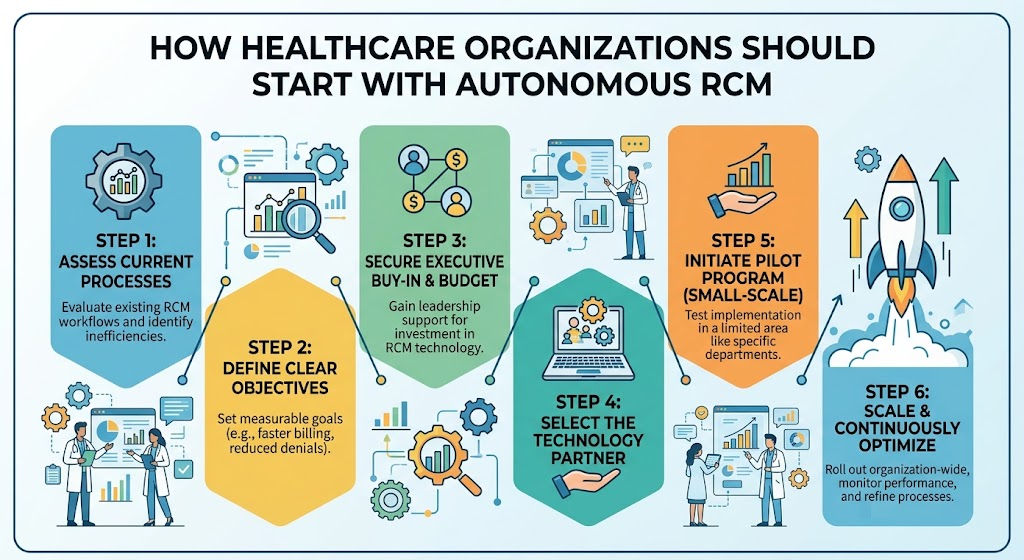
How Healthcare Organizations Should Start With Autonomous RCM
Organizations should not attempt to automate the entire revenue cycle at once. Instead, they should identify high-volume workflows where manual work creates measurable financial leakage. Denial prediction is one strong starting point because the organization can measure denial rates before and after implementation. Eligibility verification is another strong opportunity because errors can be identified before they become claims problems.
Likewise, accounts receivable prioritization can demonstrate measurable improvements through days in A/R, recovery rates, and staff productivity. Once the organization proves value, it can expand the agent architecture into coding validation, prior authorization, claim status, denial management, payment variance analysis, and other workflows.
The implementation should also connect AI to existing systems rather than creating another isolated dashboard. For CTOs and CIOs, interoperability should therefore be a core evaluation criterion. CMS’s current interoperability direction reinforces the importance of APIs and standardized healthcare data exchange, particularly around prior authorization and payer-provider workflows.
What CEOs and CFOs Should Measure
Autonomous RCM should not be evaluated based on AI sophistication alone. Executives should measure financial and operational outcomes. Important measurements include initial denial rate, preventable denial rate, clean claim rate, days in A/R, net collection rate, cost to collect, authorization turnaround time, underpayment recovery, staff productivity, and recovered revenue.
Equally important, organizations should measure the percentage of workflows completed autonomously and the percentage requiring human intervention. That distinction helps leadership understand whether AI is actually reducing operational workload. Ultimately, the strongest business case comes from connecting AI activity to financial results.
The Future of Autonomous RCM Is Human-Guided, Not Human-Free
The future of RCM will not necessarily be a healthcare organization where AI makes every decision. Instead, the more practical model is a human-guided autonomous revenue cycle. AI agents can monitor thousands of transactions continuously. They can detect patterns that humans would struggle to identify manually. They can prioritize work, perform repetitive actions, explain complex cases, and escalate exceptions.
Meanwhile, RCM professionals can focus on complex payer issues, unusual claims, policy decisions, financial strategy, and cases where judgment matters most. That combination can create a more scalable revenue cycle without sacrificing accountability.
Can AI Agents Run Healthcare RCM? The Short Answer
Yes, AI agents can autonomously perform many healthcare revenue cycle workflows, but they should not operate without governance or human oversight. The strongest model combines AI agents with predictive analytics, deterministic rules, healthcare integrations, payer intelligence, audit trails, and human escalation.
In other words, autonomous RCM is not about replacing the revenue cycle team. It is about creating a revenue cycle that can see risk earlier, make decisions faster, take action automatically, and involve humans only when their expertise is needed.
What Autonomous RCM Means for Healthcare Organizations
Healthcare organizations that continue to rely entirely on manual RCM processes may face increasing labor pressure, growing denial complexity, and slower response times. At the same time, organizations that deploy AI without governance may create new operational and compliance risks.
Therefore, the winning strategy is intelligent orchestration. The revenue cycle should continuously evaluate what happened, determine what is likely to happen next, decide what action creates the best outcome, and execute that action within clearly defined controls.
That is the foundation of autonomous RCM. For healthcare leaders evaluating AI revenue cycle management, the next step should not be asking, “Can AI replace our RCM team?” Instead, ask:
Which revenue cycle decisions can AI make safely today, and where can autonomous execution create measurable financial value? That question moves the conversation from AI experimentation to measurable revenue transformation.
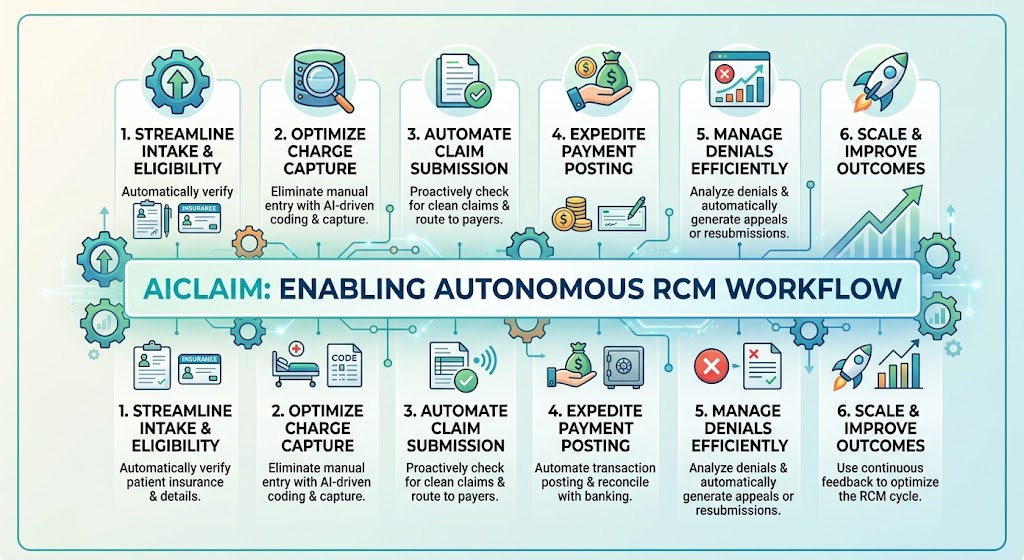
How Aiclaim Can Help Build a More Autonomous RCM Workflow
Aiclaim focuses on using AI-driven intelligence to help healthcare organizations identify revenue-cycle risk before it becomes a costly problem. With intelligent claim analysis, organizations can move from reactive denial management toward proactive claim intelligence. Instead of waiting for a payer to reject a claim, AI can help identify potential problems earlier and give RCM teams an opportunity to intervene.
This approach supports the broader transition from traditional RCM automation toward autonomous, continuously monitored revenue operations.
Ready to evaluate where AI agents could automate your revenue cycle?
Explore Aiclaim’s AI-powered revenue cycle capabilities or contact the team to identify high-value workflows for automation. Start Your AI-Powered RCM Assessment
Download the Autonomous RCM Readiness Checklist: 25 AI Workflows Healthcare Leaders Should Evaluate Before 2027.
Frequently Asked Questions About Autonomous RCM
What is autonomous RCM?
Autonomous RCM is an AI-driven revenue cycle model where intelligent agents analyze healthcare financial workflows, make permitted decisions, execute actions, monitor outcomes, and escalate exceptions to human specialists.
Can AI agents replace RCM staff?
AI agents can automate many repetitive RCM tasks, but they should not completely replace RCM professionals. Human oversight remains important for complex claims, exceptions, governance, compliance, and high-impact financial decisions.
How do AI agents reduce claim denials?
AI agents can analyze eligibility, coding, authorization, payer behavior, documentation, and historical claim outcomes before submission. Predictive models can then identify high-risk claims so staff can correct issues before the payer rejects them.
Is autonomous RCM safe for healthcare organizations?
Autonomous RCM can be deployed safely when organizations use controlled workflows, access permissions, audit trails, approved data sources, deterministic rules, model monitoring, and human escalation for high-risk decisions.
What is the difference between RCM automation and autonomous RCM?
Traditional RCM automation usually follows predefined rules. Autonomous RCM adds AI-driven reasoning, prediction, decision-making, workflow execution, monitoring, and adaptive prioritization.
What should healthcare organizations automate first?
Organizations should start with high-volume, measurable workflows such as eligibility verification, claim validation, denial prediction, prior authorization tracking, claim-status follow-up, A/R prioritization, and payment variance detection.
What will autonomous RCM look like in the future?
The future will likely combine specialized AI agents, predictive models, healthcare APIs, payer intelligence, workflow orchestration, and human oversight. Instead of replacing the entire RCM department, AI will increasingly act as an always-on operational layer across the revenue cycle.