
Choosing the best AI RCM software for your practice is no longer simply a technology decision.
It directly affects how quickly claims are submitted and how many denials your team needs to manage. It also determines how efficiently your staff works and how consistently your practice receives payment for the care it provides.
However, the growing number of AI revenue cycle management platforms has made it harder for practices to choose the right solution. How do you know which AI RCM software will actually improve your revenue cycle instead of adding another complicated system to manage?
Answer is not to choose the platform with the most impressive AI features.Instead, practices should evaluate how effectively the software identifies revenue risks and fits into existing workflows. They should also assess its EHR and practice management integrations, data security, and ability to deliver measurable financial results.
That distinction matters because claim denials continue to create significant operational pressure. HFMA reported that denial rates averaged close to 12% in 2025, with many organizations experiencing even higher levels. Consequently, selecting an AI RCM platform that focuses on prevention rather than simply processing more claims can make a meaningful difference.
Why Practices Are Moving From Traditional RCM to AI-Powered RCM
Traditional RCM workflows depend heavily on manual claim review, repetitive eligibility checks, coding validation, authorization follow-up, payment posting, and denial work. Although these processes can work, they become difficult to scale when claim volumes increase and payer rules become more complex.
For example, a small coding error may appear insignificant at the time of claim creation. Nevertheless, that error can trigger a denial, create additional staff work, delay reimbursement, and eventually increase accounts receivable.
AI-powered RCM software approaches the problem differently. AI analyzes claims, payer behavior, coding, documentation, and authorization data to identify risks before they cause costly denials.
Furthermore, current healthcare payment workflows are becoming increasingly digital. CMS requirements around interoperability and electronic prior authorization are pushing healthcare organizations toward more connected, automated processes. Some CMS interoperability and prior authorization requirements began in 2026, while additional API requirements have later deadlines.
Therefore, practices need RCM software that can evolve with this environment rather than simply automate yesterday’s workflow.
What Should the Best AI RCM Software Actually Do?
The best AI RCM software should solve specific revenue problems rather than simply provide an AI label. A practice should first identify where revenue is being lost. Is the biggest problem claim denials? Eligibility errors? Coding inconsistencies? Prior authorization delays? Slow AR follow-up? Underpayments? Manual billing tasks?
Once those problems are clear, the software can be evaluated against measurable outcomes.
AI-Powered Claim Prediction and Denial Prevention
Denial prevention should be one of the most important evaluation criteria. A conventional claim scrubber generally checks predefined rules. While that remains useful, AI-powered systems can go further by identifying patterns associated with previous denials and recognizing relationships across multiple data points.
AI can analyze payer, procedure, diagnosis, provider, documentation, and claim history to predict elevated denial risk. The important question, therefore, is not simply, “Does this platform have AI?”
Instead, ask, “Can this platform identify why a claim may fail before I submit it?”
That shift from reactive denial management to predictive denial prevention can help teams focus their attention where it matters most.
Intelligent Medical Coding and Documentation Validation
Coding errors can quickly become revenue problems. A strong AI RCM platform should help identify potential mismatches between clinical documentation, diagnosis codes, procedure codes, modifiers, payer requirements, and claim information.
However, practices should avoid systems that promise completely autonomous coding without appropriate validation and human oversight. Healthcare revenue cycle decisions require context. AI should assist qualified professionals by identifying risks, inconsistencies, and opportunities for review rather than becoming an uncontrolled black box.
Automated Eligibility and Prior Authorization Workflows
Eligibility and prior authorization problems are another major source of avoidable administrative work. Consequently, an AI RCM platform should help teams verify coverage information, identify missing requirements, track authorization status, and reduce repetitive follow-up.
This capability is becoming even more important as CMS continues to advance electronic prior authorization and interoperability standards. In 2026, CMS also proposed additional interoperability standards for electronic prior authorization for drugs, demonstrating that the direction of healthcare administration is increasingly toward connected, electronic workflows. For practices, this means the software selected today should be capable of supporting increasingly automated payer interactions tomorrow.

Integration Matters More Than an Impressive AI Demo
One of the most common mistakes practices make is choosing software because its demonstration looks impressive. A 30-minute demo can show powerful dashboards and sophisticated AI predictions. Nevertheless, the real test begins after implementation. The platform should integrate smoothly with the systems your practice already uses, including your EHR, practice management software, clearinghouse, billing workflow, and other relevant revenue cycle systems.
If employees must constantly export spreadsheets, manually transfer data, or switch between disconnected platforms, much of the promised efficiency disappears. Therefore, ask vendors to demonstrate the actual workflow using realistic scenarios.
Ask how patient and claim information enters the platform, how recommendations are generated, how staff receive alerts, how corrections are returned to the billing workflow, and how outcomes are tracked. A useful AI platform should fit into the revenue cycle instead of forcing your revenue cycle team to work around the software.
How to Evaluate AI Accuracy and Model Performance
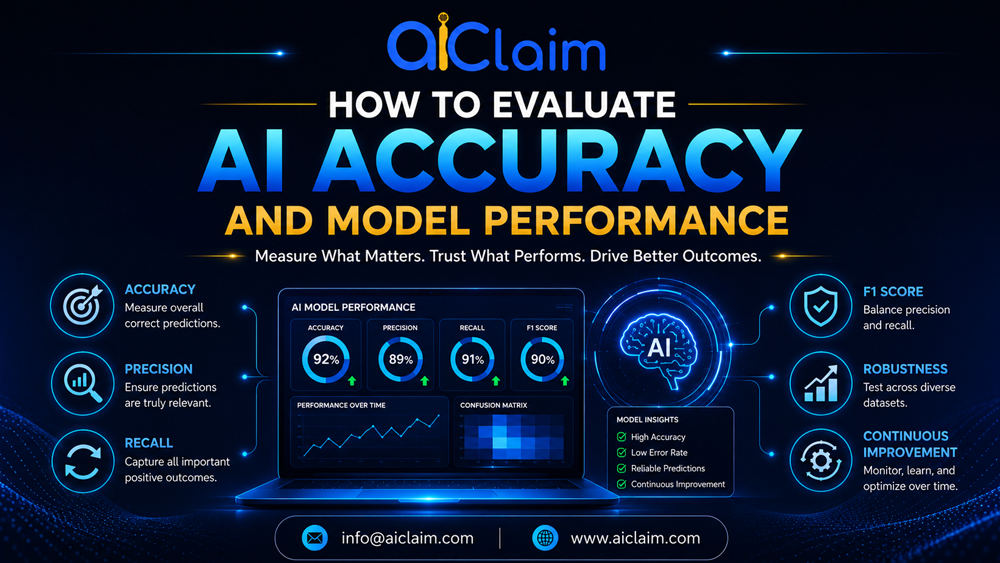
AI accuracy deserves careful attention because “AI-powered” does not automatically mean “accurate.”Ask the vendor which data the model uses, how the team validates its predictions, how often the team evaluates the model, and how the vendor measures performance after deployment.
You should also understand whether the system uses machine learning, natural language processing, predictive analytics, generative AI, rules-based validation, or a combination of these technologies. More importantly, look for measurable performance indicators. For example, evaluate whether the platform can demonstrate improvement in clean claim rates, denial rates, first-pass acceptance, authorization turnaround time, AR days, staff productivity, or recovered revenue.
A trustworthy vendor should be able to explain its methodology clearly instead of relying on vague statements such as “our AI is highly accurate.”
Security, Compliance and Human Oversight Cannot Be Optional
Healthcare RCM software handles highly sensitive information. Therefore, security and compliance should be evaluated before functionality. Ask how patient information is protected, where data is processed, how access is controlled, whether activity is logged, and what security standards and contractual safeguards are available.
At the same time, AI governance deserves equal attention. Healthcare organizations need to know when an AI system makes a recommendation, what information influenced that recommendation, and when a human should review it.
This is particularly important because research on AI in healthcare continues to highlight concerns around fairness, transparency, accountability, and data quality. In practical terms, the best AI RCM solution should make your team more informed and efficient, not remove accountability from the process.
Calculate ROI Before Signing a Contract
Software cost alone does not tell you whether an AI RCM platform is affordable. Instead, calculate the financial impact of your current problems. Suppose your practice loses revenue because of preventable denials. In that case, estimate the annual value of those denials, the staff hours spent correcting them, the additional billing work created by resubmissions, and the revenue delayed by those problems.
Then compare those costs with the expected cost of the AI RCM platform. Also consider the value of recovered staff time.
If your billing team spends hours every week searching for claim errors, checking payer websites, monitoring authorization status, or manually identifying denial patterns, automation can create value even before considering additional collections.
The strongest business case is therefore based on measurable outcomes rather than software features.
Avoid These Common AI RCM Buying Mistakes
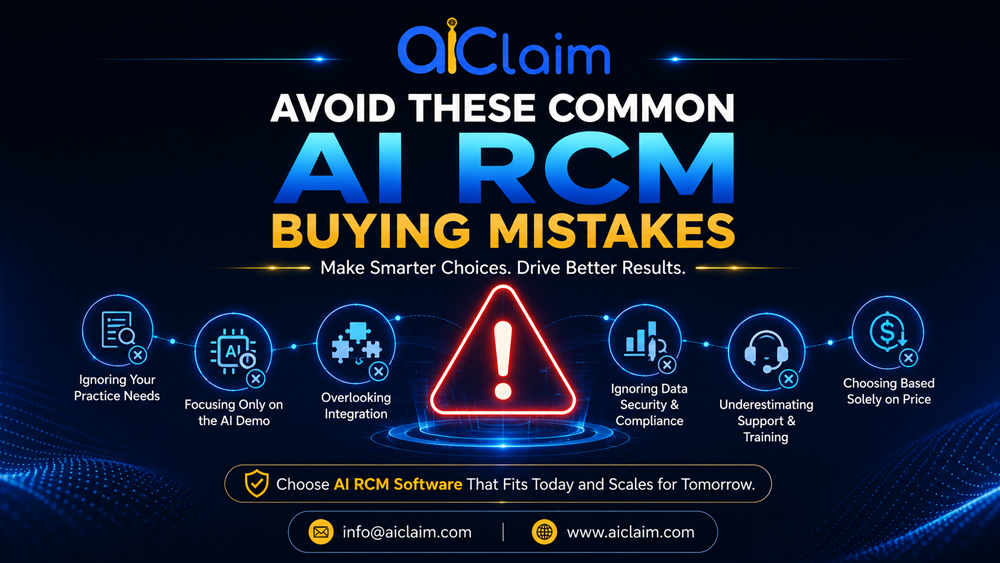
A practice can easily choose the wrong platform by focusing on technology instead of outcomes. One common mistake is selecting a platform that offers dozens of features but does not solve the practice’s biggest revenue problem. Another is choosing software that requires major workflow changes without providing adequate implementation support.
Likewise, a low subscription price can become expensive if the system creates additional manual work or fails to integrate properly. Finally, avoid choosing a vendor that cannot clearly explain how its AI makes predictions, how performance is measured, and how human review fits into the workflow.
The best AI RCM software should make your revenue cycle easier to understand, easier to manage, and easier to improve.
A Practical AI RCM Software Evaluation Framework
Before making a final decision, evaluate the platform across five areas: revenue impact, AI capability, workflow integration, security and governance, and scalability. Start with revenue impact. Determine whether the software can address the specific sources of lost or delayed revenue in your organization.
Next, examine AI capability. Look for predictive analytics, denial-risk identification, intelligent automation, and continuous performance monitoring rather than marketing language alone. Then evaluate integration. The platform should connect with your existing technology without creating unnecessary manual processes.
After that, review security, compliance, transparency, and human oversight. Finally, consider scalability. Your practice may process a certain number of claims today, but that volume could change significantly as you add providers, locations, specialties, or services.
Why Predictive RCM Is Becoming the Next Competitive Advantage
The direction of healthcare revenue cycle management is changing from reactive correction to proactive prevention.
Payers are increasingly using sophisticated technologies to evaluate claims, while providers are responding with AI-powered tools for coding, documentation, denial prevention, and revenue optimization. Reuters reported in 2026 that both insurers and healthcare organizations are increasingly using AI in the ongoing struggle over claims and payments.
As a result, practices that continue relying entirely on manual review may find it increasingly difficult to keep pace. Predictive RCM provides a different approach. Rather than asking why a claim was denied after the money is already delayed, the system asks what can be changed before submission.
That is where AI can create its greatest financial value.
How AIclaim Can Help Your Practice Strengthen Revenue Performance
Aiclaim takes a prevention-focused approach to healthcare revenue cycle management. Its AI-powered RCM capabilities are designed to help healthcare organizations improve billing efficiency, identify revenue risks, manage denials, strengthen coding accuracy, and improve overall revenue performance.
For practices specifically focused on claim-denial risk, ClearClaim provides an AI-powered denial prediction approach designed to identify potential claim problems before submission. Instead of waiting for a payer response and then assigning staff to investigate the denial, predictive technology can help your team prioritize claims that require attention before they become costly rework.
The Bottom Line: Choose the AI RCM Platform That Solves Your Problem
The best AI RCM software for your practice is not necessarily the platform with the biggest feature list or the most impressive AI terminology. Instead, it is the platform that understands your revenue cycle, integrates with your existing workflow, identifies preventable risks, protects sensitive information, provides measurable results, and gives your team actionable information before revenue is lost.
Start by identifying your biggest revenue leakage points. Then evaluate AI RCM vendors against those specific problems. Most importantly, ask vendors to prove the value of their technology using measurable outcomes.
When AI is applied correctly, RCM becomes more than an administrative function. It becomes a proactive financial intelligence system that helps your practice prevent avoidable problems, reduce manual work, accelerate reimbursement, and protect revenue.
Get Your AI RCM Readiness Assessment
Not sure whether your practice is ready for AI-powered revenue cycle management?
Start with a practical assessment of your current claim workflow, denial patterns, billing processes, and automation opportunities. Identify where revenue is being lost before investing in another RCM technology.
Explore AI-powered RCM solutions from Aiclaim and discover where predictive automation can fit into your existing revenue cycle.