
Why Faster Insurance Claim Approvals Matter More Than Ever
Insurance claim approvals have become one of the biggest operational challenges for healthcare providers and insurance companies. Even a small delay in claim processing can create serious financial pressure for hospitals, disrupt revenue cycles, increase administrative workload, and negatively affect patient experience. Moreover, as claim volumes continue to rise, many organizations are finding it increasingly difficult to manage approvals efficiently using traditional manual processes.
At the same time, healthcare providers are expected to maintain accuracy, comply with changing payer regulations, reduce claim denials, and accelerate reimbursements without increasing operational costs. However, manual verification, repetitive documentation reviews, coding errors, and outdated workflows often slow down the entire claims approval process.
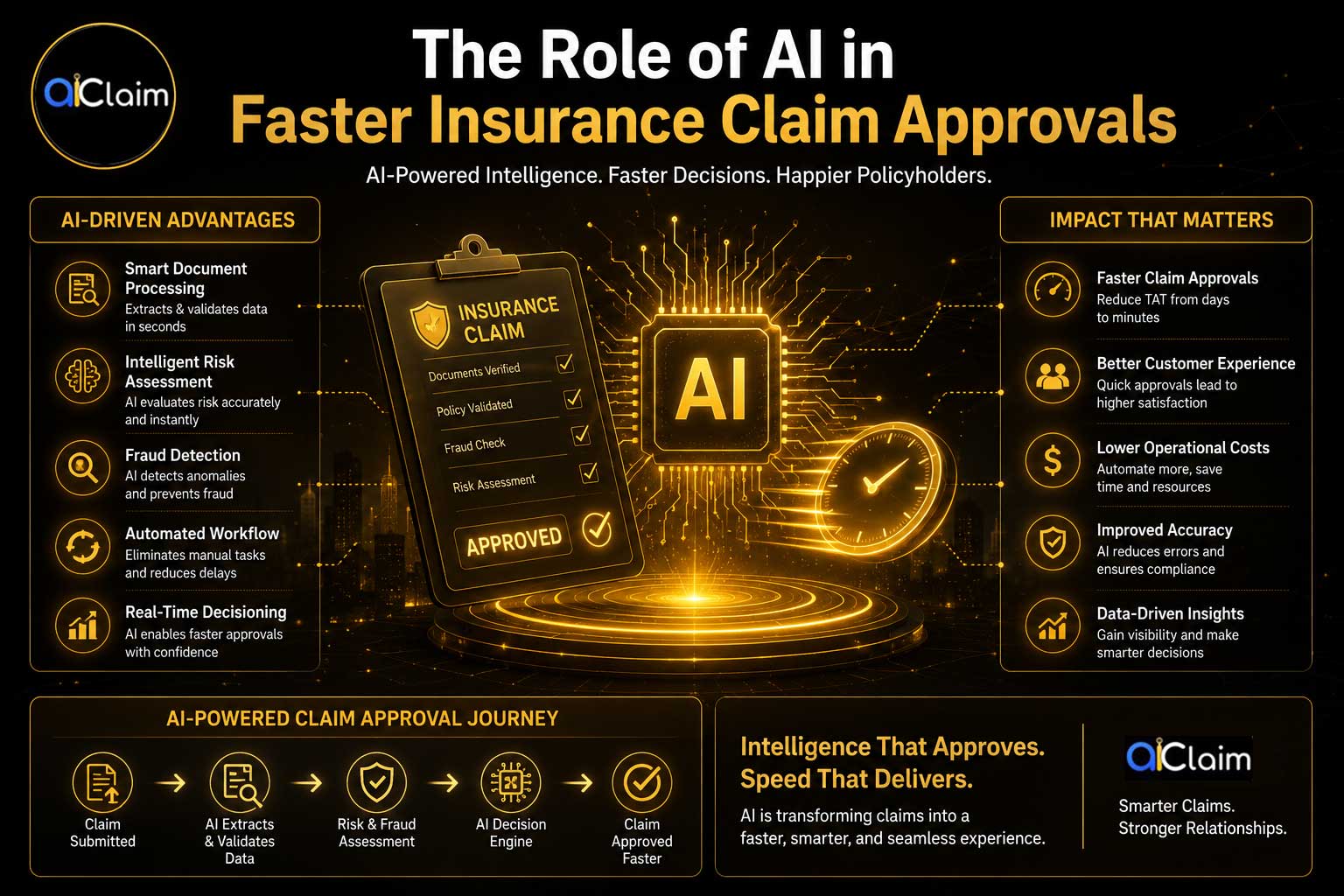
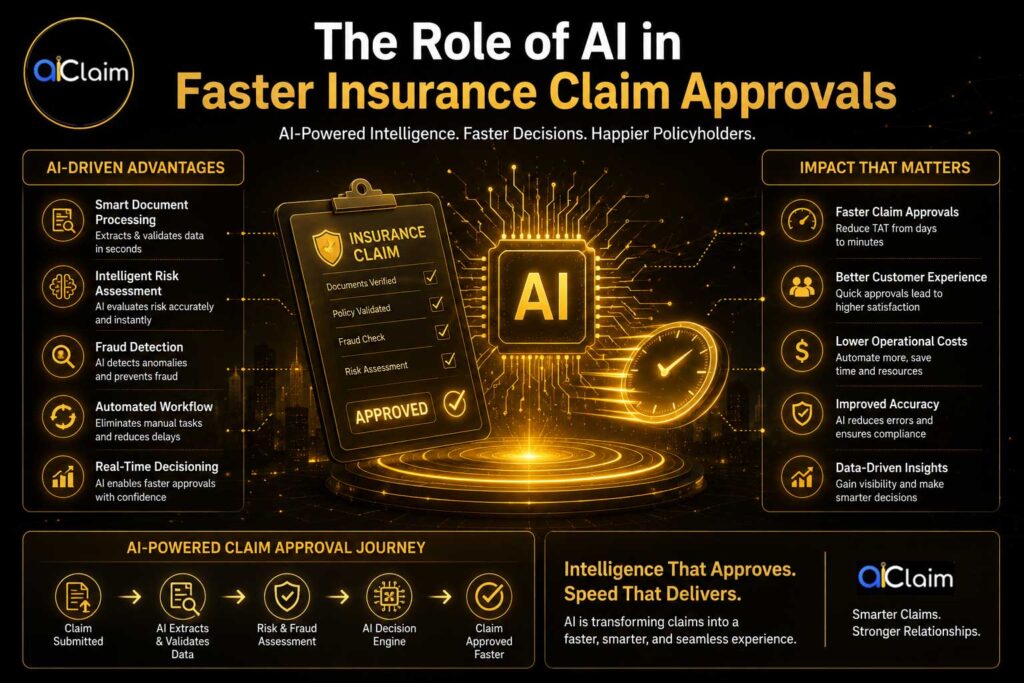
Because of these ongoing challenges, Artificial Intelligence (AI) is becoming a powerful solution for transforming insurance claims management. By automating repetitive tasks, analyzing claims data in real time, identifying potential errors before submission, and improving decision-making accuracy, AI is helping healthcare organizations process claims faster and achieve higher approval rates.
As a result, AI-powered insurance claims automation is not only reducing delays and administrative burden but also helping providers improve cash flow, enhance patient satisfaction, and optimize overall revenue cycle management.
As healthcare claims continue to grow in complexity, manual workflows are becoming outdated. In fact, according to recent industry reports, administrative inefficiencies account for billions of dollars in annual healthcare losses globally. Moreover, claim approval delays can significantly affect cash flow, patient experience, and reimbursement timelines.
Therefore, healthcare organizations are increasingly turning toward Artificial Intelligence (AI) to streamline insurance claims processing and accelerate approvals. AI-driven claims automation is not only improving operational efficiency but also helping organizations reduce errors, identify risks earlier, predict denials, and improve first-pass claim acceptance rates.
Understanding the Traditional Insurance Claims Approval Process
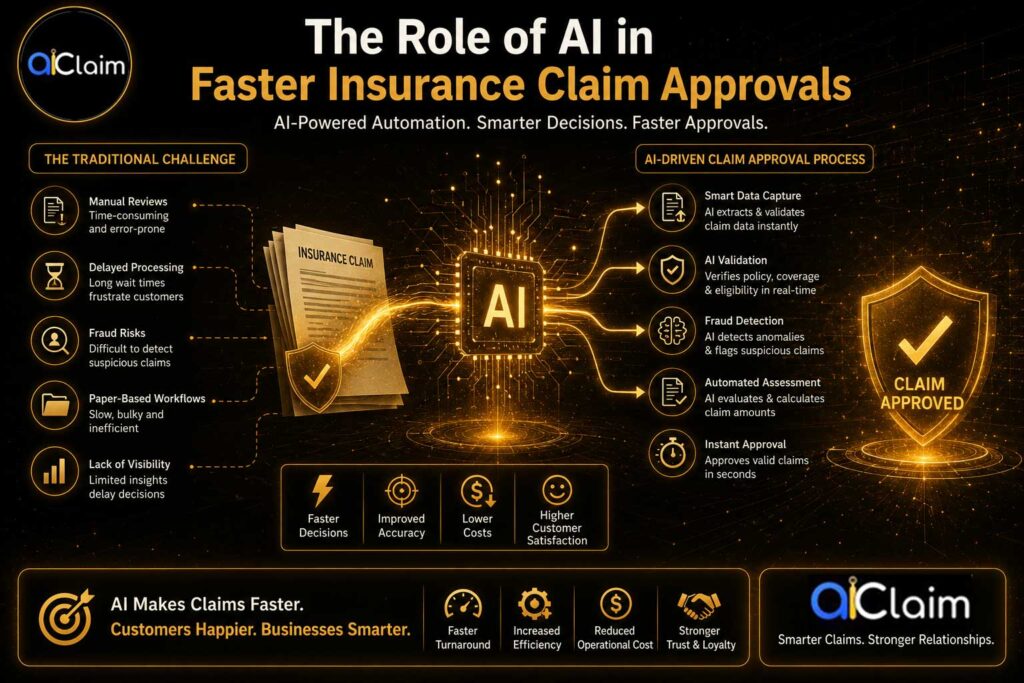
Before understanding how AI improves insurance claim approvals, it is important to examine why traditional claims processing systems often struggle. Although many healthcare organizations use digital systems, several workflows still rely heavily on manual tasks, outdated processes, and repetitive verification steps. As a result, even small errors in coding, documentation, or eligibility checks can lead to delays, denials, and payment disruptions.
Furthermore, rising claim volumes and changing payer regulations continue to increase operational pressure. Consequently, healthcare providers often face slower reimbursements, higher administrative burden, and reduced efficiency, which is why AI-driven automation is becoming increasingly important in modern claims processing.
Manual Data Entry Creates Delays
Traditionally, healthcare claims processing involves multiple manual steps, including:
- Patient eligibility verification
- Medical coding
- Documentation review
- Claims submission
- Payer validation
- Error correction
- Approval or denial management
However, manual workflows are highly vulnerable to human error, and even a small mistake in coding, documentation, or eligibility verification can lead to claim delays, denials, and costly rework cycles. As a result, healthcare organizations often experience slower reimbursements, increased administrative burden, and reduced operational efficiency.
Consequently, healthcare providers often experience:
- Slower reimbursements
- Increased administrative burden
- Higher denial rates
- Revenue leakage
- Reduced patient satisfaction
Rising Claim Volumes Are Overwhelming Healthcare Systems
As healthcare organizations continue to digitize operations, claim volumes are increasing dramatically. Simultaneously, insurers are implementing stricter compliance checks and fraud detection mechanisms.
Because of this, traditional processing teams struggle to handle:
- High claim submission volumes
- Complex payer rules
- Regulatory compliance requirements
- Prior authorization workflows
- Multi-layer claim validation
As a result, approval timelines become significantly longer.
What Is AI-Powered Insurance Claims Processing?
AI-powered insurance claims processing refers to the use of advanced technologies such as:
- Machine Learning (ML)
- Natural Language Processing (NLP)
- Predictive Analytics
- Intelligent Document Processing
- Robotic Process Automation (RPA)
These technologies automate repetitive tasks, analyze massive datasets, detect anomalies, and make intelligent decisions in real time.
Most importantly, AI continuously learns from historical claims data, enabling healthcare organizations to improve claim accuracy and approval speed over time.
How AI Accelerates Insurance Claim Approvals
1. Automated Data Extraction Improves Processing Speed
One of the biggest bottlenecks in claims management is manual document handling. Healthcare claims often include:
- Medical records
- Diagnostic reports
- Insurance forms
- Prior authorization documents
- Physician notes
Traditionally, staff members manually review and enter this information into claims systems.
However, AI-powered Intelligent Document Processing not only extracts and analyzes critical claim information automatically but also validates the data within seconds. As a result, healthcare organizations can significantly reduce manual effort, minimize processing delays, and improve overall claims approval efficiency.
As a result:
- Processing time decreases dramatically
- Administrative workload reduces
- Human errors minimize
- Claims move faster through approval pipelines
Therefore, organizations can accelerate reimbursements while improving operational efficiency.
2. AI-Based Eligibility Verification Prevents Claim Delays
Insurance eligibility errors are among the leading causes of claim denials and approval delays.
Fortunately, AI-powered eligibility verification systems can instantly:
- Validate patient insurance coverage
- Verify payer requirements
- Detect missing information
- Identify policy limitations
- Confirm authorization requirements
Because AI performs these checks in real time, providers can resolve issues before claims are submitted.
Consequently:
- First-pass claim acceptance rates improve
- Rework cycles decrease
- Approval timelines shorten significantly
At Aiclaim.com, AI-driven eligibility verification solutions help healthcare providers minimize costly billing errors while accelerating claims approvals.
AI Algorithms That Improve Claim Approval Accuracy
Modern AI systems rely on advanced machine learning algorithms to identify patterns and optimize decision-making.
Predictive Analytics for Denial Prevention
Predictive analytics not only uses historical claims data to identify patterns but also forecasts potential denial risks before claim submission. As a result, healthcare providers can detect possible errors early, take corrective action immediately, and significantly improve claim approval rates while reducing costly denials and reimbursement delays.
For example, AI models can analyze:
- Previous denial reasons
- Coding inconsistencies
- Payer-specific rejection patterns
- Missing documentation
- Compliance violations
Then, the system automatically flags high-risk claims for correction.
As a result:
- Denial rates decrease
- Approval rates improve
- Revenue cycle efficiency increases
Industry studies indicate that AI-driven predictive denial management can improve denial prediction accuracy by up to 80%.
Natural Language Processing (NLP) Enhances Documentation Review
Healthcare documentation often contains unstructured text, including:
- Physician notes
- Clinical summaries
- Diagnostic explanations
- Treatment histories
Manually reviewing these records is time-consuming.
However, Natural Language Processing (NLP) not only enables AI systems to understand complex medical language but also helps extract critical claim details and validate accuracy automatically. As a result, healthcare organizations can reduce manual review time, minimize documentation errors, and accelerate insurance claim approvals more efficiently.
Therefore:
- Claims processing becomes faster
- Documentation mismatches reduce
- Compliance improves
The Business Impact of Faster Insurance Claim Approvals
Improved Cash Flow for Healthcare Providers
Delayed approvals directly affect revenue cycles. When claims remain pending for weeks or months, healthcare organizations experience:
- Cash flow disruptions
- Increased accounts receivable
- Operational instability
However, AI-powered claims automation significantly accelerates reimbursement timelines.
Consequently:
- Providers receive payments faster
- Financial predictability improves
- Administrative costs decrease
This is especially important for hospitals and multi-specialty healthcare organizations managing large claim volumes daily.
Better Patient Experience and Satisfaction
Patients expect transparent, fast, and hassle-free billing experiences.
Unfortunately, claim delays often lead to:
- Billing confusion
- Treatment delays
- Patient dissatisfaction
- Increased support inquiries
AI-driven automation improves communication and reduces processing errors.
As a result:
- Patients receive faster approvals
- Billing transparency improves
- Trust between providers and patients strengthens
AI and Fraud Detection in Insurance Claims
Insurance fraud remains a massive challenge in healthcare and insurance industries.
According to industry estimates, fraudulent claims contribute to billions in annual losses worldwide.
Fortunately, AI can detect suspicious activity by analyzing:
- Abnormal billing patterns
- Duplicate submissions
- Inconsistent treatment records
- Unusual provider behavior
- Historical fraud indicators
Because AI systems continuously learn from evolving fraud patterns and historical claims data, they become increasingly accurate over time. As a result, healthcare organizations can identify suspicious activities faster, reduce fraudulent claim approvals, and improve the overall efficiency and reliability of insurance claims processing.
Consequently:
- Fraudulent claims are identified earlier
- Financial losses reduce
- Genuine claims receive faster approvals
Real-Time Claims Processing: The Future of Insurance Approvals
Traditional claims processing can take days or even weeks.
However, AI-powered real-time claims processing is changing the landscape dramatically.
How Real-Time AI Claims Processing Works
AI systems can instantly:
- Validate claims data
- Cross-check payer rules
- Verify coding accuracy
- Detect missing documents
- Assess approval probability
Then, claims can seamlessly move through automated workflows without unnecessary human intervention. As a result, healthcare organizations can accelerate approval timelines, reduce administrative bottlenecks, and improve overall claims processing efficiency.
As a result:
- Approval cycles become significantly shorter
- Operational efficiency improves
- Staff productivity increases
Real-time AI claims processing is rapidly becoming a competitive advantage for modern healthcare organizations.
How AI Reduces Administrative Burden
Administrative burnout is becoming an increasingly serious challenge for healthcare organizations, especially as claim volumes, documentation requirements, and operational pressures continue to rise. As a result, healthcare staff often struggle with excessive workloads, repetitive manual tasks, and growing administrative complexity.
Manual claim handling requires staff to spend countless hours on:
- Data entry
- Appeals management
- Documentation reviews
- Error corrections
- Follow-ups with payers
AI automation eliminates repetitive tasks and allows teams to focus on higher-value responsibilities.
Consequently:
- Staff productivity increases
- Operational costs decline
- Employee satisfaction improves
Why Healthcare Organizations Are Investing in AI Claims Automation
Healthcare leaders are increasingly prioritizing AI investments because traditional claims processing systems can no longer keep pace with growing claim volumes, changing payer regulations, and rising operational demands. As a result, organizations are turning toward AI-driven automation to improve efficiency, accelerate approvals, and optimize overall revenue cycle performance.
Key Drivers Behind AI Adoption
Increasing Claim Complexity
Payer rules and compliance regulations are constantly evolving, and as a result, healthcare organizations often struggle to keep up with changing requirements, policy updates, and documentation standards. Consequently, even minor compliance errors can lead to claim delays, denials, and revenue loss.
Rising Operational Costs
Manual claims processing requires large administrative teams to manage data entry, verification, documentation reviews, and follow-up tasks. As a result, healthcare organizations often face higher operational costs, increased workload pressure, and reduced overall efficiency.
Demand for Faster Reimbursements
Organizations need improved cash flow and reduced claim delays to maintain financial stability, optimize revenue cycle performance, and ensure smoother operational management. As a result, faster and more accurate claims processing has become a top priority for healthcare providers and insurance companies.
Competitive Healthcare Market
Providers must improve patient experiences while simultaneously maximizing operational efficiency and reducing administrative complexity. Consequently, healthcare organizations are increasingly adopting smarter technologies to streamline workflows and accelerate service delivery.
Therefore, AI-powered claims automation is rapidly becoming essential rather than optional, especially for organizations aiming to improve claim accuracy, reduce delays, and optimize overall revenue cycle performance.
The Role of AI in Revenue Cycle Management (RCM)
AI is not limited to insurance claim approvals alone. Instead, it supports the entire Revenue Cycle Management (RCM) process by automating critical workflows such as eligibility verification, medical coding, claims validation, denial management, payment posting, and revenue optimization. As a result, healthcare organizations can improve operational efficiency, reduce administrative burden, and accelerate overall financial performance.
AI Improves Every Stage of RCM
Patient Eligibility Verification
AI instantly validates insurance coverage by automatically verifying patient eligibility, policy details, payer requirements, and authorization status in real time. As a result, healthcare providers can reduce verification errors, prevent claim delays, and improve overall claims processing efficiency.
Medical Coding Automation
AI-assisted medical coding not only improves coding accuracy but also helps healthcare organizations maintain better compliance with evolving payer regulations and industry standards. As a result, providers can reduce coding errors, minimize claim denials, and accelerate insurance claim approvals.
Claims Scrubbing
AI automatically detects claim submission errors before transmission by identifying missing information, coding inconsistencies, and documentation issues in real time. As a result, healthcare organizations can reduce claim rejections, improve first-pass acceptance rates, and accelerate reimbursement cycles.
Denial Management
Predictive AI models identify high-risk claims early by analyzing historical claims data, denial patterns, and payer-specific trends. As a result, healthcare providers can proactively correct potential issues before submission, reduce denial rates, and improve overall claims approval efficiency.
Payment Posting
Automation accelerates reconciliation workflows by streamlining payment matching, reducing manual intervention, and improving financial accuracy across the revenue cycle. As a result, healthcare organizations can process payments faster and minimize operational delays.
Because of this end-to-end optimization, healthcare providers achieve greater financial stability, improved cash flow management, and enhanced overall revenue cycle performance.
Why Aiclaim.com Is Leading the Future of AI Claims Automation
Aiclaim.com delivers intelligent AI-powered healthcare automation solutions designed to improve:
- Insurance claim approvals
- Denial prevention
- Eligibility verification
- Revenue cycle performance
- Fraud detection
- Operational efficiency
Key Benefits of Aiclaim’s AI Solutions
Faster Claim Processing
AI-powered automation accelerates insurance claim approvals by streamlining verification, validation, and claims processing workflows in real time. As a result, healthcare organizations can significantly reduce delays, improve operational efficiency, and achieve faster reimbursements.
Reduced Claim Denials
Predictive analytics not only identifies potential claim issues before submission but also analyzes historical denial patterns, payer requirements, and data inconsistencies in real time. As a result, healthcare organizations can proactively resolve errors early, reduce claim denials, and improve overall approval accuracy and processing efficiency.
Improved First-Pass Acceptance Rates
Real-time validation not only improves overall claim quality but also helps identify coding errors, missing information, and compliance issues before submission. As a result, healthcare organizations can reduce claim denials, improve first-pass acceptance rates, and accelerate reimbursement timelines more efficiently.
Enhanced Revenue Optimization
Faster reimbursements not only improve cash flow but also help healthcare organizations maintain better financial stability, reduce revenue cycle delays, and manage operational expenses more efficiently. As a result, providers can strengthen overall revenue performance while improving long-term business sustainability.
Scalable Healthcare Automation
AI systems adapt to growing organizational demands.
As healthcare systems continue evolving, AI-driven automation platforms like Aiclaim are becoming critical for long-term success.
Challenges of AI Adoption in Insurance Claims Processing
Although AI offers substantial benefits in insurance claims processing and revenue cycle management, its implementation still presents several operational and technical challenges. Nevertheless, healthcare organizations are increasingly overcoming these barriers by adopting scalable AI solutions, modern integration strategies, and advanced compliance frameworks.
Data Integration Issues
Many healthcare organizations operate with outdated legacy systems.
Therefore, integrating AI solutions requires:
- API connectivity
- Data standardization
- Workflow restructuring
Compliance and Data Security Concerns
Healthcare organizations must comply with:
- HIPAA
- Data privacy regulations
- Security standards
Consequently, AI platforms must prioritize:
- Encryption
- Secure access controls
- Compliance monitoring
Future Trends in AI Insurance Claim Approvals
The future of AI-driven claims processing looks increasingly promising as healthcare organizations continue adopting intelligent automation, predictive analytics, and real-time decision-making technologies. As a result, insurance claim approvals are expected to become faster, more accurate, and significantly more efficient in the years ahead.
Emerging Trends Include:
- Hyperautomation in healthcare workflows
- Real-time adjudication systems
- AI-powered conversational support
- Advanced fraud analytics
- Personalized insurance processing
- Autonomous claims decision-making
As AI models continue advancing, claims approvals will become faster, smarter, and more accurate than ever before.
Conclusion: AI Is Revolutionizing Insurance Claim Approvals
The healthcare industry is entering a new era of intelligent automation. Traditional claims management systems can no longer handle the growing complexity, speed requirements, and operational demands of modern healthcare environments.
Fortunately, Artificial Intelligence is transforming insurance claim approvals by:
- Reducing manual work
- Preventing denials
- Accelerating reimbursements
- Improving patient satisfaction
- Enhancing revenue cycle performance
Most importantly, AI empowers healthcare providers to solve current operational challenges while preparing for future growth.
Organizations that adopt AI-powered claims automation today will gain a significant competitive advantage tomorrow.
With advanced automation, predictive analytics, and intelligent workflow optimization, Aiclaim.com is helping healthcare providers transform insurance claims processing into a faster, smarter, and more profitable system.
Frequently Asked Questions (FAQs)
How does AI speed up insurance claim approvals?
AI automates data validation, eligibility verification, document processing, and denial prediction, which significantly reduces manual delays.
Can AI reduce insurance claim denials?
Yes. Predictive analytics and real-time claim validation help identify potential errors before submission, reducing denial rates.
What are the benefits of AI in healthcare claims management?
AI improves operational efficiency, accelerates reimbursements, enhances claim accuracy, reduces administrative costs, and improves patient satisfaction.
Is AI-based claims automation secure?
Modern AI healthcare platforms use advanced encryption, compliance monitoring, and secure access controls to protect sensitive patient data.
Why should healthcare providers adopt AI claims automation?
AI helps providers improve cash flow, reduce claim delays, enhance operational efficiency, and stay competitive in an increasingly digital healthcare industry.