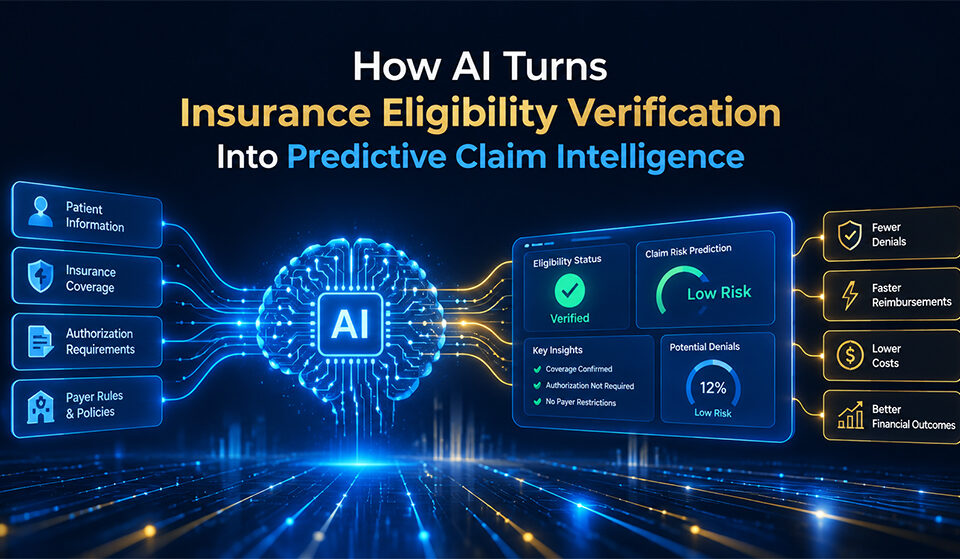
How AI Turns Insurance Eligibility Verification Into Predictive Claim Intelligence

Healthcare organizations have traditionally treated insurance eligibility verification as a front-end administrative task. Staff confirm coverage, check benefits, record the response, and then move the patient through the billing process. However, this approach leaves valuable information unused. Eligibility data can provide much more than confirmation that a patient has insurance. It can also reveal coverage risks, benefit limitations, payer requirements, and other signals that may affect whether a claim gets paid.
When combined with patient demographics, payer rules, benefit information, historical claim outcomes, authorization requirements, procedure details, and denial patterns, eligibility information can become a powerful source of predictive claim intelligence. Rather than simply checking whether a patient has active coverage, an AI-powered eligibility verification system can assess the claim’s risk and identify potential problems before submission.
This shift is particularly important because front-end issues continue to create significant revenue-cycle pressure. Kaufman Hall’s 2025 Health System Performance Outlook reported that 26% of organizations identified front-end issues such as authorization, eligibility, and benefits as their most significant physician-related denial challenge.
Therefore, healthcare organizations need to move beyond basic insurance verification. They need a system that can interpret eligibility information, recognize patterns, predict risk, and recommend action before a claim becomes a denial.
Why Traditional Insurance Eligibility Verification Is No Longer Enough
Traditional eligibility verification answers a narrow question. It determines whether coverage exists on a particular date and may provide information about benefits, deductibles, copayments, coinsurance, and coverage limitations. However, eligibility confirmation does not automatically mean that a claim is ready for payment.
A patient may have active insurance, yet the payer can still deny the claim if the provider skips prior authorization, the plan excludes the service, the provider falls outside the network, the member information contains errors, the diagnosis does not support the service, or the benefit structure creates unexpected patient responsibility. Therefore, confirming “active coverage” alone can give healthcare organizations a false sense of security.
CMS continues to support standardized electronic eligibility transactions through the HIPAA 270/271 framework. Medicare’s HETS system, for example, allows providers and authorized billing agents to submit 270 eligibility inquiries and receive 271 responses to help prepare accurate claims and determine beneficiary liability. Nevertheless, electronic eligibility alone is not predictive intelligence.
The real opportunity begins when AI interprets the information returned by those transactions and connects it with what happened to similar claims in the past.
What Predictive Claim Intelligence Means in Healthcare
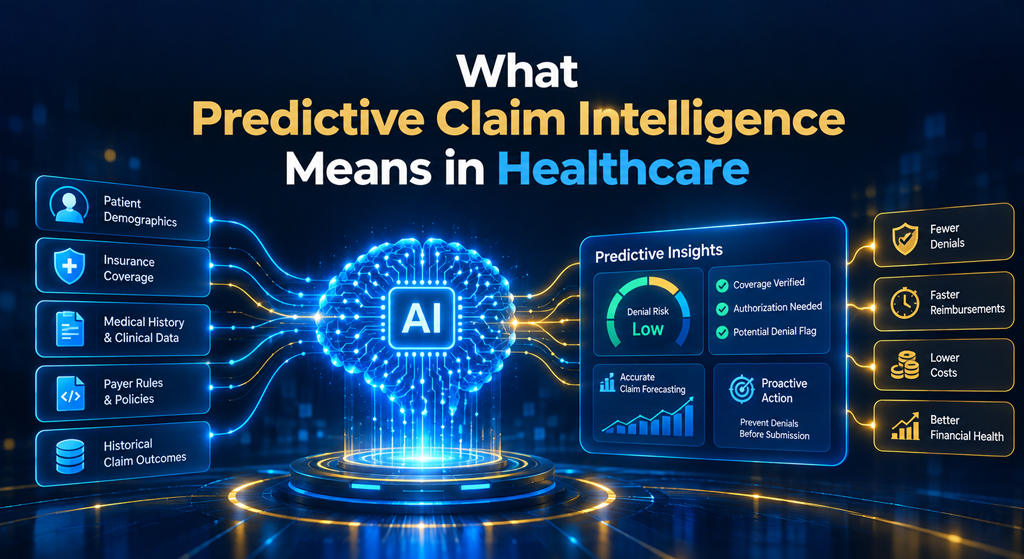
Predictive claim intelligence analyzes historical and real-time data to identify potential claim problems before providers submit claims. Instead of treating every eligibility response independently, an AI model can evaluate multiple variables simultaneously.
For example, the model may analyze the payer, plan type, patient demographics, provider, service category, diagnosis, procedure, authorization requirement, benefit limitations, historical denial patterns, previous eligibility responses, and claim outcomes. The system can then produce a risk assessment.
A low-risk claim may move through the normal workflow. A medium-risk claim may receive an additional verification step. The system can route high-risk claims to billing, authorization, or revenue integrity specialists for review before submission. Therefore, predictive eligibility verification changes the workflow from reactive correction to proactive prevention.
How AI Converts Eligibility Data Into Claim Risk Signals
The transformation begins with data collection. An AI-powered eligibility platform can collect structured information from 270/271 transactions, payer portals, practice management systems, electronic health records, claims history, authorization workflows, and other revenue-cycle systems. Next, the system normalizes the information.
This step matters because payers often provide eligibility responses in different formats. AI can map different response structures into standardized data elements, allowing the organization to compare information across payers and plans. After that, the predictive model evaluates relationships between those variables.
For example, suppose a particular payer frequently denies a specific service when an authorization requirement is missing. When the eligibility response indicates that the payer may require authorization, the AI system raises the claim-risk score.Similarly, if a patient’s coverage is active but the provider is outside the relevant network, the system can flag the encounter before billing. As a result, eligibility verification becomes an early-warning system rather than a simple coverage lookup.
How AI Models Predict Claim Denials Before Submission
The intelligence layer can use several machine-learning approaches depending on the organization’s data maturity and business requirements. When the eligibility response indicates that the payer may require authorization, the AI system raises the claim-risk score. Approved claims provide positive examples, while denied or rejected claims provide negative examples. Over time, the model learns relationships between claim characteristics and payment outcomes.
Classification models can then estimate whether a new claim belongs to a lower-risk or higher-risk category. In complex environments, healthcare organizations can use gradient-boosting models, random forests, logistic regression, neural networks, or ensemble approaches to evaluate multiple risk factors.. However, the algorithm should not operate as a black box.
Healthcare organizations need explainable predictions. Therefore, the system should identify the factors contributing to the risk score. For example, instead of simply displaying “High Risk,” the platform could explain that the claim has an elevated risk because the payer requires authorization, the patient’s benefit structure has a service limitation, and similar historical claims experienced denials. That explanation gives revenue-cycle teams something they can act on.
From Eligibility Verification to Predictive Claim Intelligence
Healthcare organizations can best understand the difference between conventional verification and predictive intelligence by viewing it as a progression.. Traditional verification asks whether insurance is active. Automated eligibility verification asks whether coverage and benefits can be checked electronically. Predictive eligibility intelligence goes further by asking what the eligibility information means for the probability of successful claim payment.
That final step creates business value. For providers, it can reduce avoidable denials, prevent rework, improve clean-claim performance, and reduce unnecessary patient billing corrections. For payers, better front-end information can improve transaction quality, reduce preventable administrative friction, and support more consistent claim processing. Therefore, the same eligibility data can become useful to both sides of the healthcare payment ecosystem.
Why Front-End Claim Intelligence Matters
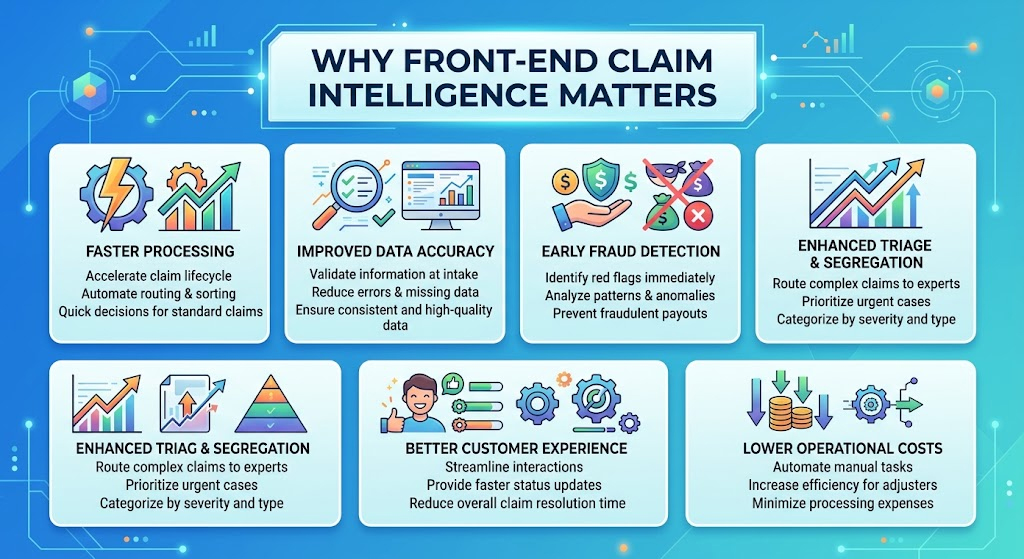
Many organizations focus their denial-management efforts after the claim has already failed. However, once a claim is denied, the organization has already spent resources on registration, coding, billing, submission, denial identification, investigation, correction, resubmission, and follow-up. That makes prevention more efficient than recovery.
HFMA material citing the Waystar Denials Index reported registration and eligibility as 22% of denials and identified 41% of denials as front-end errors. Consequently, organizations should not view eligibility verification as a small registration function. It is part of the organization’s claim-quality strategy. When eligibility data is connected to predictive analytics, staff can intervene while the claim is still controllable.
Solving the Biggest Problems Healthcare Organizations Face
One common problem is inaccurate or incomplete patient information. A small demographic mismatch can create downstream problems when the information submitted with the claim does not align with payer records. AI can identify inconsistencies between available patient and insurance information and trigger verification before submission.
Another problem is hidden authorization requirements. A patient’s insurance may be active, but a particular service can still require authorization. Predictive models can identify combinations of payer, plan, service, diagnosis, and historical outcomes that indicate elevated authorization risk.
Benefit limitations create another challenge. Eligibility responses can contain extensive information that is difficult for staff to interpret quickly. AI can extract relevant coverage signals and connect them to the planned service, helping staff determine whether additional verification is appropriate. Finally, payer-specific behavior can be difficult to manage manually.
A rule that creates problems for one payer may not create the same risk for another. AI can learn payer-specific patterns from historical outcomes and continuously refine its predictions as new claims are processed.
How Real-Time Eligibility and AI Work Together
Predictive claim intelligence does not replace electronic eligibility transactions. Instead, it builds intelligence on top of them. CMS’s HETS infrastructure demonstrates the importance of real-time 270/271 eligibility workflows for Medicare. CMS also announced a HETS2026-4 release scheduled for December 2026 that may introduce changes to 270 requests and 271 responses, reinforcing the need for systems that can adapt to evolving transaction requirements.
This is particularly important for healthcare organizations operating across multiple payers. An effective architecture can retrieve eligibility information, normalize the response, apply payer-specific logic, evaluate historical claim patterns, calculate risk, and return an actionable recommendation within the revenue-cycle workflow. As a result, staff do not have to manually interpret every piece of information.
The AI Workflow Behind Predictive Eligibility Verification
A practical AI workflow begins when the patient is scheduled or registered. The system retrieves insurance information and initiates the appropriate eligibility transaction. Next, the returned data is normalized and compared with patient and encounter information. The AI model then evaluates relevant risk features.
Those features can include coverage status, payer, plan, provider participation, benefit restrictions, authorization indicators, service type, diagnosis and procedure relationships, historical denial patterns, and previous claim outcomes. Next, the model calculates a claim-risk score.
If the score is low, the workflow can continue. If the score is elevated, the system can explain why the claim is risky and recommend the next verification step. Finally, the result can be captured within the organization’s revenue-cycle workflow so the issue can be resolved before claim submission.
This creates a continuous feedback loop. Every completed claim can provide another data point that helps improve future predictions, provided the organization has appropriate data governance, validation, and model-monitoring processes.
What Healthcare Providers Should Measure
The success of predictive eligibility verification should not be measured simply by the number of eligibility checks completed. Instead, organizations should monitor whether those checks improve financial and operational outcomes. Important measures include eligibility-related denial rates, first-pass claim acceptance, clean-claim rates, authorization-related denials, registration-related rework, claim correction volume, days in accounts receivable, staff intervention rates, and preventable patient billing issues.
Furthermore, organizations should compare outcomes before and after implementation. That approach makes it easier to determine whether AI is genuinely improving the revenue cycle rather than simply increasing automation activity.
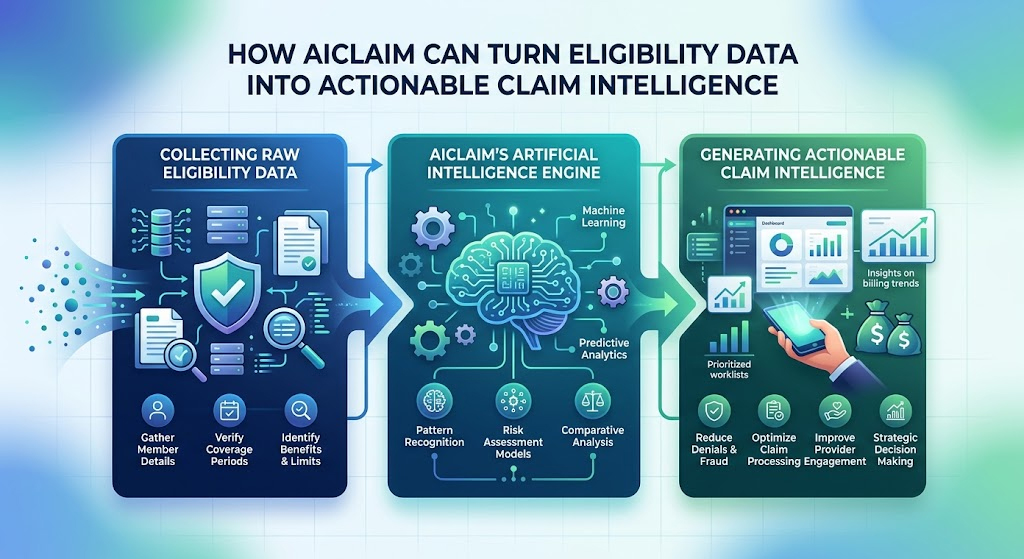
How Aiclaim Can Turn Eligibility Data Into Actionable Claim Intelligence
For organizations looking to move beyond basic automated insurance eligibility checks, Aiclaim’s approach can connect front-end insurance intelligence with broader claim-management workflows. The objective is not simply to verify whether coverage exists. Instead, eligibility information can become one of the signals used to identify claim risk before submission.
By combining automated verification, payer intelligence, claim data, and AI-driven risk analysis, healthcare organizations can create a more proactive revenue-cycle process. This approach helps providers focus their teams on exceptions rather than repetitive verification work. At the same time, it creates a stronger foundation for denial prevention because potential problems can be identified while there is still time to correct them.
For organizations evaluating AI for revenue cycle management, the key question should therefore be: “Can the system identify why a claim may fail before the payer tells us?” If the answer is yes, eligibility verification has evolved from an administrative task into predictive claim intelligence.
Frequently Asked Questions About AI Insurance Eligibility Verification
What is AI insurance eligibility verification?
AI insurance eligibility verification uses automation, payer data, eligibility transactions, machine-learning models, and business rules to determine whether a patient’s coverage is active and identify potential claim risks before submission.
Can AI predict insurance claim denials?
Yes. When sufficient historical claim data is available, machine-learning models can identify patterns associated with denials and assign risk scores to new claims. However, predictions should be validated against actual organizational outcomes and monitored continuously.
How does automated eligibility verification reduce claim denials?
Automated eligibility verification can identify coverage problems, demographic inconsistencies, benefit limitations, payer requirements, and other front-end issues before a claim is submitted. When predictive analytics are added, the system can prioritize higher-risk encounters for additional review.
What is the difference between eligibility verification and predictive claim intelligence?
Eligibility verification determines coverage and benefits. Predictive claim intelligence uses that information together with other clinical, administrative, payer, and historical claim signals to estimate the likelihood of a claim problem.
Does predictive eligibility replace revenue-cycle staff?
No. The strongest model is usually human-assisted automation. AI identifies patterns, prioritizes risk, and recommends actions, while revenue-cycle professionals handle exceptions, complex cases, payer communication, and decisions requiring human judgment.
What data does an AI eligibility system need?
Depending on the implementation, useful data can include eligibility responses, payer and plan information, patient demographics, provider information, authorization indicators, procedure and diagnosis information, historical claims, denial reasons, payment outcomes, and payer-specific rules.
The Future of Insurance Eligibility Is Predictive
Insurance eligibility verification is moving toward a more intelligent model. The most valuable system will not simply tell a provider that a patient has active coverage. Instead, it will explain what that coverage means for the planned encounter and whether the resulting claim appears likely to encounter a problem. That distinction matters.
Healthcare organizations are under continuous pressure to improve reimbursement, reduce administrative costs, manage denial rates, and protect revenue. Consequently, preventing a claim problem before submission can be more valuable than recovering the same claim after denial. AI makes that shift possible by turning eligibility data into a predictive signal.
Ultimately, the goal is simple: verify coverage, understand risk, act before submission, and improve the probability of clean payment.
Ready to move from eligibility verification to predictive claim intelligence?
Explore how Aiclaim can help healthcare organizations use AI-powered claim intelligence to identify risks earlier, strengthen front-end revenue-cycle workflows, and reduce avoidable claim problems.
Request a personalized AI claim-intelligence assessment from Aiclaim and identify where predictive eligibility verification can fit into your existing RCM workflow.