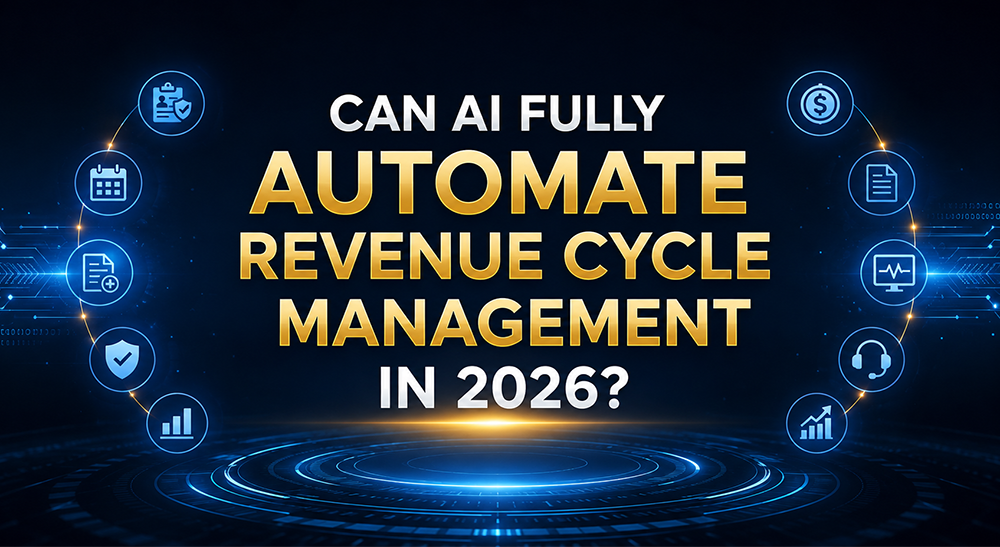

Revenue cycle management (RCM) is moving from manual, reactive work toward predictive and increasingly autonomous operations. However, one question is becoming more important for hospitals, medical groups, physician practices, and billing companies: Can AI fully automate revenue cycle management in 2026?
The short answer is not completely—but AI can automate a substantial portion of repetitive RCM work while continuously identifying, prioritizing, and preventing revenue problems that traditionally required human intervention.
That distinction matters. Healthcare organizations are still dealing with claim denials, eligibility errors, prior authorization requirements, coding inconsistencies, delayed payments, staffing shortages, payer complexity, and revenue leakage. At the same time, AI is becoming capable of analyzing large volumes of structured and unstructured healthcare data, recognizing patterns, predicting risk, and recommending or executing next-best actions.
The opportunity, therefore, is not simply to replace an RCM employee with software. Instead, the goal is to create an AI-powered revenue cycle that detects problems earlier, automates routine decisions, escalates exceptions, and continuously learns from outcomes.
What Is AI-Powered Revenue Cycle Management?
AI-powered revenue cycle management uses artificial intelligence, machine learning, natural language processing, predictive analytics, rules engines, and automation to manage revenue-cycle activities from patient access through final payment.
Traditional RCM generally depends on staff checking information, working queues, correcting claims, contacting payers, reviewing denials, and following up on outstanding accounts. AI changes that workflow by analyzing information continuously.
For example, an AI system can evaluate patient demographics, eligibility information, payer policies, authorization requirements, clinical documentation, procedure codes, historical claim outcomes, and denial patterns before a claim reaches the payer.
Instead of asking, “Why was this claim denied?”, the system can ask a more valuable question: “What is likely to cause this claim to fail, and can we fix it before submission?” That shift from reactive RCM to predictive RCM is one of the biggest opportunities for healthcare organizations in 2026.
The Healthcare Financial Management Association (HFMA) has similarly highlighted the movement toward intelligent automation, predictive operations, real-time analytics, and stronger AI governance as healthcare organizations face financial pressure and operational complexity.
Why Traditional Revenue Cycle Management Is Still Losing Revenue
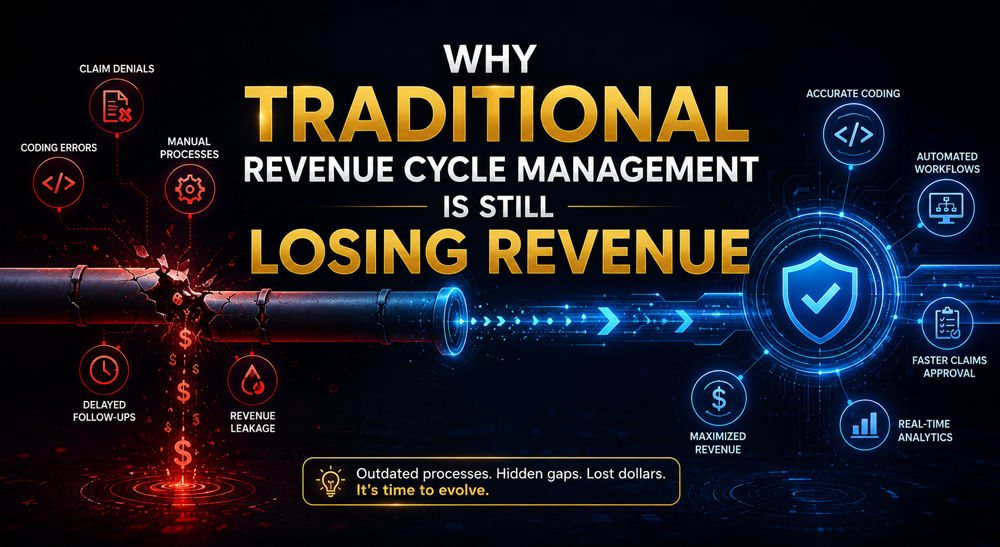
The biggest RCM problem is rarely a single major mistake. Instead, revenue leakage often develops through hundreds or thousands of small operational failures. A patient’s insurance information may be outdated. An authorization may be missing. Documentation may not support the billed service. A claim may contain an incorrect modifier. A coding issue may remain unnoticed until after submission. A payer may request additional information, while the account sits in a work queue.
Consequently, even organizations with experienced billing teams can lose revenue through delays, preventable denials, underpayments, missed follow-ups, and manual rework. HFMA reported in January 2026 that hospitals can lose approximately 3% to 5% of net revenue annually through revenue leakage, emphasizing how financially significant these operational gaps can become.
Meanwhile, Experian Health reported in July 2026 that more than four in ten providers surveyed said at least 10% of their claims were denied, while inaccurate registration data, claim information, and authorization problems remained important denial triggers.
Therefore, simply hiring more people to process more work is not always the answer. The better solution is to prevent unnecessary work from entering the RCM pipeline in the first place.
How AI Can Automate the Healthcare Revenue Cycle
AI can support automation across almost every major stage of the revenue cycle. However, the highest-value applications are those where large volumes of information must be analyzed quickly and consistently.
AI for Patient Eligibility Verification
Eligibility verification is one of the first opportunities for healthcare revenue cycle automation. Manual eligibility checks can consume significant staff time, particularly when information must be verified across multiple payer systems. AI-powered eligibility workflows can automatically analyze insurance information, identify inconsistencies, detect missing information, and flag accounts that require human attention.
Instead of treating every patient account equally, an AI model can assign a risk score and prioritize accounts where eligibility problems are most likely. The result is a more intelligent front-end workflow and fewer downstream billing problems.
AI for Prior Authorization
Prior authorization remains a major source of administrative complexity. AI can identify whether a service is likely to require authorization, determine what documentation may be needed, extract relevant information from clinical records, and route the request through the appropriate workflow.
This becomes particularly important as healthcare organizations move toward greater interoperability. CMS’s interoperability and prior authorization requirements include operational provisions beginning in 2026, while several API requirements have compliance dates beginning in 2027. CMS also requires impacted payers to provide specific reasons for certain denied prior authorization decisions beginning in 2026.
Furthermore, CMS released a 2026 proposed rule that would extend electronic prior authorization and interoperability requirements to additional drug-related workflows. Consequently, AI-enabled authorization workflows are becoming increasingly relevant for organizations trying to reduce administrative delays.
AI for Medical Coding and Documentation Review
Coding errors can create both financial and compliance risks. AI can analyze clinical documentation and identify potential discrepancies between the patient’s record and the codes selected for billing. Natural language processing can extract relevant clinical concepts from unstructured documentation, while machine-learning models can compare patterns against historical coding and reimbursement outcomes.
However, the goal should not be uncontrolled autonomous coding. A safer approach is AI-assisted coding with confidence scoring and human escalation. Straightforward cases can move through automated workflows, while ambiguous or high-risk cases are routed to qualified coding professionals.
This creates a balance between automation, accuracy, compliance, and human judgment.
AI-Powered Claim Scrubbing Can Prevent Denials Before Submission
One of the strongest use cases for AI in RCM is predictive claim prevention. Traditional claim scrubbing generally checks predefined rules. While rules remain useful, healthcare claims are too complex for static rules alone. A modern AI claim-risk engine can combine rules with machine learning.
For example, the model can examine historical claim outcomes, payer behavior, provider patterns, diagnosis and procedure combinations, authorization information, patient data, documentation signals, and previous denial reasons. The system can then generate a probability score such as:
Claim Risk Score: High
Instead of merely identifying an error, the system can explain the likely problem and recommend an action before submission. This creates a fundamentally different workflow:
Detect → Predict → Explain → Correct → Submit
That is much more valuable than:
Submit → Denial → Investigate → Appeal
For healthcare organizations focused on reducing denial rates, this predictive approach can turn denial management from a recovery function into a prevention strategy.
Can AI Automate Denial Management?
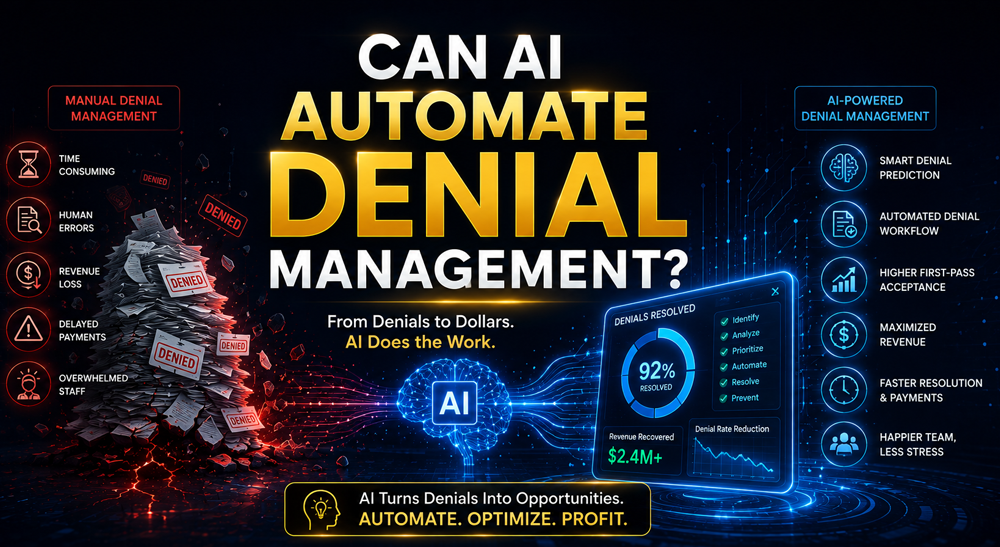
AI can automate significant portions of denial management, but completely eliminating human involvement is unrealistic for every denial. Simple and repetitive denial categories are highly suitable for automation. AI can classify denial reasons, identify patterns, prioritize accounts by financial value and probability of recovery, retrieve relevant documentation, recommend corrective actions, and generate work queues.
More advanced systems can use agentic workflows to investigate multiple data sources and determine the next appropriate action. However, complex contractual disputes, unusual clinical circumstances, payer-specific interpretations, compliance-sensitive cases, and high-value appeals may still require human review.
Therefore, the strongest model is not “AI versus humans.”
It is AI for scale, humans for judgment.
How AI Models Learn From Revenue Cycle Data
The intelligence behind AI-powered RCM depends on how the model processes historical and real-time information. A machine-learning system can analyze previous claims and identify relationships between claim characteristics and outcomes. Suppose thousands of historical claims reveal that a particular payer frequently denies a specific combination of procedure, diagnosis, modifier, and authorization status.
The model can learn that relationship. When a similar claim appears in the future, the system can calculate its probability of denial and flag it before submission. Over time, the model can be retrained using new claim outcomes.
That creates a continuous learning loop:
Historical Data → Model Training → Risk Prediction → RCM Action → Claim Outcome → Feedback → Model Improvement
This is where AI can provide an advantage over static automation. Rules tell software what to do when a known condition occurs. Machine learning can identify patterns that may not have been explicitly programmed.
What AI Cannot Safely Automate Completely in 2026
Despite rapid progress, healthcare RCM should not be treated as a completely hands-off environment. AI can make incorrect predictions. Payer policies change. Documentation can be ambiguous. Regulations evolve. Clinical context can be difficult to interpret. Furthermore, unusual claims may fall outside the model’s historical training data.
Therefore, organizations need governance around AI implementation. A mature AI-powered RCM platform should provide confidence scores, explainable recommendations, audit trails, human escalation, model monitoring, access controls, and performance measurement.
HFMA has specifically emphasized the importance of governance, accuracy, accountability, continuous improvement, and financial-outcome measurement when implementing automation. The objective is not to automate every decision simply because automation is technically possible. The objective is to automate the right decisions safely.
What Will the Fully Automated RCM Workflow Look Like?
The future RCM workflow is likely to become increasingly autonomous. A patient enters the system. AI verifies eligibility. The system identifies authorization requirements. Documentation is analyzed. Coding is validated. Claim risk is calculated. Potential errors are corrected or escalated. The claim is submitted electronically.
After submission, AI monitors payer responses, identifies delays, tracks claim status, detects underpayments, categorizes denials, and determines whether an account requires human intervention. The system then feeds the outcome back into its analytical models.
This means the revenue cycle becomes a continuous intelligence system rather than a collection of disconnected billing tasks. CAQH’s 2025 Index, released in February 2026, reported that U.S. healthcare avoided an estimated $258 billion in administrative costs in 2024 through electronic transactions and improved data exchange, based on data from more than 600 provider organizations and health plans representing 63% of insured lives.
The message is clear: automation is already producing measurable administrative value. AI is now pushing that automation toward prediction and decision intelligence.
AI + Human Expertise Is the Most Practical RCM Strategy
Healthcare organizations should not approach AI implementation as a decision to eliminate their RCM workforce. Instead, AI should remove repetitive administrative work so experienced professionals can concentrate on exceptions, complex claims, payer disputes, compliance, patient communication, and revenue strategy.
For example, an RCM specialist should not spend most of the day manually searching for routine claim-status updates if an AI workflow can identify which accounts actually need intervention. Likewise, a denial specialist should spend more time solving complex root causes instead of repeatedly correcting predictable errors.
This is where AI delivers its strongest business value: fewer low-value tasks, faster decisions, earlier intervention, and better use of specialized human expertise.
How Healthcare Organizations Should Start AI Automation in 2026
Organizations do not need to automate their entire revenue cycle overnight. The strongest implementation strategy begins with a high-volume, measurable problem. For one organization, that may be eligibility verification. For another, it may be claim denial prevention, coding validation, AR follow-up, payment variance detection, or prior authorization.
The organization should establish a baseline first. Measure denial rate, clean claim rate, days in AR, cost to collect, authorization turnaround time, payment variance, staff productivity, and preventable rework. Then introduce AI into a controlled workflow and compare results against the baseline.
Most importantly, AI should integrate with existing RCM systems rather than create another disconnected data silo. The goal is not another dashboard. The goal is a measurable improvement in the revenue cycle.
So, Can AI Fully Automate Revenue Cycle Management in 2026?
AI cannot safely and reliably automate every aspect of healthcare revenue cycle management without human oversight in 2026.
However, it can automate a growing percentage of repetitive RCM activities and, more importantly, it can make the entire revenue cycle more predictive. The biggest transformation is therefore not complete workforce replacement.
It is the movement from manual RCM to intelligent RCM, from reactive denial management to proactive denial prevention, and from static rules to continuously learning AI models. Organizations that start with measurable use cases, strong data governance, human oversight, and system integration can build toward increasingly autonomous revenue operations without sacrificing control.
The question is no longer whether AI belongs in RCM. The more important question is which part of your revenue cycle should AI optimize first?
Frequently Asked Questions About AI in Revenue Cycle Management
Will AI replace RCM employees?
AI is more likely to change RCM roles than eliminate the entire RCM workforce. Routine verification, claim-status monitoring, data validation, classification, and repetitive follow-up can increasingly be automated, while humans remain important for complex decisions, exceptions, compliance, and payer disputes.
What is AI-powered RCM?
AI-powered RCM combines artificial intelligence, machine learning, predictive analytics, natural language processing, automation, and healthcare data to improve revenue-cycle activities from eligibility and authorization through claims, payments, denials, and accounts receivable.
Can AI prevent healthcare claim denials?
Yes. AI can analyze historical claim outcomes and current claim information to identify patterns associated with denials. Predictive claim-risk systems can flag potential problems before submission, allowing staff to correct issues before they become denials.
Is AI safe for healthcare revenue cycle management?
AI can be used safely when organizations implement appropriate governance, security, validation, auditability, human oversight, and ongoing model monitoring. AI should support responsible decision-making rather than operate as an uncontrolled black box.
What is the biggest benefit of AI in RCM?
The biggest benefit is the ability to move from reactive revenue-cycle management to predictive revenue-cycle management. Instead of discovering problems after a claim fails, AI can identify risk earlier and help organizations intervene before revenue is lost.
Turn Your RCM From Reactive to Predictive
If your team is still discovering preventable claim problems after submission, there is an opportunity to move the intervention upstream.
Aiclaim helps healthcare organizations use AI-driven revenue-cycle technology to identify claim risks, improve operational efficiency, and reduce preventable revenue leakage.
Start by identifying the RCM workflow where your organization spends the most manual time or experiences the highest financial leakage.
Download the 2026 AI-Powered RCM Automation Readiness Checklist to evaluate eligibility verification, authorization, coding, claim submission, denial prevention, AR management, and payment optimization.
Ready to identify where AI can create the biggest impact in your revenue cycle? Explore Aiclaim’s AI-powered RCM solutions and discover the workflows that can be automated first.
Editorial & Trust Note
This article is intended for healthcare revenue-cycle, financial, and operational professionals. Industry and regulatory information referenced in this article is based on current 2026 publications from organizations including CMS, HFMA, CAQH, and Experian Health. Healthcare organizations should validate payer-specific requirements, regulatory obligations, and implementation decisions with their appropriate compliance, legal, clinical, and revenue-cycle teams before deployment.