

Introduction: The Hidden Revenue Problem in Healthcare
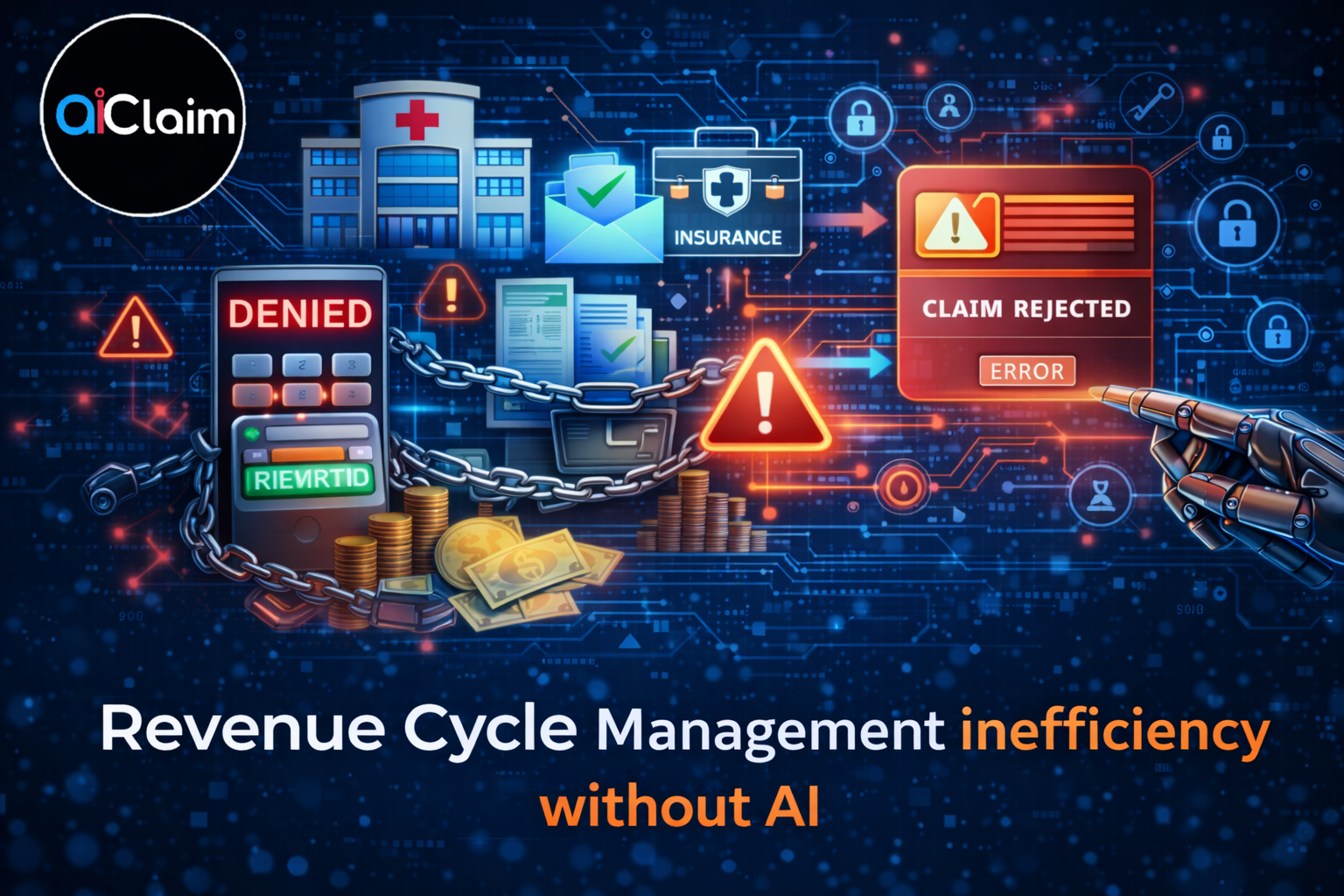
Revenue Cycle Management (RCM) inefficiency without AI has become a major challenge in the financial health of modern healthcare organizations, especially when processes are handled manually. While providers continue to focus on delivering quality patient care, the backend systems responsible for ensuring timely payments often remain slow, fragmented, and highly error-prone.
In today’s fast-evolving healthcare landscape, relying on traditional methods only increases revenue cycle management inefficiency without AI, making operations unsustainable in the long run. Without artificial intelligence, organizations struggle with delays, rising operational costs, and increasing claim denials. As a result, a significant portion of revenue is lost—not because services were not delivered, but because outdated processes fail to support efficient billing and collections.
Understanding Revenue Cycle Management in Modern Healthcare
Revenue Cycle Management (RCM) inefficiency without AI becomes evident when we look at the entire financial lifecycle of a patient, starting from appointment scheduling and insurance verification to final payment collection. Every step in this process must work seamlessly to ensure accurate billing and faster reimbursements, yet traditional systems often struggle to maintain consistency.
However, revenue cycle management inefficiency without AI increases significantly because the system relies heavily on manual effort and disconnected tools. Consequently, even small inefficiencies at one stage create a ripple effect across the entire cycle, ultimately leading to delays, errors, and a direct impact on revenue and overall operational efficiency.
Manual Data Entry: The Root Cause of Inefficiency
One of the biggest challenges in traditional RCM is the reliance on manual data entry. Staff members are required to input patient information, insurance details, and medical codes, which naturally increases the risk of human error. Even a minor mistake in a patient ID or coding entry can lead to claim rejection.
Moreover, these errors are not isolated incidents but recurring problems that affect overall workflow efficiency. Because every incorrect entry requires rework, organizations end up spending more time fixing issues than processing new claims, which directly impacts productivity and revenue.
Delayed Claims Processing and Its Financial Impact
Another major inefficiency arises from delays in claims processing. Without AI, claims must go through multiple layers of manual verification, which significantly slows down the entire process. Additionally, communication between providers and payers often lacks real-time synchronization, further increasing delays.
As a result, healthcare providers experience longer payment cycles, which affects cash flow stability. When payments are delayed for weeks or even months, it becomes increasingly difficult for organizations to manage operational expenses and invest in growth.

Rising Claim Denials and Revenue Loss
Claim denials have become one of the most pressing challenges in revenue cycle management. Without AI-driven validation, claims are often submitted with incomplete or incorrect information, leading to higher rejection rates. This not only delays payments but also increases administrative workload.
Furthermore, denied claims require additional effort to review, correct, and resubmit, which consumes valuable time and resources. Over time, this repeated cycle of denial and resubmission significantly reduces overall efficiency and results in substantial revenue leakage.
The Burden of Rework in Traditional RCM
Rework is another hidden cost that many healthcare organizations underestimate. When claims are denied or processed incorrectly, staff must manually investigate the issue, make corrections, and resubmit the claim. This repetitive process not only slows down operations but also increases employee workload.
In addition, continuous rework leads to staff fatigue and burnout, which further increases the likelihood of errors. Therefore, without AI, RCM becomes a cycle of inefficiency where the same issues are repeatedly addressed instead of being prevented.
Fragmented Systems and Lack of Integration
Many healthcare organizations operate using multiple systems for electronic health records, billing, and insurance processing. Without AI integration, these systems often function independently, creating data silos and inconsistencies. As a result, accessing and analyzing information becomes time-consuming and inefficient.
This lack of integration also affects decision-making, as organizations do not have real-time visibility into their financial performance. Consequently, delays in identifying issues lead to missed opportunities for optimization and revenue improvement.
High Cost of Revenue Collection
Managing revenue cycle operations without AI is not only inefficient but also expensive. Organizations must invest heavily in manpower to handle manual processes, including data entry, claim processing, and denial management. These operational costs continue to rise as the volume of claims increases.
At the same time, inefficiencies such as errors and delays further add to the financial burden. When organizations spend a significant percentage of their revenue just to collect payments, it directly impacts profitability and long-term sustainability.
Staffing Challenges and Workforce Limitations
The healthcare industry is currently facing a shortage of skilled billing and coding professionals. Without AI support, existing staff are required to handle increasing workloads, which often leads to decreased efficiency and higher error rates.
Additionally, the complexity of modern billing systems requires continuous training and expertise, making it difficult for organizations to scale operations. As a result, staffing challenges become a major bottleneck in achieving efficient revenue cycle management.
Compliance Risks and Regulatory Complexity
Healthcare billing is governed by strict regulations and constantly evolving payer requirements. Without AI, keeping up with these changes becomes a challenging task for staff, increasing the risk of non-compliance. Even small mistakes can lead to penalties and financial losses.
Furthermore, manual processes lack the ability to automatically adapt to regulatory updates, which makes organizations vulnerable to compliance issues. Therefore, relying solely on traditional methods creates significant risks in an already complex environment.
How AI Transforms Revenue Cycle Management
Artificial intelligence introduces a proactive and intelligent approach to revenue cycle management. Instead of reacting to errors after they occur, AI systems identify and prevent issues before they impact the workflow. This shift from reactive to proactive management significantly improves efficiency.
By automating repetitive tasks and providing real-time insights, AI enables organizations to streamline operations and reduce dependency on manual processes. As a result, healthcare providers can focus more on patient care while ensuring financial stability.
Intelligent Automation for Faster Operations
AI-powered automation eliminates the need for manual data entry and repetitive tasks. It can capture, process, and validate information with high accuracy, reducing the chances of errors. This not only speeds up operations but also ensures consistency across the entire RCM process.
Moreover, automation allows organizations to handle higher volumes of claims without increasing workforce requirements. Consequently, operational efficiency improves while costs remain under control.
Predictive Analytics for Better Decision-Making
One of the most powerful advantages of AI is its ability to analyze large volumes of data and predict outcomes. In revenue cycle management, predictive analytics helps identify potential claim denials, payment delays, and workflow bottlenecks.
With these insights, organizations can take preventive measures and optimize their processes. This proactive approach leads to higher approval rates, faster payments, and improved financial performance.
Real-Time Claim Validation and Accuracy
AI systems can validate claims in real time before submission, ensuring that all required information is accurate and complete. This significantly increases the clean claim rate and reduces the likelihood of denials.
Additionally, real-time validation minimizes the need for rework, allowing staff to focus on more strategic tasks. As a result, overall efficiency and productivity improve.
Smart Denial Management and Resolution
AI not only helps prevent denials but also simplifies the process of managing them. By analyzing patterns and identifying root causes, AI systems provide actionable insights for faster resolution.
This reduces the time and effort required to handle denied claims, enabling organizations to recover revenue more efficiently. Over time, denial rates decrease, and financial performance improves.
AI-Based Algorithm Approach to RCM Optimization
An AI-driven revenue cycle follows a structured and intelligent workflow that ensures accuracy and efficiency at every stage. The process begins with automated data capture, where patient and billing information is extracted and organized without manual intervention.
This is followed by intelligent validation and coding, where AI ensures that all data is accurate and compliant with payer requirements. Once validated, claims are submitted automatically, and their status is monitored in real time. Finally, predictive analytics helps prevent denials and optimize payment collection, creating a seamless and efficient revenue cycle.
Why Healthcare Providers Must Adopt AI Now
The healthcare industry is becoming increasingly complex, and traditional RCM methods are no longer sufficient to meet modern demands. Without AI, organizations will continue to face challenges such as rising costs, increasing errors, and delayed payments.
On the other hand, adopting AI enables healthcare providers to stay competitive by improving efficiency, reducing errors, and enhancing patient experience. Therefore, investing in AI-driven solutions is no longer optional but essential for long-term success.
Conclusion: The Future of RCM Is AI-Driven
Revenue cycle management inefficiency without AI is a growing concern that directly impacts the financial stability of healthcare organizations. Manual processes, fragmented systems, and reactive workflows create significant challenges that are difficult to overcome using traditional methods.
However, AI offers a transformative solution by automating processes, improving accuracy, and enabling proactive decision-making. As a result, organizations that embrace AI can achieve faster payments, reduced costs, and sustainable growth.
🚀 Take the Next Step with Aiclaim
If you are looking to eliminate inefficiencies, reduce claim denials, and improve cash flow, now is the time to adopt AI-powered revenue cycle management.
Explore how Aiclaim can transform your billing operations and help you achieve maximum efficiency.
👉 https://www.aiclaim.com/appointment.php